Physicochemical Properties
| Molecular Formula | C186H284N50O61S |
| CAS # | 305815-28-5 |
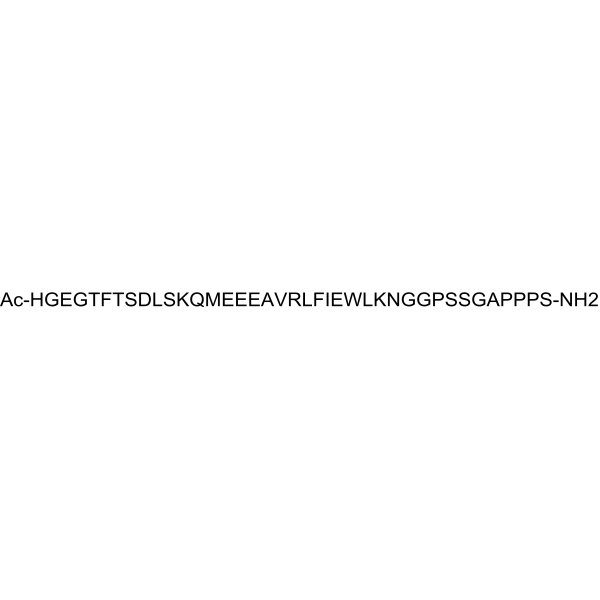
| Sequence | Ac-His-Gly-Glu-Gly-Thr-Phe-Thr-Ser-Asp-Leu-Ser-Lys-Gln-Met-Glu-Glu-Glu-Ala-Val-Arg-Leu-Phe-Ile-Glu-Trp-Leu-Lys-Asn-Gly-Gly-Pro-Ser-Ser-Gly-Ala-Pro-Pro-Pro-Ser-NH2 |
| SequenceShortening | Ac-HGEGTFTSDLSKQMEEEAVRLFIEWLKNGGPSSGAPPPS-NH2 |
| Appearance | Typically exists as solid at room temperature |
| Synonyms | Acetyl-Exenatide trifluoroacetate salt; FA110125; 305815-28-5; Ac-His-Gly-Glu-Gly-Thr-Phe-Thr-Ser-Asp-Leu-Ser-Lys-Gln-Met-Glu-Glu-Glu-Ala-Val-Arg-Leu-Phe-Ile-Glu-Trp-Leu-Lys-Asn-Gly-Gly-Pro-Ser-S er-Gly-Ala-Pro-Pro-Pro-Ser-NH2; Ac-HGEGTFTSDLSKQMEEEAVRLFIEWLKNGGPSSGAPPPS-NH2 |
| HS Tariff Code | 2934.99.9001 |
| Storage |
Powder-20°C 3 years 4°C 2 years In solvent -80°C 6 months -20°C 1 month |
| Shipping Condition | Room temperature (This product is stable at ambient temperature for a few days during ordinary shipping and time spent in Customs) |
Biological Activity
| Targets | GLP-1 receptor |
| ln Vivo | Exenatide treatment improved β-cell function and insulitis in addition to glucose, insulin sensitivity and weight. Increased Th17 and decreased Treg cells in peripheral blood were present as diabetes progressed while exenatide corrected this imbalance. Progressive IL-17 + T cell infiltration of pancreatic islets was alleviated by exenatide intervention. In vitro study showed no significant difference in the level of GLP-1R expression in PBMCs between control and palmitate (PA) groups. In addition, PA could promote Th17 but suppress Treg differentiation along with down-regulating the phosphorylation of PI3K/Akt/FoxO1, which was reversed by exenatide intervention. FoxO1 inhibitor AS1842856 could abrogate all these effects of exenatide against lipid stress. Conclusions: Exenatide could restore systemic Th17/Treg balance via regulating FoxO1 pathway with the progression of diabetes in db/db mice. The protection of pancreatic β-cell function may be partially mediated by inhibiting Th17 cell infiltration into pancreatic islets, and the resultant alleviation of islet inflammation [1]. |
| Animal Protocol | Background: The T helper 17 (Th17)/T regulatory (Treg) cell imbalance is involved in the course of obesity and type 2 diabetes mellitus (T2DM). In the current study, the exact role of glucagon-like peptide-1 receptor agonist (GLP-1RA) exenatide on regulating the Th17/Treg balance and the underlying molecular mechanisms are investigated in obese diabetic mice model. Methods: Metabolic parameters were monitored in db/db mice treated with/without exenatide during 8-week study period. The frequencies of Th17 and Treg cells from peripheral blood and pancreas in db/db mice were assessed. The phosphoinositide 3-kinase (PI3K)/protein kinase B (Akt)/Forkhead box O1 (FoxO1) pathway in Th17 and Treg cells from the spleens of male C57BL/6J mice was detected by western blotting. In addition, the expression of glucagon-like peptide-1 receptor (GLP-1R) in peripheral blood mononuclear cells (PBMCs) of male C57BL/6J mice was analyzed[1]. |
| References | [1]. Xu Q, et al. Exenatide regulates Th17/Treg balance via PI3K/Akt/FoxO1 pathway in db/db mice. Mol Med. 2022 Dec 3;28(1):144. |
Solubility Data
| Solubility (In Vitro) | May dissolve in DMSO (in most cases), if not, try other solvents such as H2O, Ethanol, or DMF with a minute amount of products to avoid loss of samples |
| Solubility (In Vivo) |
Note: Listed below are some common formulations that may be used to formulate products with low water solubility (e.g. < 1 mg/mL), you may test these formulations using a minute amount of products to avoid loss of samples. Injection Formulations (e.g. IP/IV/IM/SC) Injection Formulation 1: DMSO : Tween 80: Saline = 10 : 5 : 85 (i.e. 100 μL DMSO stock solution → 50 μL Tween 80 → 850 μL Saline) *Preparation of saline: Dissolve 0.9 g of sodium chloride in 100 mL ddH ₂ O to obtain a clear solution. Injection Formulation 2: DMSO : PEG300 :Tween 80 : Saline = 10 : 40 : 5 : 45 (i.e. 100 μL DMSO → 400 μLPEG300 → 50 μL Tween 80 → 450 μL Saline) Injection Formulation 3: DMSO : Corn oil = 10 : 90 (i.e. 100 μL DMSO → 900 μL Corn oil) Example: Take the Injection Formulation 3 (DMSO : Corn oil = 10 : 90) as an example, if 1 mL of 2.5 mg/mL working solution is to be prepared, you can take 100 μL 25 mg/mL DMSO stock solution and add to 900 μL corn oil, mix well to obtain a clear or suspension solution (2.5 mg/mL, ready for use in animals). Injection Formulation 4: DMSO : 20% SBE-β-CD in saline = 10 : 90 [i.e. 100 μL DMSO → 900 μL (20% SBE-β-CD in saline)] *Preparation of 20% SBE-β-CD in Saline (4°C,1 week): Dissolve 2 g SBE-β-CD in 10 mL saline to obtain a clear solution. Injection Formulation 5: 2-Hydroxypropyl-β-cyclodextrin : Saline = 50 : 50 (i.e. 500 μL 2-Hydroxypropyl-β-cyclodextrin → 500 μL Saline) Injection Formulation 6: DMSO : PEG300 : castor oil : Saline = 5 : 10 : 20 : 65 (i.e. 50 μL DMSO → 100 μLPEG300 → 200 μL castor oil → 650 μL Saline) Injection Formulation 7: Ethanol : Cremophor : Saline = 10: 10 : 80 (i.e. 100 μL Ethanol → 100 μL Cremophor → 800 μL Saline) Injection Formulation 8: Dissolve in Cremophor/Ethanol (50 : 50), then diluted by Saline Injection Formulation 9: EtOH : Corn oil = 10 : 90 (i.e. 100 μL EtOH → 900 μL Corn oil) Injection Formulation 10: EtOH : PEG300:Tween 80 : Saline = 10 : 40 : 5 : 45 (i.e. 100 μL EtOH → 400 μLPEG300 → 50 μL Tween 80 → 450 μL Saline) Oral Formulations Oral Formulation 1: Suspend in 0.5% CMC Na (carboxymethylcellulose sodium) Oral Formulation 2: Suspend in 0.5% Carboxymethyl cellulose Example: Take the Oral Formulation 1 (Suspend in 0.5% CMC Na) as an example, if 100 mL of 2.5 mg/mL working solution is to be prepared, you can first prepare 0.5% CMC Na solution by measuring 0.5 g CMC Na and dissolve it in 100 mL ddH2O to obtain a clear solution; then add 250 mg of the product to 100 mL 0.5% CMC Na solution, to make the suspension solution (2.5 mg/mL, ready for use in animals). Oral Formulation 3: Dissolved in PEG400 Oral Formulation 4: Suspend in 0.2% Carboxymethyl cellulose Oral Formulation 5: Dissolve in 0.25% Tween 80 and 0.5% Carboxymethyl cellulose Oral Formulation 6: Mixing with food powders Note: Please be aware that the above formulations are for reference only. InvivoChem strongly recommends customers to read literature methods/protocols carefully before determining which formulation you should use for in vivo studies, as different compounds have different solubility properties and have to be formulated differently. (Please use freshly prepared in vivo formulations for optimal results.) |