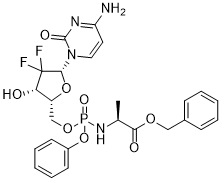
Physicochemical Properties
| Molecular Formula | C25H27F2N4O8P |
| Molecular Weight | 580.4816 |
| Exact Mass | 580.153 |
| CAS # | 840506-29-8 |
| PubChem CID | 11169170 |
| Appearance | White to off-white solid powder |
| LogP | 3.616 |
| Hydrogen Bond Donor Count | 3 |
| Hydrogen Bond Acceptor Count | 11 |
| Rotatable Bond Count | 12 |
| Heavy Atom Count | 40 |
| Complexity | 1020 |
| Defined Atom Stereocenter Count | 4 |
| SMILES | C[C@@H](C(=O)OCC1=CC=CC=C1)NP(=O)(OC[C@@H]2[C@H](C([C@@H](O2)N3C=CC(=NC3=O)N)(F)F)O)OC4=CC=CC=C4 |
| InChi Key | NHTKGYOMICWFQZ-KKQYNPQSSA-N |
| InChi Code | InChI=1S/C25H27F2N4O8P/c1-16(22(33)36-14-17-8-4-2-5-9-17)30-40(35,39-18-10-6-3-7-11-18)37-15-19-21(32)25(26,27)23(38-19)31-13-12-20(28)29-24(31)34/h2-13,16,19,21,23,32H,14-15H2,1H3,(H,30,35)(H2,28,29,34)/t16-,19+,21+,23+,40?/m0/s1 |
| Chemical Name | benzyl (2S)-2-[[[(2R,3R,5R)-5-(4-amino-2-oxopyrimidin-1-yl)-4,4-difluoro-3-hydroxyoxolan-2-yl]methoxy-phenoxyphosphoryl]amino]propanoate |
| Synonyms | GTPL 7389 CPF-31 CPF31Acelarin NUC-1031 NUC 1031 NUC1031GTPL7389 GTPL-7389 |
| HS Tariff Code | 2934.99.9001 |
| Storage |
Powder-20°C 3 years 4°C 2 years In solvent -80°C 6 months -20°C 1 month |
| Shipping Condition | Room temperature (This product is stable at ambient temperature for a few days during ordinary shipping and time spent in Customs) |
Biological Activity
| ln Vitro | Gemcitabine, a nucleoside analog, is frequently used to treat cancer; however, because cancer cells are highly sensitive to drug resistance, its effectiveness is restricted. Gemcitabine is shielded from several important anticancer pathways by the addition of a phosphoramidate motif. A number of prodrugs of gemcitabine phosphoramidate were prepared and tested for their ability to inhibit tumor growth in a variety of tumor cell lines. Of the compounds produced, NUC-1031 had strong effects in vitro. |
| ln Vivo | In a pancreatic xenograft model, ProTide significantly reduced tumor size and had less negative effects on body weight than the gemcitabine-treated group, suggesting a superior safety profile. The information clearly indicates that ProTides are stable in the presence of deaminases and do not depend on kinases or nucleoside transporters to function within tumor cells. ProTide NUC-1031 is presently progressing into a Phase I/II clinical investigation and has produced encouraging early efficacy signals, excellent security, and robust pharmacokinetic data showing notable increases in intracellular levels of gemcitabine triphosphate. Phosphoramidate compounds have the potential to be a significant source of novel, highly effective anticancer medications, resulting in a plethora of cutting-edge therapies intended to circumvent cancer resistance mechanisms and enhance patient outcomes [1]. |
| References |
[1]. Application of ProTide technology to gemcitabine: a successful approach to overcome the key cancer resistance mechanisms leads to a new agent (NUC-1031) in clinical development. J Med Chem. 2014 Feb 27;57(4):1531-42. |
Solubility Data
| Solubility (In Vitro) | DMSO : ≥ 36 mg/mL (~62.02 mM) |
| Solubility (In Vivo) |
Solubility in Formulation 1: ≥ 2.08 mg/mL (3.58 mM) (saturation unknown) in 10% DMSO + 40% PEG300 + 5% Tween80 + 45% Saline (add these co-solvents sequentially from left to right, and one by one), clear solution. For example, if 1 mL of working solution is to be prepared, you can add 100 μL of 20.8 mg/mL clear DMSO stock solution to 400 μL PEG300 and mix evenly; then add 50 μL Tween-80 to the above solution and mix evenly; then add 450 μL normal saline to adjust the volume to 1 mL. Preparation of saline: Dissolve 0.9 g of sodium chloride in 100 mL ddH₂ O to obtain a clear solution. Solubility in Formulation 2: ≥ 2.08 mg/mL (3.58 mM) (saturation unknown) in 10% DMSO + 90% (20% SBE-β-CD in Saline) (add these co-solvents sequentially from left to right, and one by one), clear solution. For example, if 1 mL of working solution is to be prepared, you can add 100 μL of 20.8 mg/mL clear DMSO stock solution to 900 μL of 20% SBE-β-CD physiological saline solution and mix evenly. Preparation of 20% SBE-β-CD in Saline (4°C,1 week): Dissolve 2 g SBE-β-CD in 10 mL saline to obtain a clear solution. Solubility in Formulation 3: ≥ 2.08 mg/mL (3.58 mM) (saturation unknown) in 10% DMSO + 90% Corn Oil (add these co-solvents sequentially from left to right, and one by one), clear solution. For example, if 1 mL of working solution is to be prepared, you can add 100 μL of 20.8 mg/mL clear DMSO stock solution to 900 μL of corn oil and mix evenly. (Please use freshly prepared in vivo formulations for optimal results.) |
| Preparing Stock Solutions | 1 mg | 5 mg | 10 mg | |
| 1 mM | 1.7227 mL | 8.6136 mL | 17.2271 mL | |
| 5 mM | 0.3445 mL | 1.7227 mL | 3.4454 mL | |
| 10 mM | 0.1723 mL | 0.8614 mL | 1.7227 mL |