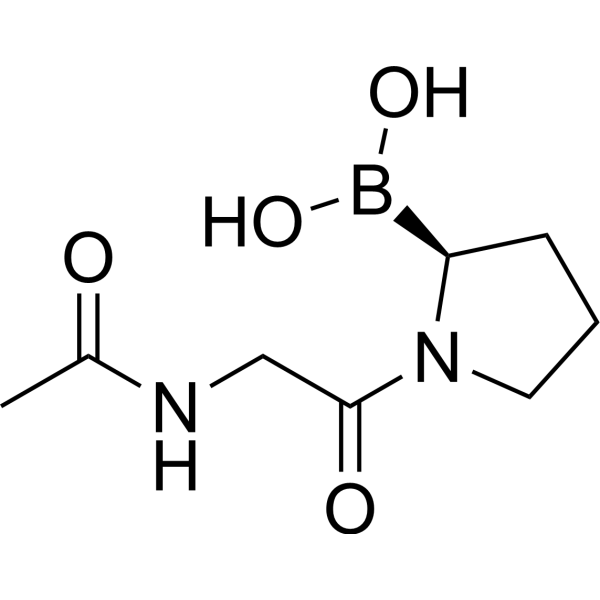
Physicochemical Properties
| Molecular Formula | C8H15BN2O4 |
| Molecular Weight | 214.026702165604 |
| Exact Mass | 214.112 |
| CAS # | 886992-99-0 |
| PubChem CID | 102176419 |
| Appearance | White to off-white solid powder |
| Density | 1.3±0.1 g/cm3 |
| Index of Refraction | 1.520 |
| LogP | -1.21 |
| Hydrogen Bond Donor Count | 3 |
| Hydrogen Bond Acceptor Count | 4 |
| Rotatable Bond Count | 3 |
| Heavy Atom Count | 15 |
| Complexity | 259 |
| Defined Atom Stereocenter Count | 1 |
| SMILES | B([C@H]1CCCN1C(=O)CNC(=O)C)(O)O |
| InChi Key | UUOZISWTWURDGU-SSDOTTSWSA-N |
| InChi Code | InChI=1S/C8H15BN2O4/c1-6(12)10-5-8(13)11-4-2-3-7(11)9(14)15/h7,14-15H,2-5H2,1H3,(H,10,12)/t7-/m1/s1 |
| Chemical Name | [(2S)-1-(2-acetamidoacetyl)pyrrolidin-2-yl]boronic acid |
| HS Tariff Code | 2934.99.9001 |
| Storage |
Powder-20°C 3 years 4°C 2 years In solvent -80°C 6 months -20°C 1 month Note: (1). This product requires protection from light (avoid light exposure) during transportation and storage.(2). Please store this product in a sealed and protected environment (e.g. under nitrogen), avoid exposure to moisture.(3). This product is not stable in solution, please use freshly prepared working solution for optimal results. |
| Shipping Condition | Room temperature (This product is stable at ambient temperature for a few days during ordinary shipping and time spent in Customs) |
Biological Activity
| ln Vitro | Although FAP has been linked to cancer, its precise function is still unknown due to the lack of inhibitors that would separate it from other prolyl peptidases, such dipeptidyl peptidase 4 (DPP-4). FAP is specifically inhibited by Ac-Gly-BoroPro in contrast to other prolyl peptidases. Submicromolar concentrations of Ac-Gly-BoroPro react with FAP easily, and the inhibition levels reach steady-state quickly (Ki=23±3 nM). On the other hand, DPP-4 took longer to attain steady-state inhibition levels (Ki=377±18 nM) and required greater doses of Ac-Gly-BoroPro for inhibition. Other prolyl peptidases (DPP-7, DPP-8, DPP-9, prolyl oligopeptidase, and acyl peptide hydrolase) are inhibited by Ac-Gly-BoroPro with Ki values 9–5400 times greater than that of FAP inhibition. Ac-Gly-BoroPro's N-acyl linkage inhibits the inhibitor's N-terminus, reducing its nucleophilicity and decreasing the likelihood that it will cyclize [1]. |
| References |
[1]. Selective inhibition of fibroblast activation protein protease based on dipeptide substrate specificity. J Biol Chem. 2006 Mar 17;281(11):7437-44. |
Solubility Data
| Solubility (In Vitro) | DMSO : ≥ 50 mg/mL (~233.61 mM) |
| Solubility (In Vivo) |
Solubility in Formulation 1: ≥ 2.5 mg/mL (11.68 mM) (saturation unknown) in 10% DMSO + 40% PEG300 + 5% Tween80 + 45% Saline (add these co-solvents sequentially from left to right, and one by one), clear solution. For example, if 1 mL of working solution is to be prepared, you can add 100 μL of 25.0 mg/mL clear DMSO stock solution to 400 μL PEG300 and mix evenly; then add 50 μL Tween-80 to the above solution and mix evenly; then add 450 μL normal saline to adjust the volume to 1 mL. Preparation of saline: Dissolve 0.9 g of sodium chloride in 100 mL ddH₂ O to obtain a clear solution. Solubility in Formulation 2: ≥ 2.5 mg/mL (11.68 mM) (saturation unknown) in 10% DMSO + 90% (20% SBE-β-CD in Saline) (add these co-solvents sequentially from left to right, and one by one), clear solution. For example, if 1 mL of working solution is to be prepared, you can add 100 μL of 25.0 mg/mL clear DMSO stock solution to 900 μL of 20% SBE-β-CD physiological saline solution and mix evenly. Preparation of 20% SBE-β-CD in Saline (4°C,1 week): Dissolve 2 g SBE-β-CD in 10 mL saline to obtain a clear solution. (Please use freshly prepared in vivo formulations for optimal results.) |
| Preparing Stock Solutions | 1 mg | 5 mg | 10 mg | |
| 1 mM | 4.6722 mL | 23.3612 mL | 46.7224 mL | |
| 5 mM | 0.9344 mL | 4.6722 mL | 9.3445 mL | |
| 10 mM | 0.4672 mL | 2.3361 mL | 4.6722 mL |