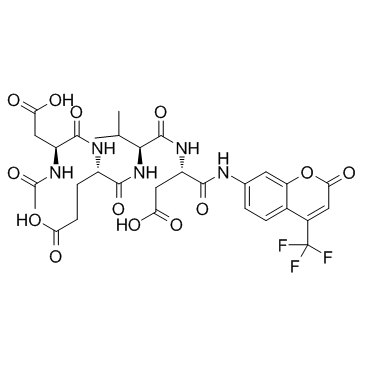
Physicochemical Properties
| Molecular Formula | C30H34N5O13F3 |
| Molecular Weight | 729.611860000001 |
| Exact Mass | 729.21 |
| CAS # | 201608-14-2 |
| PubChem CID | 644234 |
| Sequence | N-Acetyl-Asp-Glu-Val-Asp-7-amido-4-trifluoroMethylcoumarin |
| SequenceShortening | DEVD; Ac-DEVD-7-amido-4-trifluoroMethylcoumarin |
| Appearance | Light yellow to yellow solid powder |
| Density | 1.5±0.1 g/cm3 |
| Boiling Point | 1152.7±65.0 °C at 760 mmHg |
| Flash Point | 650.9±34.3 °C |
| Vapour Pressure | 0.0±0.3 mmHg at 25°C |
| Index of Refraction | 1.575 |
| LogP | 1.58 |
| Hydrogen Bond Donor Count | 8 |
| Hydrogen Bond Acceptor Count | 16 |
| Rotatable Bond Count | 17 |
| Heavy Atom Count | 51 |
| Complexity | 1430 |
| Defined Atom Stereocenter Count | 4 |
| SMILES | CC(C)[C@@H](C(=O)N[C@@H](CC(=O)O)C(=O)NC1=CC2=C(C=C1)C(=CC(=O)O2)C(F)(F)F)NC(=O)[C@H](CCC(=O)O)NC(=O)[C@H](CC(=O)O)NC(=O)C |
| InChi Key | GZDRODOYEFEHGG-NUDCOPPTSA-N |
| InChi Code | InChI=1S/C30H34F3N5O13/c1-12(2)25(38-26(47)17(6-7-21(40)41)36-28(49)18(10-22(42)43)34-13(3)39)29(50)37-19(11-23(44)45)27(48)35-14-4-5-15-16(30(31,32)33)9-24(46)51-20(15)8-14/h4-5,8-9,12,17-19,25H,6-7,10-11H2,1-3H3,(H,34,39)(H,35,48)(H,36,49)(H,37,50)(H,38,47)(H,40,41)(H,42,43)(H,44,45)/t17-,18-,19-,25-/m0/s1 |
| Chemical Name | (4S)-4-[[(2S)-2-acetamido-3-carboxypropanoyl]amino]-5-[[(2S)-1-[[(2S)-3-carboxy-1-oxo-1-[[2-oxo-4-(trifluoromethyl)chromen-7-yl]amino]propan-2-yl]amino]-3-methyl-1-oxobutan-2-yl]amino]-5-oxopentanoic acid |
| Synonyms | Ac-DEVD-AFC; Ac-Asp-Glu-Val-Asp-AFC; 201608-14-2; MFCD01310970; N-Acetyl-Asp-Glu-Val-Asp-7-amido-4-trifluoromethylcoumarin; (4S)-4-[[(2S)-2-acetamido-3-carboxypropanoyl]amino]-5-[[(2S)-1-[[(2S)-3-carboxy-1-oxo-1-[[2-oxo-4-(trifluoromethyl)chromen-7-yl]amino]propan-2-yl]amino]-3-methyl-1-oxobutan-2-yl]amino]-5-oxopentanoic acid; Ac-Asp-Glu-Val-Asp-7-amino-4-trifluoromethylcoumarin; SCHEMBL1180114; |
| HS Tariff Code | 2934.99.9001 |
| Storage |
Powder-20°C 3 years 4°C 2 years In solvent -80°C 6 months -20°C 1 month Note: Please store this product in a sealed and protected environment (e.g. under nitrogen), avoid exposure to moisture and light. |
| Shipping Condition | Room temperature (This product is stable at ambient temperature for a few days during ordinary shipping and time spent in Customs) |
Biological Activity
| Targets | Fluorogenic substrate |
| ln Vitro |
At 4 hours, there was a notable rise in caspase-3 activity in the Ac-DEVD-AFC group compared to the control after 1 hour. The Photofrin and LPLI groups did not exhibit a statistically significant elevation in caspase-3 activity. When caspase-3 is activated, the disruption of Ac-DEVD-AFC can be considerably reduced by transfecting shRNA-BiML [1].
To further confirm above observation, AFC (an indicator of caspase-3 activation) release assay was applied. Activated caspase-3 but not pro-caspase-3 does exert proteolytic activation on the Ac-DEVD-AFC substrate. As shown in Fig. 3E, after incubation with Ac-DEVD-AFC for 1 hour, significant increase of caspase-3 activity was observed at 4 hour after PPT (column 5) compared with control. There were no significant increases of caspase-3 activity in Photofrin and LPLI group (column 2 and 3). The cleavage of Ac-DEVD-AFC in response to caspase-3 activation was remarkably inhibited by shRNA-BimL transfection (column 6). These results demonstrated that Bim was involved in the PPT-induced caspase-3 activity, which was consistent with the result by western blot analysis [1]. |
| Cell Assay |
Fluorometric assay for caspase-3 activity [1] For the detection of caspase-3 activity, PBS washed cell pellets (derive from either the medium or the adherent cells) were resuspended in extract buffer [25 mM HEPES (pH7.4), 0.1% TritonX-l00, 10% glycerol, 5 mM DTT, 1mM phenylmethylsulfonyl fluoride, 10 mg/ml pepstatin, and 10 mg/ml Leupeptin] and vortexed vigorously. 20μl of extract (corresponding to 10% of the sample) were incubated with the caspase-3 fluorogenic substrates Ac-DEVD-AFC at 100 μM final concentration at room temperature, and caspase-3 activity was measured continuously by monitoring the release of fluorigenic AFC at 37°C. The excitation wavelength of AFC was 400 nm and the emission wavelength was 530 nm using auto microplate reader. As a parallel study to confirm and compare the caspase-3 detection in our experiments, batch of cells were exposed to UV irradiation, which a well-established protocol to induce apoptosis. For UV irradiation-induced apoptosis, culture medium was removed, and cells were rinsed with PBS and irradiated at fluence of 120 mJ/cm2 (253.7 nm, 200 μW/cm2), and then medium was restored. |
| References |
[1]. Involvement of Bim in Photofrin-mediated photodynamically induced apoptosis. Cell Physiol Biochem. 2015;35(4):1527-36. |
| Additional Infomation |
Background/aims: Photodynamic therapy (PDT) is a promising noninvasive technique, which has been successfully applied to the treatment of human cancers. Studies have shown that the Bcl-2 family proteins play important roles in PDT-induced apoptosis. However, whether Bcl-2-interacting mediator of cell death (Bim) is involved in photodynamic treatment remains unknown. In this study, we attempt to determine the effect of Bim on Photofrin photodynamic treatment (PPT)-induced apoptosis in human lung adenocarcinoma ASTC-a-1 cells.
Methods: The translocation of Bim/Bax of the cells were monitored by laser confocal scanning microscope. The levels of Bim protein and activated caspase-3 in cells were detected by western blot assay. Caspase-3 activities were measured by Caspase-3 Fluorogenic Substrate (Ac-DEVD-AFC) analysis. The induction of apoptosis was detected by Hoechst 33258 and PI staining as well as flow cytometry analysis. The effect of Bim on PPT-induced apoptosis was determined by RNAi. Results: BimL translocated to mitochondria in response to PPT, similar to the downstream pro-apoptotic protein Bax activation. PPT increased the level of Bim and activated caspase-3 in cells and that knockdown of Bim by RNAi significantly protected against caspase-3 activity. PPT-induced apoptosis were suppressed in cells transfected with shRNA-Bim. Conclusion: We demonstrated the involvement of Bim in PPT-induced apoptosis in human ASTC-a-1 lung adenocarcinoma cells and suggested that enhancing Bim activity might be a potential strategy for treating human cancers. [1] |
Solubility Data
| Solubility (In Vitro) |
DMSO : ≥ 50 mg/mL (~68.53 mM) H2O : ~0.67 mg/mL (~0.92 mM) |
| Solubility (In Vivo) |
Solubility in Formulation 1: ≥ 2.5 mg/mL (3.43 mM) (saturation unknown) in 10% DMSO + 40% PEG300 + 5% Tween80 + 45% Saline (add these co-solvents sequentially from left to right, and one by one), clear solution. For example, if 1 mL of working solution is to be prepared, you can add 100 μL of 25.0 mg/mL clear DMSO stock solution to 400 μL PEG300 and mix evenly; then add 50 μL Tween-80 to the above solution and mix evenly; then add 450 μL normal saline to adjust the volume to 1 mL. Preparation of saline: Dissolve 0.9 g of sodium chloride in 100 mL ddH₂ O to obtain a clear solution. Solubility in Formulation 2: ≥ 2.5 mg/mL (3.43 mM) (saturation unknown) in 10% DMSO + 90% (20% SBE-β-CD in Saline) (add these co-solvents sequentially from left to right, and one by one), clear solution. For example, if 1 mL of working solution is to be prepared, you can add 100 μL of 25.0 mg/mL clear DMSO stock solution to 900 μL of 20% SBE-β-CD physiological saline solution and mix evenly. Preparation of 20% SBE-β-CD in Saline (4°C,1 week): Dissolve 2 g SBE-β-CD in 10 mL saline to obtain a clear solution. Solubility in Formulation 3: ≥ 2.5 mg/mL (3.43 mM) (saturation unknown) in 10% DMSO + 90% Corn Oil (add these co-solvents sequentially from left to right, and one by one), clear solution. For example, if 1 mL of working solution is to be prepared, you can add 100 μL of 25.0 mg/mL clear DMSO stock solution to 900 μL of corn oil and mix evenly. (Please use freshly prepared in vivo formulations for optimal results.) |
| Preparing Stock Solutions | 1 mg | 5 mg | 10 mg | |
| 1 mM | 1.3706 mL | 6.8530 mL | 13.7060 mL | |
| 5 mM | 0.2741 mL | 1.3706 mL | 2.7412 mL | |
| 10 mM | 0.1371 mL | 0.6853 mL | 1.3706 mL |