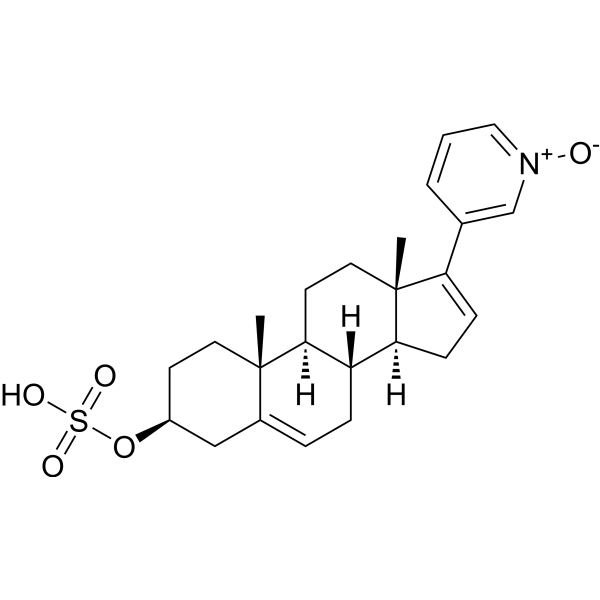
Physicochemical Properties
| Molecular Formula | C24H31NO5S |
| Molecular Weight | 445.571645975113 |
| CAS # | 1993430-24-2 |
| Appearance | Typically exists as solid at room temperature |
| HS Tariff Code | 2934.99.9001 |
| Storage |
Powder-20°C 3 years 4°C 2 years In solvent -80°C 6 months -20°C 1 month |
| Shipping Condition | Room temperature (This product is stable at ambient temperature for a few days during ordinary shipping and time spent in Customs) |
Biological Activity
| Targets | Major metabolite of Abiraterone; CYP17A1 |
| ln Vitro | Abiraterone acetate, the prodrug of the cytochrome P450 C17 inhibitor abiraterone, plus prednisone is approved for treatment of metastatic castration-resistant prostate cancer. We explored whether abiraterone interacts with drugs metabolized by CYP2C8, an enzyme responsible for the metabolism of many drugs. Abiraterone acetate and abiraterone and its major metabolites, abiraterone sulfate and abiraterone sulfate N-oxide, inhibited CYP2C8 in human liver microsomes, with IC50 values near or below the peak total concentrations observed in patients with metastatic castration-resistant prostate cancer (IC50 values: 1.3-3.0 µM, 1.6-2.9 µM, 0.044-0.15 µM, and 5.4-5.9 µM, respectively). CYP2C8 inhibition was reversible and time-independent.[2] |
| ln Vivo | To explore the clinical relevance of the in vitro data, an open-label, single-center study was conducted comprising 16 healthy male subjects who received a single 15-mg dose of the CYP2C8 substrate pioglitazone on day 1 and again 1 hour after the administration of abiraterone acetate 1000 mg on day 8. Plasma concentrations of pioglitazone, its active M-III (keto derivative) and M-IV (hydroxyl derivative) metabolites, and abiraterone were determined for up to 72 hours after each dose. Abiraterone acetate increased exposure to pioglitazone; the geometric mean ratio (day 8/day 1) was 125 [90% confidence interval (CI), 99.9-156] for Cmax and 146 (90% CI, 126-171) for AUClast Exposure to M-III and M-IV was reduced by 10% to 13%. Plasma abiraterone concentrations were consistent with previous studies. These results show that abiraterone only weakly inhibits CYP2C8 in vivo.[2] |
| Enzyme Assay |
Background: Abiraterone acetate and enzalutamide are 2 novel drugs for the treatment of metastatic castration-resistant prostate cancer. The metabolism of these drugs is extensive. Major metabolites are N-desmethyl enzalutamide, enzalutamide carboxylic acid, abiraterone N-oxide sulfate, and abiraterone sulfate; of which N-desmethyl enzalutamide is reported to possess antiandrogen capacities. A liquid chromatography-tandem mass spectrometry method for simultaneous quantification of abiraterone, enzalutamide, and the main metabolites has been developed and validated to support therapeutic drug monitoring.
Methods: Human plasma samples of patients treated with abiraterone or enzalutamide were harvested at the clinic and stored at -20°C. Proteins were precipitated by acetonitrile, and the final extract was injected on a Kinetex C18 column and separated with gradient elution. Analytes were detected by liquid chromatography-mass spectrometry (Triple Quad 6500). Results: The method was validated over various linear ranges: 1-100 ng/mL for abiraterone, 5-500 ng/mL for enzalutamide and enzalutamide carboxylic acid, 10-1000 ng/mL for N-desmethyl enzalutamide, 30-3000 ng/mL for abiraterone N-oxide sulfate, and 100-10,000 ng/mL for abiraterone sulfate. Intra-assay and interassay variabilities were within ±15% of the nominal concentrations for quality control samples at medium and high concentrations and within ±20% at the lower limit of quantification, respectively. Conclusions: The described method for simultaneous determination of abiraterone and enzalutamide was validated successfully and provides a useful tool for therapeutic drug monitoring in patients treated with these agents.[1] |
| References |
[1]. Development and Validation of an LC-MS/MS Method for the Simultaneous Quantification of Abiraterone, Enzalutamide, and Their Major Metabolites in Human Plasma. Ther Drug Monit. 2017 Jun;39(3):243-251. [2]. In Vitro and In Vivo Drug-Drug Interaction Studies to Assess the Effect of Abiraterone Acetate, Abiraterone, and Metabolites of Abiraterone on CYP2C8 Activity. Drug Metab Dispos. 2016 Oct;44(10):1682-91. |
Solubility Data
| Solubility (In Vitro) | May dissolve in DMSO (in most cases), if not, try other solvents such as H2O, Ethanol, or DMF with a minute amount of products to avoid loss of samples |
| Solubility (In Vivo) |
Note: Listed below are some common formulations that may be used to formulate products with low water solubility (e.g. < 1 mg/mL), you may test these formulations using a minute amount of products to avoid loss of samples. Injection Formulations (e.g. IP/IV/IM/SC) Injection Formulation 1: DMSO : Tween 80: Saline = 10 : 5 : 85 (i.e. 100 μL DMSO stock solution → 50 μL Tween 80 → 850 μL Saline) *Preparation of saline: Dissolve 0.9 g of sodium chloride in 100 mL ddH ₂ O to obtain a clear solution. Injection Formulation 2: DMSO : PEG300 :Tween 80 : Saline = 10 : 40 : 5 : 45 (i.e. 100 μL DMSO → 400 μLPEG300 → 50 μL Tween 80 → 450 μL Saline) Injection Formulation 3: DMSO : Corn oil = 10 : 90 (i.e. 100 μL DMSO → 900 μL Corn oil) Example: Take the Injection Formulation 3 (DMSO : Corn oil = 10 : 90) as an example, if 1 mL of 2.5 mg/mL working solution is to be prepared, you can take 100 μL 25 mg/mL DMSO stock solution and add to 900 μL corn oil, mix well to obtain a clear or suspension solution (2.5 mg/mL, ready for use in animals). Injection Formulation 4: DMSO : 20% SBE-β-CD in saline = 10 : 90 [i.e. 100 μL DMSO → 900 μL (20% SBE-β-CD in saline)] *Preparation of 20% SBE-β-CD in Saline (4°C,1 week): Dissolve 2 g SBE-β-CD in 10 mL saline to obtain a clear solution. Injection Formulation 5: 2-Hydroxypropyl-β-cyclodextrin : Saline = 50 : 50 (i.e. 500 μL 2-Hydroxypropyl-β-cyclodextrin → 500 μL Saline) Injection Formulation 6: DMSO : PEG300 : castor oil : Saline = 5 : 10 : 20 : 65 (i.e. 50 μL DMSO → 100 μLPEG300 → 200 μL castor oil → 650 μL Saline) Injection Formulation 7: Ethanol : Cremophor : Saline = 10: 10 : 80 (i.e. 100 μL Ethanol → 100 μL Cremophor → 800 μL Saline) Injection Formulation 8: Dissolve in Cremophor/Ethanol (50 : 50), then diluted by Saline Injection Formulation 9: EtOH : Corn oil = 10 : 90 (i.e. 100 μL EtOH → 900 μL Corn oil) Injection Formulation 10: EtOH : PEG300:Tween 80 : Saline = 10 : 40 : 5 : 45 (i.e. 100 μL EtOH → 400 μLPEG300 → 50 μL Tween 80 → 450 μL Saline) Oral Formulations Oral Formulation 1: Suspend in 0.5% CMC Na (carboxymethylcellulose sodium) Oral Formulation 2: Suspend in 0.5% Carboxymethyl cellulose Example: Take the Oral Formulation 1 (Suspend in 0.5% CMC Na) as an example, if 100 mL of 2.5 mg/mL working solution is to be prepared, you can first prepare 0.5% CMC Na solution by measuring 0.5 g CMC Na and dissolve it in 100 mL ddH2O to obtain a clear solution; then add 250 mg of the product to 100 mL 0.5% CMC Na solution, to make the suspension solution (2.5 mg/mL, ready for use in animals). Oral Formulation 3: Dissolved in PEG400 Oral Formulation 4: Suspend in 0.2% Carboxymethyl cellulose Oral Formulation 5: Dissolve in 0.25% Tween 80 and 0.5% Carboxymethyl cellulose Oral Formulation 6: Mixing with food powders Note: Please be aware that the above formulations are for reference only. InvivoChem strongly recommends customers to read literature methods/protocols carefully before determining which formulation you should use for in vivo studies, as different compounds have different solubility properties and have to be formulated differently. (Please use freshly prepared in vivo formulations for optimal results.) |
| Preparing Stock Solutions | 1 mg | 5 mg | 10 mg | |
| 1 mM | 2.2443 mL | 11.2216 mL | 22.4432 mL | |
| 5 mM | 0.4489 mL | 2.2443 mL | 4.4886 mL | |
| 10 mM | 0.2244 mL | 1.1222 mL | 2.2443 mL |