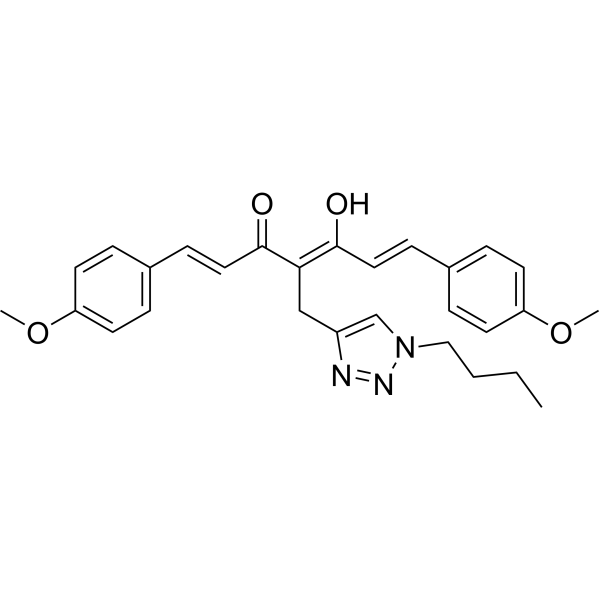
Physicochemical Properties
| Molecular Formula | C28H31N3O4 |
| Molecular Weight | 473.56 |
| Appearance | Typically exists as solid at room temperature |
| HS Tariff Code | 2934.99.9001 |
| Storage |
Powder-20°C 3 years 4°C 2 years In solvent -80°C 6 months -20°C 1 month |
| Shipping Condition | Room temperature (This product is stable at ambient temperature for a few days during ordinary shipping and time spent in Customs) |
Biological Activity
| ln Vitro | Starting at a dose of 5 μM, Aβ-IN-6 (Compound 4; 1–20 μM; 24 hours) dramatically lowers microglial viability [1]. At concentrations greater than 2.5 μM, Aβ-IN-6 (1.25-40 μM; 24 hours) significantly damages SH-SY5Y neuroblastoma cells [1]. The nuclear translocation of Nrf2 is considerably induced by Aβ-IN-6 (2.5 μM; 3 hours) [1]. The LPS-induced increase in the levels of two cytokines and NLRP3 mRNA was considerably reduced by Aβ-IN-6 (2.5 μM) [1]. Significantly less TNF-α and IL-1β were released when exposed to LPS for 24 hours after an hour-long pretreatment with Aβ-IN-6 (1, 2.5 μM) [1]. An inhibition rate of around 18% can be achieved by pretreating Aβ-IN-6 (2.5 μM; 24 hours) before tert-butyl hydroperoxide (t-BuOOH; 50 μM, 30 minutes). |
| ln Vivo | Compound 4 (Aβ-IN-6; 10 μM) when administered to regular chow efficiently restores the higher ROS levels to the levels shown in the Spastin Drosophila model Control levels observed in [1] in larval brain and muscle under neurodegenerative disease (D-spastin loss-of-function model). |
| Cell Assay |
Cell Viability Assay[1] Cell Types: Microglia Tested Concentrations: 1-20 μM Incubation Duration: 24 h Experimental Results: Markedly decreased microglia viability starting from the concentration of 5 μM. Cell Cytotoxicity Assay[1] Cell Types: SH-SY5Y neuroblastoma cells Tested Concentrations: 1.25, 2.5, 5, 10, 20, 40 μM Incubation Duration: 24 h Experimental Results: Recorded significant cytotoxicity at concentrations higher than 2.5 μM. Western Blot Analysis[1] Cell Types: SH-SY5Y cells Tested Concentrations: 2.5 μM 3 h Dramatically induced Nrf2 nuclear translocation. SH-SY5Y cells 2.5 μM Incubation Duration: 3 h Experimental Results: Dramatically induced Nrf2 nuclear translocation. RT-PCR[1] Cell Types: Microglia Tested Concentrations: 2.5 μM Incubation Duration: Pretreated for 1 h and then stimulated with 100 ng/mL LPS for 6 h Experimental Results: Markedly suppressed the LPS-induced increase of mRNA levels of the two cytokines and NLRP3, confirming the anti-inflammatory properties. |
| Animal Protocol |
Animal/Disease Models: Spastin Drosophila model[1] Doses: 10 μM Route of Administration: Added to standard food (dissolved in DMSO) Experimental Results: Efficiently restored the increased ROS level in larval muscles and brains under neurodegenerative conditions (D-spastin loss of function model) to that observed for the control. Dramatically ameliorated the phenotype associated with spastin reduction. |
| References |
[1]. Targeting the multifaceted neurotoxicity of Alzheimer's disease by tailored functionalisation of the curcumin scaffold. Eur J Med Chem. 2023 Apr 5;252:115297. |
Solubility Data
| Solubility (In Vitro) | May dissolve in DMSO (in most cases), if not, try other solvents such as H2O, Ethanol, or DMF with a minute amount of products to avoid loss of samples |
| Solubility (In Vivo) |
Note: Listed below are some common formulations that may be used to formulate products with low water solubility (e.g. < 1 mg/mL), you may test these formulations using a minute amount of products to avoid loss of samples. Injection Formulations (e.g. IP/IV/IM/SC) Injection Formulation 1: DMSO : Tween 80: Saline = 10 : 5 : 85 (i.e. 100 μL DMSO stock solution → 50 μL Tween 80 → 850 μL Saline) *Preparation of saline: Dissolve 0.9 g of sodium chloride in 100 mL ddH ₂ O to obtain a clear solution. Injection Formulation 2: DMSO : PEG300 :Tween 80 : Saline = 10 : 40 : 5 : 45 (i.e. 100 μL DMSO → 400 μLPEG300 → 50 μL Tween 80 → 450 μL Saline) Injection Formulation 3: DMSO : Corn oil = 10 : 90 (i.e. 100 μL DMSO → 900 μL Corn oil) Example: Take the Injection Formulation 3 (DMSO : Corn oil = 10 : 90) as an example, if 1 mL of 2.5 mg/mL working solution is to be prepared, you can take 100 μL 25 mg/mL DMSO stock solution and add to 900 μL corn oil, mix well to obtain a clear or suspension solution (2.5 mg/mL, ready for use in animals). Injection Formulation 4: DMSO : 20% SBE-β-CD in saline = 10 : 90 [i.e. 100 μL DMSO → 900 μL (20% SBE-β-CD in saline)] *Preparation of 20% SBE-β-CD in Saline (4°C,1 week): Dissolve 2 g SBE-β-CD in 10 mL saline to obtain a clear solution. Injection Formulation 5: 2-Hydroxypropyl-β-cyclodextrin : Saline = 50 : 50 (i.e. 500 μL 2-Hydroxypropyl-β-cyclodextrin → 500 μL Saline) Injection Formulation 6: DMSO : PEG300 : castor oil : Saline = 5 : 10 : 20 : 65 (i.e. 50 μL DMSO → 100 μLPEG300 → 200 μL castor oil → 650 μL Saline) Injection Formulation 7: Ethanol : Cremophor : Saline = 10: 10 : 80 (i.e. 100 μL Ethanol → 100 μL Cremophor → 800 μL Saline) Injection Formulation 8: Dissolve in Cremophor/Ethanol (50 : 50), then diluted by Saline Injection Formulation 9: EtOH : Corn oil = 10 : 90 (i.e. 100 μL EtOH → 900 μL Corn oil) Injection Formulation 10: EtOH : PEG300:Tween 80 : Saline = 10 : 40 : 5 : 45 (i.e. 100 μL EtOH → 400 μLPEG300 → 50 μL Tween 80 → 450 μL Saline) Oral Formulations Oral Formulation 1: Suspend in 0.5% CMC Na (carboxymethylcellulose sodium) Oral Formulation 2: Suspend in 0.5% Carboxymethyl cellulose Example: Take the Oral Formulation 1 (Suspend in 0.5% CMC Na) as an example, if 100 mL of 2.5 mg/mL working solution is to be prepared, you can first prepare 0.5% CMC Na solution by measuring 0.5 g CMC Na and dissolve it in 100 mL ddH2O to obtain a clear solution; then add 250 mg of the product to 100 mL 0.5% CMC Na solution, to make the suspension solution (2.5 mg/mL, ready for use in animals). Oral Formulation 3: Dissolved in PEG400 Oral Formulation 4: Suspend in 0.2% Carboxymethyl cellulose Oral Formulation 5: Dissolve in 0.25% Tween 80 and 0.5% Carboxymethyl cellulose Oral Formulation 6: Mixing with food powders Note: Please be aware that the above formulations are for reference only. InvivoChem strongly recommends customers to read literature methods/protocols carefully before determining which formulation you should use for in vivo studies, as different compounds have different solubility properties and have to be formulated differently. (Please use freshly prepared in vivo formulations for optimal results.) |
| Preparing Stock Solutions | 1 mg | 5 mg | 10 mg | |
| 1 mM | 2.1117 mL | 10.5583 mL | 21.1166 mL | |
| 5 mM | 0.4223 mL | 2.1117 mL | 4.2233 mL | |
| 10 mM | 0.2112 mL | 1.0558 mL | 2.1117 mL |