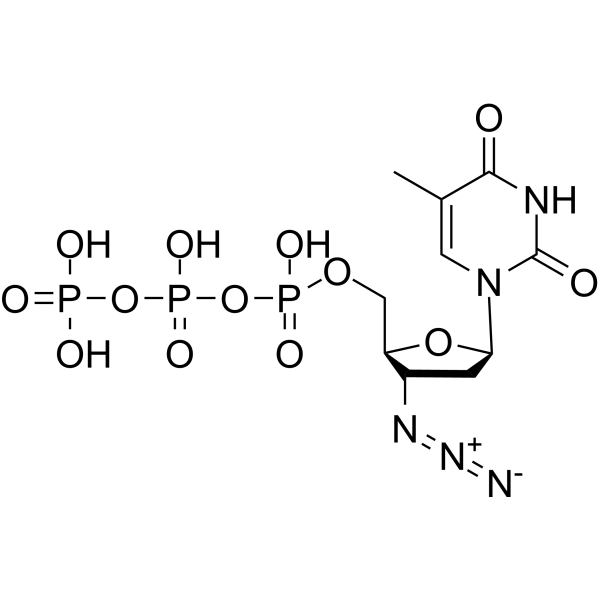
Physicochemical Properties
| Molecular Formula | C10H16N5O13P3 |
| Molecular Weight | 507.181024551392 |
| Exact Mass | 506.996 |
| Elemental Analysis | C, 23.68; H, 3.18; N, 13.81; O, 41.01; P, 18.32 |
| CAS # | 92586-35-1 |
| Related CAS # | AZT triphosphate tetraammonium;106060-92-8;AZT triphosphate TEA; 30516-87-1; 106060-89-3 (diphosphate); 92586-35-1 (triphosphate); 117675-21-5 (glucuronide) |
| PubChem CID | 72187 |
| Appearance | Typically exists as solid at room temperature |
| LogP | -3.2 |
| Hydrogen Bond Donor Count | 5 |
| Hydrogen Bond Acceptor Count | 15 |
| Rotatable Bond Count | 9 |
| Heavy Atom Count | 31 |
| Complexity | 973 |
| Defined Atom Stereocenter Count | 3 |
| SMILES | O=C1NC(=O)C(C)=CN1[C@H]1C[C@H](N=[N+]=[N-])[C@@H](COP(O)(=O)OP(O)(=O)OP(O)(O)=O)O1 |
| InChi Key | GLWHPRRGGYLLRV-XLPZGREQSA-N |
| InChi Code | InChI=1S/C10H16N5O13P3/c1-5-3-15(10(17)12-9(5)16)8-2-6(13-14-11)7(26-8)4-25-30(21,22)28-31(23,24)27-29(18,19)20/h3,6-8H,2,4H2,1H3,(H,21,22)(H,23,24)(H,12,16,17)(H2,18,19,20)/t6-,7+,8+/m0/s1 |
| Chemical Name | [[(2S,3S,5R)-3-azido-5-(5-methyl-2,4-dioxopyrimidin-1-yl)oxolan-2-yl]methoxy-hydroxyphosphoryl] phosphono hydrogen phosphate |
| Synonyms | AZT triphosphate; Zidovudine triphosphate; Combivir; AZTTP; 92586-35-1; Azt-TP; 3'-Azido-3'-deoxythymidine 5'-triphosphate; Azidothymidine triphosphate; |
| HS Tariff Code | 2934.99.9001 |
| Storage |
Powder-20°C 3 years 4°C 2 years In solvent -80°C 6 months -20°C 1 month |
| Shipping Condition | Room temperature (This product is stable at ambient temperature for a few days during ordinary shipping and time spent in Customs) |
Biological Activity
| Targets | DNA synthesis |
| ln Vitro | After 48 hours of treatment with 100 µM zidovudine (AZT), AZT triphosphate (3'-azido-3'-deoxythymidine-5'-triphosphate) buildup damages mitochondrial tubing in H9c2 cells. Drp1 is upregulated and Opa1 is downregulated when AZT triphosphate builds up. AZT triphosphate has been shown to induce mitochondrial malfunction, elevate cytotoxic reactive oxygen species (ROS) generation, and disrupt the equilibrium of the mitochondrial quality control system in the H9c2 cell model derived from rat embryonic myoblasts [1]. |
| ln Vivo | Low-dose AZT administration to non-obese diabetic/severe combined immunodeficiency (NOD/SCID) mice injected with transduced K562 cells suppressed tumor growth. This novel suicide gene therapy approach can thus be integrated as a safety switch into therapeutic vectors.[2] |
| Enzyme Assay | Acyclovir (ACV) triphosphate and azidothymidine (AZT) triphosphate inhibit the DNA polymerase of human hepatitis B virus (HBV) by 50% at submicromolar concentrations, but no effects of ACV or AZT treatment have been noted on the clinical manifestations of hepatitis B. We synthesized 1-O-octadecyl-sn-glycero-3-phospho-acyclovir (ODG-P-ACV), 1-O-hexadecylpropanediol-3-phospho-acyclovir (HDP-P-ACV), and 1-O-octadecyl-sn-glycero-3-phospho-azidothymidine (ODG-P-AZT), and evaluated their antiviral activity in human hepatoma cells that constitutively produce HBV (2.2.15 cells). ACV and AZT up to 100 microM caused only slight inhibition of HBV replication in 2.2.15 cells. However, HDP-P-ACV and ODG-P-ACV inhibited viral replication by 50% at 0.5 and 6.8 microM, respectively. ODG-P-AZT also showed increased antiviral activity, with a 50% reduction in HBV replication at 2.1 microM. Based on the EC50, HDP-P-ACV, ODG-P-ACV, and ODG-P-AZT were > 200, > 14.7, and > 48 times more active than their free nucleosides in reducing HBV replication in 2.2.15 cells. To evaluate the biochemical basis for the increased antiviral activity, we studied the uptake and metabolism of 1-O-octadecyl-sn-glycero-3-phospho-[3H]acyclovir (ODG-P-[3H]ACV) in HepG2 cells. Cellular uptake of ODG-P-[3H]ACV was found to be substantially greater than that of [3H]ACV, and cellular levels of ACV-mono-, -di-, and -triphosphate were much higher with ODG-P-ACV. ODG-P-[3H]ACV was well absorbed orally. Based on urinary recovery of tritium after oral or parenteral administration of the radiolabeled compounds, oral absorption of ODG-P-ACV in mice was 100% versus 37% for ACV. ODG-P-ACV plasma area under the curve was more than 7-fold greater than that of ACV. Lipid prodrugs of this type may be useful orally in treating viral diseases.[3] |
| Cell Assay | Gene therapy and stem cell transplantation safety could be enhanced by control over the fate of therapeutic cells. Suicide gene therapy uses enzymes that convert prodrugs to cytotoxic entities; however, heterologous moieties with poor kinetics are employed. We describe a novel enzyme/prodrug combination for selectively inducing apoptosis in lentiviral vector-transduced cells. Rationally designed variants of human thymidylate kinase (tmpk) that effectively phosphorylate 3'-azido-3'-deoxythymidine (AZT) were efficiently delivered. Transduced Jurkat cell lines were eliminated by AZT. We demonstrate that this schema targeted both dividing and non-dividing cells, with a novel killing mechanism involving apoptosis induction via disruption of the mitochondrial inner membrane potential and activation of caspase-3. Primary murine and human T cells were also transduced and responded to AZT. [2] |
| References |
[1]. Azidothymidine-triphosphate Impairs Mitochondrial Dynamics by Disrupting the Quality Control System. Redox Biol. 2017 Oct;13:407-417. [2]. Engineered Human tmpk/AZT as a Novel Enzyme/Prodrug Axis for Suicide Gene Therapy. Mol Ther. 2007 May;15(5):962-70. [3]. Enhanced Oral Absorption and Antiviral Activity of 1-O-octadecyl-sn-glycero-3-phospho-acyclovir and Related Compounds in Hepatitis B Virus Infection, in Vitro. Biochem Pharmacol. 1997 Jun 15;53(12):1815-22. |
| Additional Infomation | See also: Lamivudine; zidovudine (annotation moved to). |
Solubility Data
| Solubility (In Vitro) | May dissolve in DMSO (in most cases), if not, try other solvents such as H2O, Ethanol, or DMF with a minute amount of products to avoid loss of samples |
| Solubility (In Vivo) |
Note: Listed below are some common formulations that may be used to formulate products with low water solubility (e.g. < 1 mg/mL), you may test these formulations using a minute amount of products to avoid loss of samples. Injection Formulations (e.g. IP/IV/IM/SC) Injection Formulation 1: DMSO : Tween 80: Saline = 10 : 5 : 85 (i.e. 100 μL DMSO stock solution → 50 μL Tween 80 → 850 μL Saline) *Preparation of saline: Dissolve 0.9 g of sodium chloride in 100 mL ddH ₂ O to obtain a clear solution. Injection Formulation 2: DMSO : PEG300 :Tween 80 : Saline = 10 : 40 : 5 : 45 (i.e. 100 μL DMSO → 400 μLPEG300 → 50 μL Tween 80 → 450 μL Saline) Injection Formulation 3: DMSO : Corn oil = 10 : 90 (i.e. 100 μL DMSO → 900 μL Corn oil) Example: Take the Injection Formulation 3 (DMSO : Corn oil = 10 : 90) as an example, if 1 mL of 2.5 mg/mL working solution is to be prepared, you can take 100 μL 25 mg/mL DMSO stock solution and add to 900 μL corn oil, mix well to obtain a clear or suspension solution (2.5 mg/mL, ready for use in animals). Injection Formulation 4: DMSO : 20% SBE-β-CD in saline = 10 : 90 [i.e. 100 μL DMSO → 900 μL (20% SBE-β-CD in saline)] *Preparation of 20% SBE-β-CD in Saline (4°C,1 week): Dissolve 2 g SBE-β-CD in 10 mL saline to obtain a clear solution. Injection Formulation 5: 2-Hydroxypropyl-β-cyclodextrin : Saline = 50 : 50 (i.e. 500 μL 2-Hydroxypropyl-β-cyclodextrin → 500 μL Saline) Injection Formulation 6: DMSO : PEG300 : castor oil : Saline = 5 : 10 : 20 : 65 (i.e. 50 μL DMSO → 100 μLPEG300 → 200 μL castor oil → 650 μL Saline) Injection Formulation 7: Ethanol : Cremophor : Saline = 10: 10 : 80 (i.e. 100 μL Ethanol → 100 μL Cremophor → 800 μL Saline) Injection Formulation 8: Dissolve in Cremophor/Ethanol (50 : 50), then diluted by Saline Injection Formulation 9: EtOH : Corn oil = 10 : 90 (i.e. 100 μL EtOH → 900 μL Corn oil) Injection Formulation 10: EtOH : PEG300:Tween 80 : Saline = 10 : 40 : 5 : 45 (i.e. 100 μL EtOH → 400 μLPEG300 → 50 μL Tween 80 → 450 μL Saline) Oral Formulations Oral Formulation 1: Suspend in 0.5% CMC Na (carboxymethylcellulose sodium) Oral Formulation 2: Suspend in 0.5% Carboxymethyl cellulose Example: Take the Oral Formulation 1 (Suspend in 0.5% CMC Na) as an example, if 100 mL of 2.5 mg/mL working solution is to be prepared, you can first prepare 0.5% CMC Na solution by measuring 0.5 g CMC Na and dissolve it in 100 mL ddH2O to obtain a clear solution; then add 250 mg of the product to 100 mL 0.5% CMC Na solution, to make the suspension solution (2.5 mg/mL, ready for use in animals). Oral Formulation 3: Dissolved in PEG400 Oral Formulation 4: Suspend in 0.2% Carboxymethyl cellulose Oral Formulation 5: Dissolve in 0.25% Tween 80 and 0.5% Carboxymethyl cellulose Oral Formulation 6: Mixing with food powders Note: Please be aware that the above formulations are for reference only. InvivoChem strongly recommends customers to read literature methods/protocols carefully before determining which formulation you should use for in vivo studies, as different compounds have different solubility properties and have to be formulated differently. (Please use freshly prepared in vivo formulations for optimal results.) |
| Preparing Stock Solutions | 1 mg | 5 mg | 10 mg | |
| 1 mM | 1.9717 mL | 9.8584 mL | 19.7169 mL | |
| 5 mM | 0.3943 mL | 1.9717 mL | 3.9434 mL | |
| 10 mM | 0.1972 mL | 0.9858 mL | 1.9717 mL |