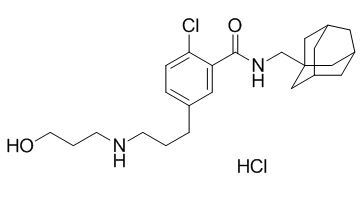
AZD9056 hydrochloride is a novel, potent, selective, orally bioavailable antagonist of P2X7 receptor which is an adenosine triphosphate (ATP)-gated cation channel expressed on a variety of cell types believed to play a role in inflammation. AZD9056 was an inhibitor of BCRP and weakly inhibited BCRP-mediated transport of methotrexate (IC(50)=92μM). Sulfasalazine inhibited methotrexate transport mediated by all transporters studied (IC(50)<5μM). Subsequent assessment of the in vitro data using [I]/IC(50) ratios indicated that both AZD9056 and sulfasalazine were unlikely to cause a DDI with methotrexate in vivo. In conclusion, to support rheumatoid arthritis drug development it is proposed that regulatory in vitro studies for OAT1, OAT3 and BCRP inhibition be routinely conducted to assess the potential for a transporter-mediated DDI with methotrexate in vivo.
Physicochemical Properties
| Molecular Formula | C24H36CL2N2O2 |
| Molecular Weight | 455.460844993591 |
| Exact Mass | 454.215 |
| CAS # | 345303-91-5 |
| Related CAS # | 345304-65-6 |
| PubChem CID | 10161380 |
| Appearance | White to off-white solid powder |
| LogP | 5.774 |
| Hydrogen Bond Donor Count | 4 |
| Hydrogen Bond Acceptor Count | 3 |
| Rotatable Bond Count | 10 |
| Heavy Atom Count | 30 |
| Complexity | 514 |
| Defined Atom Stereocenter Count | 0 |
| InChi Key | LZBBHFRRZLDHLE-UHFFFAOYSA-N |
| InChi Code | InChI=1S/C24H35ClN2O2.ClH/c25-22-5-4-17(3-1-6-26-7-2-8-28)12-21(22)23(29)27-16-24-13-18-9-19(14-24)11-20(10-18)15-24;/h4-5,12,18-20,26,28H,1-3,6-11,13-16H2,(H,27,29);1H |
| Chemical Name | Benzamide, 2-chloro-5-(3-((3-hydroxypropyl)amino)propyl)-N-(tricyclo(3.3.1.13,7)dec-1-ylmethyl)- HCl |
| Synonyms | AZD-9056 HCl; AZD 9056 HCl; AZD9056. |
| HS Tariff Code | 2934.99.9001 |
| Storage |
Powder-20°C 3 years 4°C 2 years In solvent -80°C 6 months -20°C 1 month Note: Please store this product in a sealed and protected environment, avoid exposure to moisture. |
| Shipping Condition | Room temperature (This product is stable at ambient temperature for a few days during ordinary shipping and time spent in Customs) |
Biological Activity
| Targets | The P2X7 receptor in the HEK-hP2X7 cell line is blocked by the antagonist AZD9056 with an IC50 of 11.2 nM, demonstrating the antagonist's strong receptor selectivity. AZD9056, an antagonist of the P2X7 receptor, significantly inhibits murine microglial BV2 cells (IC50=1-3 μM) [1]. The BCRP inhibitor AZD9056 has an IC50 of 92 μM, which indicates a poor inhibition of BCRP-mediated methotrexate transport[2]. |
| ln Vitro |
The P2X7 receptor in the HEK-hP2X7 cell line is blocked by the antagonist AZD9056 with an IC50 of 11.2 nM, demonstrating the antagonist's strong receptor selectivity. AZD9056, an antagonist of the P2X7 receptor, significantly inhibits murine microglial BV2 cells (IC50=1-3 μM) [1]. The BCRP inhibitor AZD9056 has an IC50 of 92 μM, which indicates a poor inhibition of BCRP-mediated methotrexate transport[2]. AZD9056 inhibited BzATP-induced inward currents in P2X7 receptor-expressing mouse microglia BV2 cells in patch-clamp experiments. The inhibition was concentration-dependent with an IC₅₀ of 1-3 μmol/L. [1] AZD9056 (10 μmol/L) did not significantly inhibit Ca²⁺ influx in human astrocytoma 1321N1 cells overexpressing P2X1, P2X2, or P2X3 receptors upon ATP stimulation. It caused a 27% decrease in activity in P2X4-expressing cells and reduced the remaining activity to 9% in P2X7-expressing cells, demonstrating selectivity for the P2X7 receptor over other P2X receptor subtypes. [1] AZD9056 inhibited ATP-induced hydrogen peroxide (H₂O₂) release from freshly isolated human mononuclear blood cells in a concentration-dependent manner, with an IC₅₀ of 3.0 μmol/L when cells were stimulated with 1 mmol/L ATP. [1] AZD9056 (10 μmol/L) reversed the BzATP (50 μmol/L)-induced increases in cellular respiration, extracellular acidification (metabolic activity), and changes in cell impedance (morphology) in HEK293 cells overexpressing the human P2X7 receptor (HEK-hP2X7). The inhibition was reversible upon washout of the antagonist. No such effects were observed in parental HEK293 cells lacking P2X7. [1] AZD9056 protected HEK-hP2X7 cells from ATP- or BzATP-induced cytotoxicity in a concentration-dependent manner. It antagonized ATP (2.5 mmol/L)-induced cytotoxicity with an IC₅₀ of 11.4 nmol/L and BzATP (0.25 mmol/L)-induced cytotoxicity with an IC₅₀ of 5.62 nmol/L. No protective effect was observed in parental HEK293 cells. [1] AZD9056 (10 μmol/L) inhibited the ATP (250 μmol/L)-induced uptake of the fluorescent dye YoPro1 in HEK-hP2X7 cells, a marker for P2X7 receptor pore dilation, with an IC₅₀ of 11.2 nmol/L. [1] |
| ln Vivo | Treatment with AZD9056 has anti-inflammatory and analgesic properties. causes the expression of interleukin (IL)-1β, IL-6, matrix metalloproteinase-13 (MMP-13), substance P (SP), prostaglandin E2 (PGE2), and tumor necrosis factor-α (TNF-α) to be upregulated. AZD9056 can counteract the effects of MIA in cartilage tissue [3]. |
| Enzyme Assay |
Patch-clamp electrophysiology: Mouse microglia BV2 cells, which express functional P2X7 receptors, were analyzed in the whole-cell patch-clamp configuration. The intracellular pipette solution contained KF, KCl, EGTA, and Hepes buffer. The extracellular bath solution contained NaCl, KCl, CaCl₂, Hepes, and glucose. Cells were held at a constant potential of -70 mV. Agonist-induced currents were recorded upon application of BzATP (100 μmol/L) in the presence or absence of different concentrations of AZD9056 via a computer-controlled perfusion system. Steady-state currents were measured, leak-corrected, and used to generate concentration-response curves for the antagonist. [1] Calcium flux assay: Human astrocytoma 1321N1 cells overexpressing specific human P2X receptor subtypes (P2X1, P2X2, P2X3, P2X4, or P2X7) were loaded with the calcium-sensitive fluorescent dye Fluo-4 AM. After washing, cells were preincubated with 10 μmol/L AZD9056 for 2 minutes before stimulation with ATP (0.2-2 mmol/L). Fluorescence signals, indicating intracellular Ca²⁺ increase, were recorded after 15 minutes using a fluorescent plate reader to assess receptor activity and antagonist selectivity. [1] YoPro1 uptake assay: This assay measures pore dilation of the P2X7 receptor. HEK-hP2X7 cells were seeded in plates. After removal of culture medium, assay buffer containing the membrane-impermeable dye YoPro1 was added along with ATP (250 μmol/L) and varying concentrations of AZD9056. Cells were incubated for 45 minutes, allowing dye entry through the dilated P2X7 pore. Fluorescence was measured using a plate reader (excitation 485 nm, emission 530 nm) to quantify dye uptake and antagonist inhibition. [1] |
| Cell Assay |
Hydrogen peroxide release assay: Freshly isolated human mononuclear blood cells were incubated in a buffer containing Amplex Red reagent and horseradish peroxidase. After adding ATP (1 mmol/L) or BzATP, the fluorescence resulting from H₂O₂-dependent conversion of Amplex Red to resorufin was quantified using a microplate reader (excitation 550 nm, emission/absorbance 600 nm). The effect of AZD9056 was tested by preincubating cells with the antagonist before agonist addition. [1] Cytosensor real-time monitoring: HEK-hP2X7 or parental HEK293 cells were cultured on a sensor chip. A cytosensor system continuously recorded extracellular acidification (metabolism), oxygen consumption (respiration), and cellular impedance (morphology/adhesion) under a constant flow of assay medium. Cells were exposed to BzATP (0-100 μmol/L) in increasing concentrations during stop-flow cycles. For inhibition experiments, cells were pre-exposed to 10 μmol/L AZD9056 prior to stimulation with 50 μmol/L BzATP. Wash-out phases were included to assess reversibility. [1] Cell viability/cytotoxicity assay: HEK-hP2X7 or parental HEK293 cells were seeded in plates and allowed to attach. For agonist toxicity, ATP or BzATP was added at varying concentrations. For antagonist protection, cells were preincubated with increasing concentrations of AZD9056 for 5 minutes before adding a fixed concentration of ATP (2.5 mmol/L) or BzATP (0.25 mmol/L). After a 30-minute incubation, a cell viability reagent was added, and fluorescence was measured after 1 hour (excitation 560 nm, emission 590 nm) to determine cell survival. [1] Mitochondrial membrane potential assay: HEK-hP2X7 and parental HEK293 cells were seeded on coated slides and loaded with the JC-1 dye, which accumulates in mitochondria and exhibits red fluorescence in healthy cells with intact membrane potential. Cells were then treated with BzATP (31.3 or 250 μmol/L) for 1 hour. Depolarization of mitochondria leads to a shift in JC-1 fluorescence from red to green, which was monitored using confocal microscopy. Valinomycin served as a positive control for depolarization. This assay was used to demonstrate agonist-induced mitochondrial toxicity, but the direct effect of AZD9056 on mitochondrial potential was not described in this context. [1] |
| References |
[1]. ATP-induced cellular stress and mitochondrial toxicity in cells expressing purinergic P2X7 receptor. Pharmacol Res Perspect. 2015 Mar;3(2):e00123. [2]. In vitro risk assessment of AZD9056 perpetrating a transporter-mediated drug-drug interaction with methotrexate. Eur J Pharm Sci. 2011 May 18;43(1-2):41-9. [3]. Blocking of the P2X7 receptor inhibits the activation of the MMP-13 and NF-κB pathways in the cartilage tissue of rats with osteoarthritis. Int J Mol Med. 2016 Dec;38(6):1922-1932. |
| Additional Infomation |
AZD9056 is described as a selective antagonist of the purinergic P2X7 receptor. [1] Its efficacy in rheumatoid arthritis was evaluated in a phase II clinical trial, as mentioned in the introduction. [1] In this study, AZD9056 was used primarily as a pharmacological tool to confirm that various cellular effects (ion flux, dye uptake, metabolic changes, oxidative stress, cytotoxicity) induced by ATP or its analog BzATP were specifically mediated through the activation of the P2X7 receptor. [1] The antagonist demonstrated reversible inhibition in the cytosensor experiments. [1] |
Solubility Data
| Solubility (In Vitro) |
DMSO : ~50 mg/mL (~109.78 mM) H2O : ~1.67 mg/mL (~3.67 mM) |
| Solubility (In Vivo) |
Solubility in Formulation 1: ≥ 2.5 mg/mL (5.49 mM) (saturation unknown) in 10% DMSO + 40% PEG300 + 5% Tween80 + 45% Saline (add these co-solvents sequentially from left to right, and one by one), clear solution. For example, if 1 mL of working solution is to be prepared, you can add 100 μL of 25.0 mg/mL clear DMSO stock solution to 400 μL PEG300 and mix evenly; then add 50 μL Tween-80 to the above solution and mix evenly; then add 450 μL normal saline to adjust the volume to 1 mL. Preparation of saline: Dissolve 0.9 g of sodium chloride in 100 mL ddH₂ O to obtain a clear solution. Solubility in Formulation 2: ≥ 2.5 mg/mL (5.49 mM) (saturation unknown) in 10% DMSO + 90% (20% SBE-β-CD in Saline) (add these co-solvents sequentially from left to right, and one by one), clear solution. For example, if 1 mL of working solution is to be prepared, you can add 100 μL of 25.0 mg/mL clear DMSO stock solution to 900 μL of 20% SBE-β-CD physiological saline solution and mix evenly. Preparation of 20% SBE-β-CD in Saline (4°C,1 week): Dissolve 2 g SBE-β-CD in 10 mL saline to obtain a clear solution. Solubility in Formulation 3: ≥ 2.5 mg/mL (5.49 mM) (saturation unknown) in 10% DMSO + 90% Corn Oil (add these co-solvents sequentially from left to right, and one by one), clear solution. For example, if 1 mL of working solution is to be prepared, you can add 100 μL of 25.0 mg/mL clear DMSO stock solution to 900 μL of corn oil and mix evenly. (Please use freshly prepared in vivo formulations for optimal results.) |
| Preparing Stock Solutions | 1 mg | 5 mg | 10 mg | |
| 1 mM | 2.1956 mL | 10.9779 mL | 21.9558 mL | |
| 5 mM | 0.4391 mL | 2.1956 mL | 4.3912 mL | |
| 10 mM | 0.2196 mL | 1.0978 mL | 2.1956 mL |