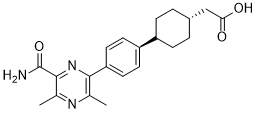
AZD7687 is a novel, potent, selective, reversible and pyrazinecarboxamide-based inhibitor of diacylglycerol acyltransferase 1 (DGAT1) with an IC50 value of 80 nM for hDGAT1. AZD7687 attenuates postprandial triacylglyceride excursion. AZD7687 markedly reduced postprandial TAG excursion with a steep concentration-effect relationship. Incremental TAG AUC (area under the serum concentration vs. time curve) following SMM 60% was decreased >75% from baseline at doses ≥5 mg (p < 0.0001 vs. placebo). Serum levels of diacylglycerol, specifically measured with mass spectrometry, did not increase after AZD7687 administration. Nausea, vomiting and diarrhoea were reported with increasing doses and they limited dose escalation. Lowering of SMM fat content to 45 or 30% in five cohorts gradually reduced the frequency of gastrointestinal symptoms at a given dose of AZD7687.
Physicochemical Properties
| Molecular Formula | C21H25N3O3 |
| Molecular Weight | 367.44150519371 |
| Exact Mass | 367.19 |
| CAS # | 1166827-44-6 |
| PubChem CID | 42636350 |
| Appearance | Off-white to pink solid powder |
| LogP | 4.492 |
| Hydrogen Bond Donor Count | 2 |
| Hydrogen Bond Acceptor Count | 5 |
| Rotatable Bond Count | 5 |
| Heavy Atom Count | 27 |
| Complexity | 525 |
| Defined Atom Stereocenter Count | 0 |
| InChi Key | YXFNPRHZMOGREC-UHFFFAOYSA-N |
| InChi Code | InChI=1S/C21H25N3O3/c1-12-19(24-20(21(22)27)13(2)23-12)17-9-7-16(8-10-17)15-5-3-14(4-6-15)11-18(25)26/h7-10,14-15H,3-6,11H2,1-2H3,(H2,22,27)(H,25,26) |
| Chemical Name | 2-[4-[4-(6-carbamoyl-3,5-dimethylpyrazin-2-yl)phenyl]cyclohexyl]acetic acid |
| HS Tariff Code | 2934.99.9001 |
| Storage |
Powder-20°C 3 years 4°C 2 years In solvent -80°C 6 months -20°C 1 month |
| Shipping Condition | Room temperature (This product is stable at ambient temperature for a few days during ordinary shipping and time spent in Customs) |
Biological Activity
| ln Vitro | AZD7687's IC50 was roughly 100 nM, 60 nM, and 80 nM in in vitro recombinant mouse, dog, and human DGAT1 enzyme tests, respectively. Compound 30, AZD7687, exhibited activity against muscarinic M2 receptor (IC50 = 80.5 μM), fatty acid amide hydrolase (IC50 = 3.7 μM), acyl-CoA:cholesterol acetyltransferase (79% at 10 μM), and diphosphate inhibition of esterase PDE10A1 (IC50 = 5.5 μM). There has been no evidence of any activity against human DGAT2 [1][2]. |
| ln Vivo | The identical skin phenotype, including baldness and atrophy of the sebaceous glands, as observed in the skin of DGAT1-/- mice is produced when DGAT1 is long-term pharmacologically inhibited in mice treated with AZD7687. The effects of AZD7687 on the skin can be reversed and are depending on time and dose [3]. |
| References |
[1]. Design and optimization of pyrazinecarboxamide-based inhibitors of diacylglycerol acyltransferase 1 (DGAT1) leading to a clinical candidate dimethylpyrazinecarboxamide phenylcyclohexylacetic acid (AZD7687). J Med Chem. 2012 Dec 13;55(23):10610-29. [2]. Diacylglycerol acyltransferase 1 inhibition with AZD7687 alters lipid handling and hormone secretion in the gut with intolerable side effects: a randomized clinical trial. Diabetes Obes Metab. 2013 Oct 4. [3]. Pharmacological inhibition of DGAT1 induces sebaceous gland atrophy in mouse and dog skin while overt alopecia is restricted to the mouse. Toxicol Pathol. 2015 Apr;43(3):376-83. |
| Additional Infomation | AZD-7687 is under investigation in clinical trial NCT01119352 (AZD7687 Multiple Ascending Dose Study). |
Solubility Data
| Solubility (In Vitro) | DMSO : ≥ 50 mg/mL (~136.08 mM) |
| Solubility (In Vivo) |
Solubility in Formulation 1: 2.5 mg/mL (6.80 mM) in 10% DMSO + 40% PEG300 + 5% Tween80 + 45% Saline (add these co-solvents sequentially from left to right, and one by one), suspension solution; with heating and sonication. For example, if 1 mL of working solution is to be prepared, you can add 100 μL of 25.0 mg/mL clear DMSO stock solution to 400 μL PEG300 and mix evenly; then add 50 μL Tween-80 to the above solution and mix evenly; then add 450 μL normal saline to adjust the volume to 1 mL. Preparation of saline: Dissolve 0.9 g of sodium chloride in 100 mL ddH₂ O to obtain a clear solution. Solubility in Formulation 2: ≥ 2.5 mg/mL (6.80 mM) (saturation unknown) in 10% DMSO + 90% (20% SBE-β-CD in Saline) (add these co-solvents sequentially from left to right, and one by one), clear solution. For example, if 1 mL of working solution is to be prepared, you can add 100 μL of 25.0 mg/mL clear DMSO stock solution to 900 μL of 20% SBE-β-CD physiological saline solution and mix evenly. Preparation of 20% SBE-β-CD in Saline (4°C,1 week): Dissolve 2 g SBE-β-CD in 10 mL saline to obtain a clear solution. (Please use freshly prepared in vivo formulations for optimal results.) |
| Preparing Stock Solutions | 1 mg | 5 mg | 10 mg | |
| 1 mM | 2.7215 mL | 13.6077 mL | 27.2153 mL | |
| 5 mM | 0.5443 mL | 2.7215 mL | 5.4431 mL | |
| 10 mM | 0.2722 mL | 1.3608 mL | 2.7215 mL |