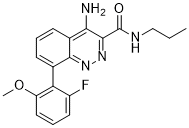
AZD-7325 is a novel, potent and selective GABAA(α2/3) receptor modulator, used for treatment of generalized anxiety disorder. The increases in prolactin levels after administration of AZD7325 at 2 mg and 10 mg doses (difference 7.6% and 10.5%, respectively) did not reach statistical significance, suggesting that doses of AZD7325 or intrinsic efficacy at the α2 and α3 receptor subtypes may have been too low.
Physicochemical Properties
| Molecular Formula | C19H19FN4O2 |
| Molecular Weight | 354.378167390823 |
| Exact Mass | 354.149 |
| CAS # | 942437-37-8 |
| Related CAS # | 1252802-75-7 (hydrogen sulfate); |
| PubChem CID | 23581869 |
| Appearance | White to off-white solid powder |
| Density | 1.3±0.1 g/cm3 |
| Index of Refraction | 1.625 |
| LogP | 3.83 |
| Hydrogen Bond Donor Count | 2 |
| Hydrogen Bond Acceptor Count | 6 |
| Rotatable Bond Count | 5 |
| Heavy Atom Count | 26 |
| Complexity | 481 |
| Defined Atom Stereocenter Count | 0 |
| InChi Key | KYDURMHFWXCKMW-UHFFFAOYSA-N |
| InChi Code | InChI=1S/C19H19FN4O2/c1-3-10-22-19(25)18-16(21)12-7-4-6-11(17(12)23-24-18)15-13(20)8-5-9-14(15)26-2/h4-9H,3,10H2,1-2H3,(H2,21,23)(H,22,25) |
| Chemical Name | 4-amino-8-(2-fluoro-6-methoxyphenyl)-N-propylcinnoline-3-carboxamide |
| Synonyms | AZD-7325; AZD 7325; AZD7325. |
| HS Tariff Code | 2934.99.9001 |
| Storage |
Powder-20°C 3 years 4°C 2 years In solvent -80°C 6 months -20°C 1 month |
| Shipping Condition | Room temperature (This product is stable at ambient temperature for a few days during ordinary shipping and time spent in Customs) |
Biological Activity
| Targets |
Human GABAA receptor α2 subunit (EC50 = 0.3 μM, determined by electrophysiological assay) [3, 4] - Human GABAA receptor α3 subunit (EC50 = 0.7 μM, determined by electrophysiological assay) [3, 4] - Human GABAA receptor α1/α5 subunits (EC50 > 10 μM, no significant potentiation) [1, 4] |
| ln Vitro |
AZD7325 displays strong binding affinities on GABAAα1, α2, and α3 (Ki=0.5, 0.3, and 1.3 nM), as well as GABAAα5 (Ki=230 nM), making it a highly selective and high-affinity modulator of the GABAA absorption system [4]. AZD7325 (0–10 μM; 3 days; once daily) causes human hepatocytes from donors HH210, HH215, and HH216, respectively, to express CYP1A2 mRNA at maximum levels of 3.2, 2.1, and 2.5 folds [2]. -10 μM; once daily for three days in a row) induced the production of CYP1A2 and CYP3A4 proteins in human hepatocytes from donor HH210 [2]. Acts as a partial positive modulator of GABAAα2,3 receptors: Concentration-dependently enhanced GABA-mediated Cl⁻ currents in HEK293 cells expressing GABAAα2β3γ2 or α3β3γ2 subunits, with maximal enhancement of ~60% (α2) and ~55% (α3) at 10 μM AZD7325 [3, 4] - Exhibits high subunit selectivity: No significant potentiation of GABAAα1β3γ2 or α5β3γ2 receptors at concentrations up to 10 μM, >30-fold selectivity for α2/α3 over α1/α5 [1, 4] - Weakly induces cytochrome P450 enzymes: 10 μM AZD7325 increased CYP1A2 mRNA expression by ~2.0 fold and CYP3A4 mRNA by ~1.5 fold in human primary hepatocytes, with no induction at concentrations ≤1 μM [2] - No cytotoxicity to human hepatocytes or HEK293 cells at concentrations up to 50 μM (cell viability > 90%) [2] |
| ln Vivo |
AZD7325 (Turkish project; 10, 17.8 or 31.6 mg/kg; 30 minutes before induction hyperthermia) enhanced the effectiveness of hyperthermia, with median thresholds in the vehicle group of 42.2°C, 42.8°C (10 mg/kg), and 43.3°C (17.8 mg/kg), as well as 43.4°C (31.6 mg/kg) [3]. Antiepileptic activity in Dravet syndrome mouse model (Scn1a⁺/⁻): Intraperitoneal administration of AZD7325 (10 mg/kg/day for 7 days) reduced spontaneous seizure frequency by ~60% and seizure duration by ~50% compared to vehicle control [3] - Central nervous system effects in healthy males: Oral doses of 10-40 mg AZD7325 produced dose-dependent anxiolysis, mild sedation, and reduced subjective anxiety scores (by ~30% at 40 mg) [1] - Reduced cognitive impairment vs. lorazepam: At equianxiolytic doses (40 mg AZD7325 vs. 2 mg lorazepam), digit symbol substitution test scores decreased by only ~10% (vs. 25% with lorazepam) [1] - Weak in vivo induction of CYP3A4: Healthy volunteers receiving 40 mg/day AZD7325 for 14 days showed a ~20% increase in midazolam (CYP3A4 substrate) clearance [2] |
| Enzyme Assay |
GABAA receptor electrophysiological assay: HEK293 cells stably expressing human GABAAα2β3γ2 or α3β3γ2 subunits were seeded on coverslips and incubated overnight. Cells were voltage-clamped using patch-clamp technique, and a submaximal concentration of GABA (EC20) was applied. Serial dilutions of AZD7325 (0.01-10 μM) were co-administered, and Cl⁻ current amplitude was recorded. EC50 values were calculated based on current enhancement [3, 4] - CYP enzyme induction assay: Human primary hepatocytes were plated in 6-well plates and cultured to confluence. Cells were treated with AZD7325 (0.1-10 μM) for 72 hours. CYP1A2 and CYP3A4 mRNA levels were quantified by RT-PCR, and enzyme activity was measured using selective fluorogenic substrates. Induction fold was compared to vehicle control [2] |
| Cell Assay |
RT-PCR[2] Cell Types: Primary human hepatocytes from one female (HH210) and two female males (HH215, HH216) Donor Tested Concentrations: 0.01, 0.1, 1, 10 µM Incubation Duration: 3 consecutive days Experimental Results: Resulted in increased CYP1A2 mRNA expression Western Blot analysis [2] Cell Types: Primary human hepatocytes from donor Tested Concentrations: 0.01, 0.1, 1, 10 µM Incubation Duration: 3 consecutive days Experimental Results: Increased CYP1A2 and CYP3A4 protein levels. GABAA subunit selectivity assay: HEK293 cells were transfected with plasmids encoding GABAAα1β3γ2, α2β3γ2, α3β3γ2, or α5β3γ2 subunits. After 48 hours, cells were subjected to patch-clamp recording. Submaximal GABA (EC20) and AZD7325 (0.01-10 μM) were co-applied, and current enhancement was compared across subunits [1, 4] - Hepatocyte viability and CYP induction assay: Human primary hepatocytes were treated with AZD7325 (0.1-50 μM) for 72 hours. Cell viability was assessed by MTT assay. For CYP induction, cell lysates were used to measure enzyme activity, and culture supernatants were analyzed for metabolic products [2] |
| Animal Protocol |
Animal/Disease Models: Male and female P18 - P20 F1.Scn1a+/- mice [3] Doses: 10, 17.8 or 31.6 mg/kg Route of Administration: po (po (oral gavage)) 30 minutes before induction of hyperthermia Experimental Results: In F1.Scn1a+/- mice Hyperthermia-induced seizures are attenuated without sedation. Dravet syndrome mouse model: 6-week-old Scn1a⁺/- mice were randomly divided into vehicle and treatment groups. AZD7325 was dissolved in 5% DMSO + 95% saline and administered intraperitoneally at 5, 10, or 20 mg/kg/day for 7 days. Seizure activity was monitored by video recording (24 hours/day) to count seizure frequency and duration. Brain tissues were collected post-treatment to analyze GABAA receptor subunit expression [3] - Rat pharmacokinetic study: Male Sprague-Dawley rats were administered AZD7325 via oral gavage (10 mg/kg) or intravenous injection (5 mg/kg). Blood samples were collected at 0.25, 0.5, 1, 2, 4, 8, 12, and 24 hours post-administration. Plasma drug concentrations were quantified by LC-MS/MS, and pharmacokinetic parameters (t1/2, Cmax, AUC, bioavailability) were calculated [2] |
| ADME/Pharmacokinetics |
Human pharmacokinetics: Oral bioavailability = ~70%; Tmax = 1-2 hours; Cmax = 20 ng/mL (10 mg dose), 85 ng/mL (40 mg dose); plasma half-life (t1/2) = 6-8 hours; volume of distribution (Vd) = 1.2 L/kg [1, 2] - Rat pharmacokinetics: Oral bioavailability = ~65%; t1/2 = 4 hours; Vd = 1.5 L/kg [2] - Metabolism: Primarily metabolized by CYP3A4 in the liver; major metabolites are inactive [2] - Excretion: ~60% excreted in urine (as metabolites), ~30% in feces; unchanged drug in urine < 5% [2] - Plasma protein binding rate = ~85% (human); ~82% (rat) [1, 2] |
| Toxicity/Toxicokinetics |
Human clinical tolerance: Oral doses ≤40 mg/day for 14 days were well-tolerated; mild adverse events included dizziness (15%) and somnolence (10%), which were transient [1, 2] - In vitro cytotoxicity: No significant toxicity to human hepatocytes or HEK293 cells at concentrations up to 50 μM (cell viability > 90%) [2] - Acute toxicity: Mouse oral LD50 > 200 mg/kg; no mortality or organ damage at doses up to 200 mg/kg [3] - Drug-drug interaction potential: Weak induction of CYP3A4 may increase clearance of CYP3A4 substrates (e.g., midazolam) [2] - No significant changes in liver/kidney function (ALT, AST, creatinine) or hematological parameters in humans or animals [1, 2] |
| References |
[1]. The central nervous system effects of the partial GABA-Aα2,3 -selective receptor modulator AZD7325 in comparison with lorazepam in healthy males.Br J Clin Pharmacol. 2014 Dec;78(6):1298-314. [2]. A clinical study to assess CYP1A2 and CYP3A4 induction by AZD7325, a selective GABA(A) receptor modulator - an in vitro and in vivo comparison.Br J Clin Pharmacol. 2012 Jul;74(1):98-108. [3]. Potentiating α2 subunit containing perisomatic GABAA receptors protects against seizures in a mouse model of Dravet syndrome.J Physiol. 2019 Aug;597(16):4293-4307. [4]. AZD7325,Mechanism of action: Gamma-aminobutyric acid receptor A alpha 2 & 3 (GABAAα2,3) positive modulator. |
| Additional Infomation |
AZD7325 is a high affinity, selective modulator of the GABAA receptor system. AZD7325 is a partial, selective positive modulator of GABAA receptors containing α2 and α3 subunits, developed by AstraZeneca [4] - Core mechanism of action: Enhances GABA-mediated inhibitory neurotransmission by binding to the benzodiazepine site of GABAAα2,3 receptors, without significant interaction with α1/α5 subunits [1, 4] - Potential therapeutic applications: Anxiety disorders, epilepsy (especially Dravet syndrome), and other central nervous system conditions requiring enhanced inhibitory signaling [3, 4] - Advantages over non-selective benzodiazepines (e.g., lorazepam): Reduced cognitive impairment and sedation due to lack of α1 subunit activity [1] - Characterized by favorable pharmacokinetics (oral bioavailability, linear dose-response, moderate half-life) supporting once-daily dosing [1, 2] |
Solubility Data
| Solubility (In Vitro) | DMSO : ~100 mg/mL (~282.18 mM) |
| Solubility (In Vivo) |
Solubility in Formulation 1: ≥ 2.08 mg/mL (5.87 mM) (saturation unknown) in 10% DMSO + 40% PEG300 + 5% Tween80 + 45% Saline (add these co-solvents sequentially from left to right, and one by one), clear solution. For example, if 1 mL of working solution is to be prepared, you can add 100 μL of 20.8 mg/mL clear DMSO stock solution to 400 μL PEG300 and mix evenly; then add 50 μL Tween-80 to the above solution and mix evenly; then add 450 μL normal saline to adjust the volume to 1 mL. Preparation of saline: Dissolve 0.9 g of sodium chloride in 100 mL ddH₂ O to obtain a clear solution. Solubility in Formulation 2: ≥ 2.08 mg/mL (5.87 mM) (saturation unknown) in 10% DMSO + 90% Corn Oil (add these co-solvents sequentially from left to right, and one by one), clear solution. For example, if 1 mL of working solution is to be prepared, you can add 100 μL of 20.8 mg/mL clear DMSO stock solution to 900 μL of corn oil and mix evenly. (Please use freshly prepared in vivo formulations for optimal results.) |
| Preparing Stock Solutions | 1 mg | 5 mg | 10 mg | |
| 1 mM | 2.8218 mL | 14.1091 mL | 28.2183 mL | |
| 5 mM | 0.5644 mL | 2.8218 mL | 5.6437 mL | |
| 10 mM | 0.2822 mL | 1.4109 mL | 2.8218 mL |