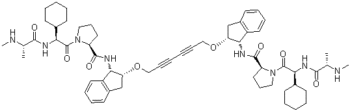
AZD5582 (AZD-5582) is a novel and potent IAP (Inhibitor of apoptosis proteins) antagonist which binds potently to the BIR3 domains of cIAP1, cIAP2, and XIAP with IC50s of 15, 21, and 15 nM, respectively. Subnanomolar concentrations of AZD5582 induce apoptosis and cIAP1 degradation in the MDA-MB-231 breast cancer cell line in vitro. AZD5582 induces cIAP1 degradation and caspase-3 cleavage within tumor cells when given intravenously to MDA-MB-231 xenograft-bearing mice, and after two weekly doses of 3.0 mg/kg, causes significant tumor regressions. In line with other published IAP inhibitors, AZD5582 only exhibits antiproliferative effects in a small subset of the more than 200 cancer cell lines examined. AZD5582 was suggested as a candidate for clinical development due to its in vitro and in vivo profiles.
Physicochemical Properties
| Molecular Formula | C58H78N8O8 |
| Molecular Weight | 1015.2887 |
| Exact Mass | 1014.594 |
| Elemental Analysis | C, 68.61; H, 7.74; N, 11.04; O, 12.61 |
| CAS # | 1258392-53-8 |
| Related CAS # | AZD5582 dihydrochloride;1883545-51-4 |
| PubChem CID | 49847690 |
| Appearance | white solid powder |
| Density | 1.3±0.1 g/cm3 |
| Boiling Point | 1207.3±65.0 °C at 760 mmHg |
| Flash Point | 683.9±34.3 °C |
| Vapour Pressure | 0.0±0.3 mmHg at 25°C |
| Index of Refraction | 1.622 |
| LogP | 9.22 |
| Hydrogen Bond Donor Count | 6 |
| Hydrogen Bond Acceptor Count | 10 |
| Rotatable Bond Count | 19 |
| Heavy Atom Count | 74 |
| Complexity | 1950 |
| Defined Atom Stereocenter Count | 10 |
| SMILES | O=C([C@H](C1CCCCC1)NC([C@H](C)NC)=O)N1CCC[C@H]1C(N[C@H]1C2=CC=CC=C2C[C@H]1OCC#CC#CCO[C@@H]1CC2=CC=CC=C2[C@@H]1NC([C@@H]1CCCN1C([C@H](C1CCCCC1)NC([C@H](C)NC)=O)=O)=O)=O |
| InChi Key | WLMCRYCCYXHPQF-ZVMUOSSASA-N |
| InChi Code | InChI=1S/C58H78N8O8/c1-37(59-3)53(67)61-49(39-21-9-7-10-22-39)57(71)65-31-19-29-45(65)55(69)63-51-43-27-15-13-25-41(43)35-47(51)73-33-17-5-6-18-34-74-48-36-42-26-14-16-28-44(42)52(48)64-56(70)46-30-20-32-66(46)58(72)50(40-23-11-8-12-24-40)62-54(68)38(2)60-4/h13-16,25-28,37-40,45-52,59-60H,7-12,19-24,29-36H2,1-4H3,(H,61,67)(H,62,68)(H,63,69) |
| Chemical Name | (2S)-1-[(2S)-2-cyclohexyl-2-[[(2S)-2-(methylamino)propanoyl]amino]acetyl]-N-[(1S,2R)-2-[6-[[(1S,2R)-1-[[(2S)-1-[(2S)-2-cyclohexyl-2-[[(2S)-2-(methylamino)propanoyl]amino]acetyl]pyrrolidine-2-carbonyl]amino]-2,3-dihydro-1H-inden-2-yl]oxy]hexa-2,4-diynoxy]-2,3-dihydro-1H-inden-1-yl]pyrrolidine-2-carboxamide |
| Synonyms | AZD-5582; AZD 5582; AZD5582 |
| HS Tariff Code | 2934.99.9001 |
| Storage |
Powder-20°C 3 years 4°C 2 years In solvent -80°C 6 months -20°C 1 month Note: (1). This product requires protection from light (avoid light exposure) during transportation and storage.(2). Please store this product in a sealed and protected environment (e.g. under nitrogen), avoid exposure to moisture. |
| Shipping Condition | Room temperature (This product is stable at ambient temperature for a few days during ordinary shipping and time spent in Customs) |
Biological Activity
| Targets | cIAP1 (IC50 = 15 nM); cIAP2 (IC50 = 21 nM); XIAP (IC50 = 15 nM) |
| ln Vitro |
In H1975 NSCLC cells, AZD5582 (20 nM; 48 hours) inhibits cell viability by working with IFN or viral double-stranded RNA (dsRNA)[2]. Inducing the cleavage of caspase-3 and caspase-7, AZD5582 (20 nM; 17 or 25 hours) downregulates cIAP-1, activates RIPK1 (the upstream regulator of caspase-8), and activates the extrinsic (caspase-8) and intrinsic (caspase-9) apoptosis pathways[2]. Due to the co-treatment of HCC827 NSCLC cells with AZD5582 and IFN, which results in the induction of cell death and active caspase-3/8 activities, AZD5582 (20 nM; 48 hours) causes apoptosis[2]. |
| ln Vivo | After two weeks of treatment with AZD5582 (intravenous injection; 0.1-3.0 mg/kg; once a week; two weeks), the tumors had mostly disappeared. When the mice are given a medium dose of the drug (0.5 mg/kg), cIAP1 degrades after administration, but it takes some time to reach an apoptosis-inducing effect[1]. |
| Cell Assay | Cell death is assessed by trypan blue exclusion using at least 200~500 cells, depending on whether the cells were treated with AZD5582, siRNA, or DNA. Pancreatic cancer cells are seeded at 1~3 × 10⁴ cells per well in a 96-well microtiter plate for the MTS assay. The next day, cells are given various doses of the IAP antagonist AZD5582 for 72 hours. The MTS assay is carried out in accordance with the MTS assay protocol. |
| References |
[1]. Discovery of a novel class of dimeric Smac mimetics as potent IAP antagonists resulting in a clinical candidate for the treatment of cancer (AZD5582). J Med Chem. 2013 Dec 27;56(24):9897-919. [2]. IF-γ and Smac mimetics synergize to induce apoptosis of lung cancer cells in a TNFα-independent manner,Cancer Cell Int. 2018; 18: 84. |
Solubility Data
| Solubility (In Vitro) | DMSO: ~100 mg/mL (~98.5 mM) |
| Solubility (In Vivo) |
Note: Listed below are some common formulations that may be used to formulate products with low water solubility (e.g. < 1 mg/mL), you may test these formulations using a minute amount of products to avoid loss of samples. Injection Formulations (e.g. IP/IV/IM/SC) Injection Formulation 1: DMSO : Tween 80: Saline = 10 : 5 : 85 (i.e. 100 μL DMSO stock solution → 50 μL Tween 80 → 850 μL Saline) *Preparation of saline: Dissolve 0.9 g of sodium chloride in 100 mL ddH ₂ O to obtain a clear solution. Injection Formulation 2: DMSO : PEG300 :Tween 80 : Saline = 10 : 40 : 5 : 45 (i.e. 100 μL DMSO → 400 μLPEG300 → 50 μL Tween 80 → 450 μL Saline) Injection Formulation 3: DMSO : Corn oil = 10 : 90 (i.e. 100 μL DMSO → 900 μL Corn oil) Example: Take the Injection Formulation 3 (DMSO : Corn oil = 10 : 90) as an example, if 1 mL of 2.5 mg/mL working solution is to be prepared, you can take 100 μL 25 mg/mL DMSO stock solution and add to 900 μL corn oil, mix well to obtain a clear or suspension solution (2.5 mg/mL, ready for use in animals). Injection Formulation 4: DMSO : 20% SBE-β-CD in saline = 10 : 90 [i.e. 100 μL DMSO → 900 μL (20% SBE-β-CD in saline)] *Preparation of 20% SBE-β-CD in Saline (4°C,1 week): Dissolve 2 g SBE-β-CD in 10 mL saline to obtain a clear solution. Injection Formulation 5: 2-Hydroxypropyl-β-cyclodextrin : Saline = 50 : 50 (i.e. 500 μL 2-Hydroxypropyl-β-cyclodextrin → 500 μL Saline) Injection Formulation 6: DMSO : PEG300 : castor oil : Saline = 5 : 10 : 20 : 65 (i.e. 50 μL DMSO → 100 μLPEG300 → 200 μL castor oil → 650 μL Saline) Injection Formulation 7: Ethanol : Cremophor : Saline = 10: 10 : 80 (i.e. 100 μL Ethanol → 100 μL Cremophor → 800 μL Saline) Injection Formulation 8: Dissolve in Cremophor/Ethanol (50 : 50), then diluted by Saline Injection Formulation 9: EtOH : Corn oil = 10 : 90 (i.e. 100 μL EtOH → 900 μL Corn oil) Injection Formulation 10: EtOH : PEG300:Tween 80 : Saline = 10 : 40 : 5 : 45 (i.e. 100 μL EtOH → 400 μLPEG300 → 50 μL Tween 80 → 450 μL Saline) Oral Formulations Oral Formulation 1: Suspend in 0.5% CMC Na (carboxymethylcellulose sodium) Oral Formulation 2: Suspend in 0.5% Carboxymethyl cellulose Example: Take the Oral Formulation 1 (Suspend in 0.5% CMC Na) as an example, if 100 mL of 2.5 mg/mL working solution is to be prepared, you can first prepare 0.5% CMC Na solution by measuring 0.5 g CMC Na and dissolve it in 100 mL ddH2O to obtain a clear solution; then add 250 mg of the product to 100 mL 0.5% CMC Na solution, to make the suspension solution (2.5 mg/mL, ready for use in animals). Oral Formulation 3: Dissolved in PEG400 Oral Formulation 4: Suspend in 0.2% Carboxymethyl cellulose Oral Formulation 5: Dissolve in 0.25% Tween 80 and 0.5% Carboxymethyl cellulose Oral Formulation 6: Mixing with food powders Note: Please be aware that the above formulations are for reference only. InvivoChem strongly recommends customers to read literature methods/protocols carefully before determining which formulation you should use for in vivo studies, as different compounds have different solubility properties and have to be formulated differently. (Please use freshly prepared in vivo formulations for optimal results.) |
| Preparing Stock Solutions | 1 mg | 5 mg | 10 mg | |
| 1 mM | 0.9849 mL | 4.9247 mL | 9.8494 mL | |
| 5 mM | 0.1970 mL | 0.9849 mL | 1.9699 mL | |
| 10 mM | 0.0985 mL | 0.4925 mL | 0.9849 mL |