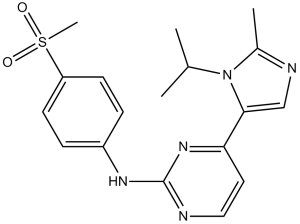
AZD5438 (AZD-5438; AZD 5438) is a novel, potent and selective small molecule inhibitor of cyclin-dependent kinase (CDK) 1, 2 and 9 with potential antineoplastic activity. The inhibitory concentrations of 16 nmol/L, 6 nmol/L, and 20 nmol/L, respectively, are found to inhibit CDK1/2/9. In multiple human tumor cell lines, AZD5438 exhibited noteworthy anti-proliferative activity, with an IC50 ranging from 0.2 μmol/L to 1.7 μmol/L. This resulted in the inhibition of cell cycling at the G2-M, S, and G1 phases as well as the phosphorylation of select proteins, such as CDK substrates pRb, nucleolin, protein phosphatase 1a, and RNA polymerase II COOH-terminal domain.
Physicochemical Properties
| Molecular Formula | C18H21N5O2S | |
| Molecular Weight | 371.4566 | |
| Exact Mass | 371.141 | |
| Elemental Analysis | C, 58.20; H, 5.70; N, 18.85; O, 8.61; S, 8.63 | |
| CAS # | 602306-29-6 | |
| Related CAS # |
|
|
| PubChem CID | 16747683 | |
| Appearance | White to light yellow solid powder | |
| Density | 1.3±0.1 g/cm3 | |
| Boiling Point | 655.2±65.0 °C at 760 mmHg | |
| Flash Point | 350.1±34.3 °C | |
| Vapour Pressure | 0.0±2.0 mmHg at 25°C | |
| Index of Refraction | 1.648 | |
| LogP | 2.13 | |
| Hydrogen Bond Donor Count | 1 | |
| Hydrogen Bond Acceptor Count | 6 | |
| Rotatable Bond Count | 5 | |
| Heavy Atom Count | 26 | |
| Complexity | 556 | |
| Defined Atom Stereocenter Count | 0 | |
| SMILES | 0 |
|
| InChi Key | WJRRGYBTGDJBFX-UHFFFAOYSA-N | |
| InChi Code | InChI=1S/C18H21N5O2S/c1-12(2)23-13(3)20-11-17(23)16-9-10-19-18(22-16)21-14-5-7-15(8-6-14)26(4,24)25/h5-12H,1-4H3,(H,19,21,22) | |
| Chemical Name | 4-(2-methyl-3-propan-2-ylimidazol-4-yl)-N-(4-methylsulfonylphenyl)pyrimidin-2-amine | |
| Synonyms |
|
|
| HS Tariff Code | 2934.99.9001 | |
| Storage |
Powder-20°C 3 years 4°C 2 years In solvent -80°C 6 months -20°C 1 month |
|
| Shipping Condition | Room temperature (This product is stable at ambient temperature for a few days during ordinary shipping and time spent in Customs) |
Biological Activity
| Targets | cdk2-cyclin E (IC50 = 6 nM); cdk2-cyclin A (IC50 = 45 nM); cdk5-p25 (IC50 = 14 nM); cdk1-cyclin B1 (IC50 = 16 nM); cdk9-cyclin T (IC50 = 20 nM); cdk6-cyclin D3 (IC50 = 21 nM); cdk4-cyclin D1 (IC50 = 449 nM); cdk7-cyclin H (IC50 = 821 nM) | |
| ln Vitro |
|
|
| ln Vivo |
|
|
| Enzyme Assay | A scintillation proximity assay is used to test AZD5438's capacity to inhibit CDK activity. It involves using recombinant CDK-cyclin complexes of cyclin-Ecdk2, cdk2-cyclin A, cdk4-cyclin D, and recombinant retinoblastoma substrate (amino acids 792-928) or cdk1-cyclin B1 with a peptide substrate derived from the in vitro p34cdc2 phosphorylation site of histone H1 (biotin-X-Pro-Lys-Thr-Pro-Lys-Lys-Ala-Lys-Lys-Leu). Using peptide substrate (AKKPKTPKKAKKLOH), AZD5438's activity against recombinant cdk5/p25 is assessed in a scintillation proximity assay-based assay at 2 μM ATP. By using human purified glycogen synthase kinase 3βenzyme and eukaryotic initiation factor 2B substrate (at 1 μM ATP), the scintillation proximity assay is used to determine the inhibition of glycogen synthase kinase 3β activity. AZD5438 is subjected to a kinase selectivity screening service in which it is screened against cdk6-cyclin D3, cdk7-cyclin H/MAT1 (cdk activating kinase complex), and cdk9-cyclin T. | |
| Cell Assay | Solid tumor cell lines are used to test AZD5438. In summary, AZD5438 is added to cells at different concentrations and incubated for 48 hours. After the incubation period, 5-bromo-2′-deoxyuridine (BrdUrd) is pulsed into the cells, and the quantity of DNA synthesis is quantified. Specifically, cell death has no bearing on the IC50 for proliferation inhibition. The following protocol is used to seed multiple myeloma cell lines into 96-well plates: RPMI 1640 supplemented with 10% FCS and glutamine, followed by a 72-hour dose of AZD5438. AlamarBlue is used to measure cell growth, and GI50 values are computed using the pretreatment control values. | |
| Animal Protocol |
|
|
| References |
[1]. AZD5438, a potent oral inhibitor of cyclin-dependent kinases 1, 2, and 9, leads to pharmacodynamic changes and potent antitumor effects in human tumor xenografts. Mol Cancer Ther. 2009 Jul;8(7):1856-66. Epub 2009 Jun 9. [2]. AZD5438, an Inhibitor of Cdk1, 2, and 9, Enhances the Radiosensitivity of Non-Small Cell Lung Carcinoma Cells. Int J Radiat Oncol Biol Phys. 2012 Jul 12. |
|
| Additional Infomation | 4-(2-methyl-3-propan-2-yl-4-imidazolyl)-N-(4-methylsulfonylphenyl)-2-pyrimidinamine is a sulfonamide. |
Solubility Data
| Solubility (In Vitro) |
|
|||
| Solubility (In Vivo) |
Solubility in Formulation 1: ≥ 2.5 mg/mL (6.73 mM) (saturation unknown) in 10% DMSO + 40% PEG300 + 5% Tween80 + 45% Saline (add these co-solvents sequentially from left to right, and one by one), clear solution. For example, if 1 mL of working solution is to be prepared, you can add 100 μL of 25.0 mg/mL clear DMSO stock solution to 400 μL PEG300 and mix evenly; then add 50 μL Tween-80 to the above solution and mix evenly; then add 450 μL normal saline to adjust the volume to 1 mL. Preparation of saline: Dissolve 0.9 g of sodium chloride in 100 mL ddH₂ O to obtain a clear solution. Solubility in Formulation 2: ≥ 2.5 mg/mL (6.73 mM) (saturation unknown) in 10% DMSO + 90% (20% SBE-β-CD in Saline) (add these co-solvents sequentially from left to right, and one by one), clear solution. For example, if 1 mL of working solution is to be prepared, you can add 100 μL of 25.0 mg/mL clear DMSO stock solution to 900 μL of 20% SBE-β-CD physiological saline solution and mix evenly. Preparation of 20% SBE-β-CD in Saline (4°C,1 week): Dissolve 2 g SBE-β-CD in 10 mL saline to obtain a clear solution. Solubility in Formulation 3: ≥ 2.5 mg/mL (6.73 mM) (saturation unknown) in 10% DMSO + 90% Corn Oil (add these co-solvents sequentially from left to right, and one by one), clear solution. For example, if 1 mL of working solution is to be prepared, you can add 100 μL of 25.0 mg/mL clear DMSO stock solution to 900 μL of corn oil and mix evenly. (Please use freshly prepared in vivo formulations for optimal results.) |
| Preparing Stock Solutions | 1 mg | 5 mg | 10 mg | |
| 1 mM | 2.6921 mL | 13.4604 mL | 26.9208 mL | |
| 5 mM | 0.5384 mL | 2.6921 mL | 5.3842 mL | |
| 10 mM | 0.2692 mL | 1.3460 mL | 2.6921 mL |