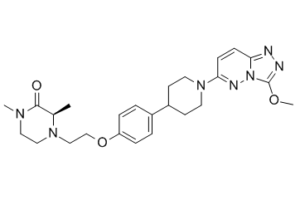
AZD-5153 (AZD5153) is a potent, selective, and orally bioavailable BET/BRD4 (bromodomain and extraterminal) bromodomain inhibitor with anticancer activity. It inhibits BRD4 with a pKi of 8.3 and possesses a bivalent binding mode. Unlike previously described monovalent inhibitors, AZD5153 ligates two bromodomains in BRD4 simultaneously. AZD5153 treatment markedly affects transcriptional programs of MYC, E2F, and mTOR. Of note, mTOR pathway modulation is associated with cell line sensitivity to AZD5153. AZD5153 potently disrupts BRD4 foci in U2OS cells with an IC50 value of 1.7 nmol/L. AZD5153 efficiently downregulates MYC protein levels across the cell line panel irrespective of their sensitivity to AZD5153. AML, MM, and DLBCL cell lines are highly sensitive to AZD5153. This study establishes AZD5153 as a highly potent, orally available BET/BRD4 inhibitor and provides a rationale for clinical development in hematologic malignancies.
Physicochemical Properties
| Molecular Formula | C25H33N7O3 | |
| Molecular Weight | 479.59 | |
| Exact Mass | 479.264 | |
| CAS # | 1869912-39-9 | |
| Related CAS # | AZD5153 6-Hydroxy-2-naphthoic acid;1869912-40-2 | |
| PubChem CID | 118693659 | |
| Appearance | Light yellow to light brown solid powder | |
| Density | 1.3±0.1 g/cm3 | |
| Index of Refraction | 1.668 | |
| LogP | 2.32 | |
| Hydrogen Bond Donor Count | 0 | |
| Hydrogen Bond Acceptor Count | 8 | |
| Rotatable Bond Count | 7 | |
| Heavy Atom Count | 35 | |
| Complexity | 699 | |
| Defined Atom Stereocenter Count | 1 | |
| SMILES | N1(C)CCN(CCOC2=CC=C(C3CCN(C4=NN5C(OC)=NN=C5C=C4)CC3)C=C2)[C@H](C)C1=O |
|
| InChi Key | RSMYFSPOTCDHHJ-GOSISDBHSA-N | |
| InChi Code | InChI=1S/C25H33N7O3/c1-18-24(33)29(2)14-15-30(18)16-17-35-21-6-4-19(5-7-21)20-10-12-31(13-11-20)23-9-8-22-26-27-25(34-3)32(22)28-23/h4-9,18,20H,10-17H2,1-3H3/t18-/m1/s1 | |
| Chemical Name | (3R)-4-[2-[4-[1-(3-methoxy-[1,2,4]triazolo[4,3-b]pyridazin-6-yl)piperidin-4-yl]phenoxy]ethyl]-1,3-dimethylpiperazin-2-one | |
| Synonyms |
|
|
| HS Tariff Code | 2934.99.9001 | |
| Storage |
Powder-20°C 3 years 4°C 2 years In solvent -80°C 6 months -20°C 1 month |
|
| Shipping Condition | Room temperature (This product is stable at ambient temperature for a few days during ordinary shipping and time spent in Customs) |
Biological Activity
| ln Vitro |
|
||
| ln Vivo |
|
||
| Animal Protocol |
|
||
| References | :Mol Cancer Ther.2016 Nov;15(11):2563-2574. Epub 2016 Aug 29. | ||
| Additional Infomation | Bivalent BRD4 Inhibitor AZD5153 is an orally bioavailable bivalent inhibitor of bromodomain-containing protein 4 (BRD4), with potential antineoplastic activity. Upon oral administration, the BRD4 inhibitor AZD5153 selectively binds to the acetylated lysine recognition motifs in two bromodomains in the BRD4 protein, thereby preventing the binding of BRD4 to acetylated lysines on histones. This disrupts chromatin remodeling and dysregulates expression of target genes, which leads to the downregulation of the expression of certain growth-promoting genes, induces apoptosis and inhibits the proliferation of BRD4-overexpressing tumor cells. BRD4, a member of the human bromodomain and extra-terminal (BET) family of proteins, is a transcriptional regulator that is overexpressed in certain tumor cells and plays an important role in cellular proliferation. |
Solubility Data
| Solubility (In Vitro) |
|
|||
| Solubility (In Vivo) |
Note: Listed below are some common formulations that may be used to formulate products with low water solubility (e.g. < 1 mg/mL), you may test these formulations using a minute amount of products to avoid loss of samples. Injection Formulations (e.g. IP/IV/IM/SC) Injection Formulation 1: DMSO : Tween 80: Saline = 10 : 5 : 85 (i.e. 100 μL DMSO stock solution → 50 μL Tween 80 → 850 μL Saline) *Preparation of saline: Dissolve 0.9 g of sodium chloride in 100 mL ddH ₂ O to obtain a clear solution. Injection Formulation 2: DMSO : PEG300 :Tween 80 : Saline = 10 : 40 : 5 : 45 (i.e. 100 μL DMSO → 400 μLPEG300 → 50 μL Tween 80 → 450 μL Saline) Injection Formulation 3: DMSO : Corn oil = 10 : 90 (i.e. 100 μL DMSO → 900 μL Corn oil) Example: Take the Injection Formulation 3 (DMSO : Corn oil = 10 : 90) as an example, if 1 mL of 2.5 mg/mL working solution is to be prepared, you can take 100 μL 25 mg/mL DMSO stock solution and add to 900 μL corn oil, mix well to obtain a clear or suspension solution (2.5 mg/mL, ready for use in animals). Injection Formulation 4: DMSO : 20% SBE-β-CD in saline = 10 : 90 [i.e. 100 μL DMSO → 900 μL (20% SBE-β-CD in saline)] *Preparation of 20% SBE-β-CD in Saline (4°C,1 week): Dissolve 2 g SBE-β-CD in 10 mL saline to obtain a clear solution. Injection Formulation 5: 2-Hydroxypropyl-β-cyclodextrin : Saline = 50 : 50 (i.e. 500 μL 2-Hydroxypropyl-β-cyclodextrin → 500 μL Saline) Injection Formulation 6: DMSO : PEG300 : castor oil : Saline = 5 : 10 : 20 : 65 (i.e. 50 μL DMSO → 100 μLPEG300 → 200 μL castor oil → 650 μL Saline) Injection Formulation 7: Ethanol : Cremophor : Saline = 10: 10 : 80 (i.e. 100 μL Ethanol → 100 μL Cremophor → 800 μL Saline) Injection Formulation 8: Dissolve in Cremophor/Ethanol (50 : 50), then diluted by Saline Injection Formulation 9: EtOH : Corn oil = 10 : 90 (i.e. 100 μL EtOH → 900 μL Corn oil) Injection Formulation 10: EtOH : PEG300:Tween 80 : Saline = 10 : 40 : 5 : 45 (i.e. 100 μL EtOH → 400 μLPEG300 → 50 μL Tween 80 → 450 μL Saline) Oral Formulations Oral Formulation 1: Suspend in 0.5% CMC Na (carboxymethylcellulose sodium) Oral Formulation 2: Suspend in 0.5% Carboxymethyl cellulose Example: Take the Oral Formulation 1 (Suspend in 0.5% CMC Na) as an example, if 100 mL of 2.5 mg/mL working solution is to be prepared, you can first prepare 0.5% CMC Na solution by measuring 0.5 g CMC Na and dissolve it in 100 mL ddH2O to obtain a clear solution; then add 250 mg of the product to 100 mL 0.5% CMC Na solution, to make the suspension solution (2.5 mg/mL, ready for use in animals). Oral Formulation 3: Dissolved in PEG400 Oral Formulation 4: Suspend in 0.2% Carboxymethyl cellulose Oral Formulation 5: Dissolve in 0.25% Tween 80 and 0.5% Carboxymethyl cellulose Oral Formulation 6: Mixing with food powders Note: Please be aware that the above formulations are for reference only. InvivoChem strongly recommends customers to read literature methods/protocols carefully before determining which formulation you should use for in vivo studies, as different compounds have different solubility properties and have to be formulated differently. (Please use freshly prepared in vivo formulations for optimal results.) |
| Preparing Stock Solutions | 1 mg | 5 mg | 10 mg | |
| 1 mM | 2.0851 mL | 10.4256 mL | 20.8511 mL | |
| 5 mM | 0.4170 mL | 2.0851 mL | 4.1702 mL | |
| 10 mM | 0.2085 mL | 1.0426 mL | 2.0851 mL |