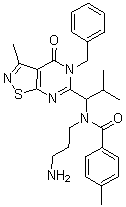
AZD4877 (AZD-4877; AZD 4877) is a novel and potent kinesin spindle protein (KSP) inhibitor with potential anticancer activity. AZD4877 selectively inhibits microtubule motor protein KSP (kinesin-5 or Eg5), which may lead to the inhibition of mitotic spindle assembly.
Physicochemical Properties
| Molecular Formula | C28H33N5O2S |
| Molecular Weight | 503.658924818039 |
| Exact Mass | 503.235 |
| CAS # | 1176760-49-8 |
| PubChem CID | 10368812 |
| Appearance | Off-white to light yellow solid powder |
| Density | 1.3±0.1 g/cm3 |
| Boiling Point | 663.3±65.0 °C at 760 mmHg |
| Flash Point | 354.9±34.3 °C |
| Vapour Pressure | 0.0±2.0 mmHg at 25°C |
| Index of Refraction | 1.647 |
| LogP | 3.66 |
| Hydrogen Bond Donor Count | 1 |
| Hydrogen Bond Acceptor Count | 6 |
| Rotatable Bond Count | 9 |
| Heavy Atom Count | 36 |
| Complexity | 791 |
| Defined Atom Stereocenter Count | 0 |
| InChi Key | SMFXSYMLJDHGIE-UHFFFAOYSA-N |
| InChi Code | InChI=1S/C28H33N5O2S/c1-18(2)24(32(16-8-15-29)27(34)22-13-11-19(3)12-14-22)25-30-26-23(20(4)31-36-26)28(35)33(25)17-21-9-6-5-7-10-21/h5-7,9-14,18,24H,8,15-17,29H2,1-4H3 |
| Chemical Name | N-(3-aminopropyl)-N-[1-(5-benzyl-3-methyl-4-oxo-[1,2]thiazolo[5,4-d]pyrimidin-6-yl)-2-methylpropyl]-4-methylbenzamide |
| HS Tariff Code | 2934.99.9001 |
| Storage |
Powder-20°C 3 years 4°C 2 years In solvent -80°C 6 months -20°C 1 month |
| Shipping Condition | Room temperature (This product is stable at ambient temperature for a few days during ordinary shipping and time spent in Customs) |
Biological Activity
| ln Vitro | In human bladder cancer cells, AZD4877 (10 nM, 24 or 48 hours) causes apoptosis, and AZD4877-sensitive cells typically display high amounts of p63[2]. |
| ln Vivo | In the rat hollow fiber model, AZD4877 (intravenous injection, 6 or 12 mg/kg; single dosage) dramatically decreased rat cell survival and elevated cleaved caspase3 levels 48 hours after delivery [1]. In Hans Wistar rats, AZD4877 (iv, 6 mg/kg; single dose) has a half-life of 3.5 hours and a plasma clearance of 36 mL/min/kg [1]. |
| Cell Assay |
Apoptosis Analysis[2] Cell Types: UC1, UC3, UC6, UC12, UC15, RT4,JB,BV, T24 cell line Tested Concentrations: 10 nM Incubation Duration: 24 or 48 hrs (hours) Experimental Results: Induced apoptosis in human bladder cancer cells |
| Animal Protocol |
Animal/Disease Models: Rat hollow fiber model[1] Doses: 6 mg/kg, 12 mg/kg Route of Administration: intravenous (iv) injection Experimental Results: Arrested cells in mitosis and induction of cellular death. Had a statistically significant reduction in cell viability and increase in cleaved caspase 3 levels was seen by 48 h post dose. Increased numbers of monoasters were observed at both time points after treatment. Increased the number of phospho-histone-H3 (PHH3) positive cells was Dramatically increased at 24 h. Animal/Disease Models: Hans Wistar rats (pharmacokinetic/PK assay)[1] Doses: 6 mg/kg Route of Administration: intravenous (iv) injection Experimental Results: pharmacokinetic/PK parameters for AZD4877 (Compound 1) in Hans Wistar rats[1] |
| References |
[1]. Theoclitou ME, et.al. Discovery of (+)-N-(3-aminopropyl)-N-[1-(5-benzyl-3-methyl-4-oxo-[1,2]thiazolo[5,4-d]pyrimidin-6-yl)-2-methylpropyl]-4-methylbenzamide (AZD4877), a kinesin spindle protein inhibitor and potential anticancer agent. J Med Chem. 2011 Oct 13;54(19):6734-50. [2]. Marquis L, et.al. p63 expression correlates with sensitivity to the Eg5 inhibitor ZD4877 in bladder cancer cells. Cancer Biol Ther. 2012 May;13(7):477-86. [3]. Gerecitano JF, et.al. A Phase I trial of the kinesin spindle protein (Eg5) inhibitor AZD4877 in patients with solid and lymphoid malignancies. Invest New Drugs. 2013 Apr;31(2):355-62. [4]. Shahin R, et.al. Kinesin spindle protein inhibitors in cancer: from high throughput screening to novel therapeutic strategies. Future Sci OA. 2022 Feb 21;8(3):FSO778. [5]. Myers SM, et.al. Recent findings and future directions for interpolar mitotic kinesin inhibitors in cancer therapy. Future Med Chem. 2016;8(4):463-89. |
| Additional Infomation |
AZD4877 has been used in trials studying the treatment of NHL, Tumors, Cancer, Lymphoma, and Neoplasms, among others. KSP Inhibitor AZD4877 is a synthetic kinesin spindle protein (KSP) inhibitor with potential antineoplastic activity. AZD4877 selectively inhibits microtubule motor protein KSP (also called kinesin-5 or Eg5), which is essential for the formation of bipolar spindles and the proper segregation of sister chromatids during mitosis. Inhibition of KSP results in an inhibition of mitotic spindle assembly, activation of the spindle assembly checkpoint, induction of cell cycle arrest during the mitotic phase, thereby causing cell death in tumor cells that are actively dividing. Because KSP is not involved in postmitotic processes, such as neuronal transport, AZD4877 may be less likely to cause the peripheral neuropathy often associated with the tubulin-targeting agents. |
Solubility Data
| Solubility (In Vitro) | May dissolve in DMSO (in most cases), if not, try other solvents such as H2O, Ethanol, or DMF with a minute amount of products to avoid loss of samples |
| Solubility (In Vivo) |
Note: Listed below are some common formulations that may be used to formulate products with low water solubility (e.g. < 1 mg/mL), you may test these formulations using a minute amount of products to avoid loss of samples. Injection Formulations (e.g. IP/IV/IM/SC) Injection Formulation 1: DMSO : Tween 80: Saline = 10 : 5 : 85 (i.e. 100 μL DMSO stock solution → 50 μL Tween 80 → 850 μL Saline) *Preparation of saline: Dissolve 0.9 g of sodium chloride in 100 mL ddH ₂ O to obtain a clear solution. Injection Formulation 2: DMSO : PEG300 :Tween 80 : Saline = 10 : 40 : 5 : 45 (i.e. 100 μL DMSO → 400 μLPEG300 → 50 μL Tween 80 → 450 μL Saline) Injection Formulation 3: DMSO : Corn oil = 10 : 90 (i.e. 100 μL DMSO → 900 μL Corn oil) Example: Take the Injection Formulation 3 (DMSO : Corn oil = 10 : 90) as an example, if 1 mL of 2.5 mg/mL working solution is to be prepared, you can take 100 μL 25 mg/mL DMSO stock solution and add to 900 μL corn oil, mix well to obtain a clear or suspension solution (2.5 mg/mL, ready for use in animals). Injection Formulation 4: DMSO : 20% SBE-β-CD in saline = 10 : 90 [i.e. 100 μL DMSO → 900 μL (20% SBE-β-CD in saline)] *Preparation of 20% SBE-β-CD in Saline (4°C,1 week): Dissolve 2 g SBE-β-CD in 10 mL saline to obtain a clear solution. Injection Formulation 5: 2-Hydroxypropyl-β-cyclodextrin : Saline = 50 : 50 (i.e. 500 μL 2-Hydroxypropyl-β-cyclodextrin → 500 μL Saline) Injection Formulation 6: DMSO : PEG300 : castor oil : Saline = 5 : 10 : 20 : 65 (i.e. 50 μL DMSO → 100 μLPEG300 → 200 μL castor oil → 650 μL Saline) Injection Formulation 7: Ethanol : Cremophor : Saline = 10: 10 : 80 (i.e. 100 μL Ethanol → 100 μL Cremophor → 800 μL Saline) Injection Formulation 8: Dissolve in Cremophor/Ethanol (50 : 50), then diluted by Saline Injection Formulation 9: EtOH : Corn oil = 10 : 90 (i.e. 100 μL EtOH → 900 μL Corn oil) Injection Formulation 10: EtOH : PEG300:Tween 80 : Saline = 10 : 40 : 5 : 45 (i.e. 100 μL EtOH → 400 μLPEG300 → 50 μL Tween 80 → 450 μL Saline) Oral Formulations Oral Formulation 1: Suspend in 0.5% CMC Na (carboxymethylcellulose sodium) Oral Formulation 2: Suspend in 0.5% Carboxymethyl cellulose Example: Take the Oral Formulation 1 (Suspend in 0.5% CMC Na) as an example, if 100 mL of 2.5 mg/mL working solution is to be prepared, you can first prepare 0.5% CMC Na solution by measuring 0.5 g CMC Na and dissolve it in 100 mL ddH2O to obtain a clear solution; then add 250 mg of the product to 100 mL 0.5% CMC Na solution, to make the suspension solution (2.5 mg/mL, ready for use in animals). Oral Formulation 3: Dissolved in PEG400 Oral Formulation 4: Suspend in 0.2% Carboxymethyl cellulose Oral Formulation 5: Dissolve in 0.25% Tween 80 and 0.5% Carboxymethyl cellulose Oral Formulation 6: Mixing with food powders Note: Please be aware that the above formulations are for reference only. InvivoChem strongly recommends customers to read literature methods/protocols carefully before determining which formulation you should use for in vivo studies, as different compounds have different solubility properties and have to be formulated differently. (Please use freshly prepared in vivo formulations for optimal results.) |
| Preparing Stock Solutions | 1 mg | 5 mg | 10 mg | |
| 1 mM | 1.9855 mL | 9.9273 mL | 19.8547 mL | |
| 5 mM | 0.3971 mL | 1.9855 mL | 3.9709 mL | |
| 10 mM | 0.1985 mL | 0.9927 mL | 1.9855 mL |