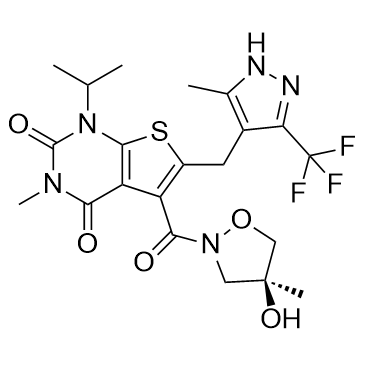
AZD3965 is a novel, potent and selective MCT1 (monocarboxylate transporter 1) inhibitor with a Ki of 1.6 nM, it showed 6-fold selectivity over MCT2. Inhibition of the monocarboxylate transporter MCT1 by AZD3965 results in an increase in glycolysis in human tumor cell lines and xenografts. This is indicated by changes in the levels of specific glycolytic metabolites and in changes in glycolytic enzyme kinetics. These drug-induced metabolic changes translate into an inhibition of tumor growth in vivo. The combination of AZD3965 with fractionated radiation to treat small cell lung cancer (SCLC) xenografts provided a significantly greater therapeutic effect than the use of either modality alone. These results strongly support the notion of combining MCT1 inhibition with radiotherapy in the treatment of SCLC and other solid tumors.
Physicochemical Properties
| Molecular Formula | C21H24F3N5O5S |
| Molecular Weight | 515.5060 |
| Exact Mass | 515.145 |
| CAS # | 1448671-31-5 |
| Related CAS # | 1448671-31-5; 733809-45-5; |
| PubChem CID | 10369242 |
| Appearance | White to off-white solid powder |
| Density | 1.5±0.1 g/cm3 |
| Boiling Point | 723.1±70.0 °C at 760 mmHg |
| Flash Point | 391.1±35.7 °C |
| Vapour Pressure | 0.0±2.5 mmHg at 25°C |
| Index of Refraction | 1.597 |
| LogP | 1.45 |
| Hydrogen Bond Donor Count | 2 |
| Hydrogen Bond Acceptor Count | 10 |
| Rotatable Bond Count | 4 |
| Heavy Atom Count | 35 |
| Complexity | 894 |
| Defined Atom Stereocenter Count | 1 |
| SMILES | CC1=C(C(=NN1)C(F)(F)F)CC2=C(C3=C(S2)N(C(=O)N(C3=O)C)C(C)C)C(=O)N4C[C@](CO4)(C)O |
| InChi Key | PRNXOFBDXNTIFG-FQEVSTJZSA-N |
| InChi Code | InChI=1S/C21H24F3N5O5S/c1-9(2)29-18-14(16(30)27(5)19(29)32)13(17(31)28-7-20(4,33)8-34-28)12(35-18)6-11-10(3)25-26-15(11)21(22,23)24/h9,33H,6-8H2,1-5H3,(H,25,26)/t20-/m0/s1 |
| Chemical Name | (S)-5-(4-hydroxy-4-methylisoxazolidine-2-carbonyl)-1-isopropyl-3-methyl-6-((3-methyl-5-(trifluoromethyl)-1H-pyrazol-4-yl)methyl)thieno[2,3-d]pyrimidine-2,4(1H,3H)-dione |
| Synonyms | AZD3965; AZD-3965; AZD 3965 |
| HS Tariff Code | 2934.99.9001 |
| Storage |
Powder-20°C 3 years 4°C 2 years In solvent -80°C 6 months -20°C 1 month |
| Shipping Condition | Room temperature (This product is stable at ambient temperature for a few days during ordinary shipping and time spent in Customs) |
Biological Activity
| Targets | The purpose of AZD3965 is to obstruct single-effector transporter-1 (MCT1), which is anticipated to impact cell entry and exit [1]. The administration of AZD3965 led to an increase in internal repletion of 3.7 times in hypoxic COR-L103 cells and 3.9 times in normoxic and hypoxic NCI-H1048 cells, respectively. A <1.9-fold rise was noted in all other cases. These results are in line with the theory that AZD3965 both decreases the number of cells and blocks leaky movement in cells. The EC50 of NCI-H1048 rises from 0.14 nM to 10.5 nM in NCI-H1048 cells when MCT1 is overexpressed, which is consistent with AZD3965's inhibitory impact via MCT1 [2]. |
| ln Vitro |
The purpose of AZD3965 is to obstruct single-effector transporter-1 (MCT1), which is anticipated to impact cell entry and exit [1]. The administration of AZD3965 led to an increase in internal repletion of 3.7 times in hypoxic COR-L103 cells and 3.9 times in normoxic and hypoxic NCI-H1048 cells, respectively. A <1.9-fold rise was noted in all other cases. These results are in line with the theory that AZD3965 both decreases the number of cells and blocks leaky movement in cells. The EC50 of NCI-H1048 rises from 0.14 nM to 10.5 nM in NCI-H1048 cells when MCT1 is overexpressed, which is consistent with AZD3965's inhibitory impact via MCT1 [2]. AZD3965 (100 nM) inhibited bidirectional lactate transport. Treatment for 24 hours increased intracellular lactate levels and decreased extracellular lactate levels (or showed a trend of decrease) in H526 (SCLC), HGC27 (gastric), and DMS114 (SCLC) cells under normoxic, hypoxic, and anoxic conditions. [1] AZD3965 significantly reduced lactate uptake (measured using 14C-lactate) in H526, HGC27, and DMS114 cells when applied 24 hours, 4 hours, or acutely (concurrently) before the assay. This inhibition persisted even in the presence of the hypoxia mimetic cobalt chloride. [1] Metabolomic analysis (LC-MS) of H526 cells treated with AZD3965 (10 nM or 1 µM for 6 or 24 hours) showed dose-dependent increases in early glycolytic intermediates (e.g., glucose-6-phosphate, fructose-1-phosphate) and decreases in late intermediates (e.g., pyruvate), indicating an increased glycolytic rate. Greater metabolic changes were observed under hypoxic conditions and with shorter (6h) treatment. [1] Enzyme kinetic analysis revealed that 24-hour treatment with 100 nM AZD3965 increased the Vmax of hexokinase and pyruvate kinase in H526 cells, suggesting upregulation of these glycolytic enzymes. [1] Treatment with 1 µM AZD3965 under normoxia caused a statistically significant 30% reduction in cellular ATP levels in H526 cells. Under anoxia, AZD3965 treatment led to a further decrease in ATP, an increase in the oxidized glutathione (GSSG) ratio, and a 50% increase in reactive oxygen species (ROS) production. [1] |
| ln Vivo |
Tumor volume was tracked while AZD3965 (100 mg/kg) or vehicle BID was administered for 21 days to COR-L103 tumor-bearing mutants. According to pharmacokinetic research, AZD3965 at a dose of 100 mg/kg produced free quantities of the drug that were expected to prevent exchange transit. Because AZD3965 only inhibits the hypoxic portion of the tumor, treatment with it considerably slowed the growth of COR-L103 tumors but did not cause any tumor regression [2]. In H526 small cell lung cancer (SCLC) xenograft models in CD-1 nude mice, oral administration of AZD3965 (100 mg/kg, twice daily for 7 days) significantly delayed tumor growth. The time for tumors to grow from 150 mm³ to 1000 mm³ increased from 8 days (vehicle) to 12 days (treated). One mouse in the treatment group showed complete tumor regression. [1] Tumors from mice treated with AZD3965 exhibited significantly higher intratumoral lactate concentrations compared to controls, confirming target engagement and inhibition of lactate efflux in vivo. This was not due to changes in angiogenesis, as vessel density (CD31 staining) remained unchanged. [1] Immunohistochemical analysis revealed a significant increase in MCT4 protein expression in tumors after AZD3965 treatment, suggesting a compensatory glycolytic adaptation. [1] Combining AZD3965 (same dosing schedule) with fractionated radiotherapy (3 fractions of 2 Gy on days 3-5 of drug treatment) in H526 xenografts resulted in a significantly greater antitumor effect than either treatment alone. The time to reach 1000 mm³ was 18 days for radiation alone and extended to 25 days for the combination. One mouse in the combination group was cured. [1] |
| Enzyme Assay |
Glycolytic enzyme kinetics were determined in cell lysates. Cells were treated, washed, and lysed in a specific buffer. Lysates were subjected to freeze-thaw cycles and centrifuged. Enzyme activities (e.g., hexokinase, pyruvate kinase) were measured in a pre-warmed microplate reader by monitoring the change in absorbance at 340 nm (NADH/NADPH production or depletion) upon addition of cell lysate to reaction buffers supplemented with specific substrates and co-factors. Initial reaction rates (V0) were calculated, plotted against substrate concentration, and Vmax and Km values were determined using analysis software. [1] |
| Cell Assay |
Lactate and glucose uptake assays: After treatment, cells were washed and incubated with an uptake cocktail containing buffer, 100 nM AZD3965 or vehicle, and either ³H-2-deoxyglucose or ¹⁴C-lactate for one hour at 37°C. The cocktail was removed, cells were washed and lysed, and radioactivity in the lysate was measured by scintillation counting. Uptake was normalized to protein concentration and the total radioactive metabolite added. [1] Intracellular and extracellular lactate measurement: Lactate concentration was determined using a colorimetric assay. For extracellular lactate, cell-free medium was analyzed. For intracellular lactate, cells were washed and lysed before assay. Values were compared to a standard curve. [1] ATP measurement: Cellular ATP levels were determined using a luminescent assay on cell lysates and compared to untreated controls. [1] GSH/GSSG measurement: Glutathione levels were determined in cell lysates using a luminescent assay. [1] Reactive Oxygen Species (ROS) assay: After treatment, cells were stained with a fluorescent ROS indicator, washed, and analyzed by flow cytometry. Mean fluorescence in the live cell population was compared to controls. [1] Metabolomics sample preparation: Cells were cultured in media with dialyzed serum. After treatment under defined oxygen conditions, metabolism was quenched by immediate addition of cold extraction solvent. Cells were scraped, proteins precipitated by centrifugation, and the supernatant analyzed by LC-MS. Data processing included peak integration, normalization, and statistical analysis. [1] |
| Animal Protocol |
Female CD-1 nude mice (8+ weeks old) were implanted subcutaneously in the mid-dorsal region with H526 small cell lung cancer cells (5 x 10⁷ cells/mL in 0.1 mL). [1] When tumor volumes reached approximately 150 mm³, mice were assigned to treatment groups. [1] AZD3965 was administered at 100 mg/kg, twice daily (BID), via oral gavage for a total of seven days. The compound was formulated for oral administration (specific vehicle not detailed in the provided text). [1] For combination studies with radiotherapy, the drug was administered for two days prior to radiation, concurrently with radiation (3 fractions of 2 Gy on days 3, 4, and 5), and for two days after the last radiation dose. Radiation was delivered locally to the tumor using an X-ray machine. [1] Tumor dimensions and body weight were monitored regularly. Mice were sacrificed at the end of treatment for tissue analysis or when tumors reached a volume of 1000 mm³. [1] |
| ADME/Pharmacokinetics |
AZD3965 has good oral bioavailability. [1] The selected in vivo dose (100 mg/kg BID) was based on being well-tolerated and maintaining MCT1 inhibition over a 7-day period. [1] |
| Toxicity/Toxicokinetics |
The dose of 100 mg/kg AZD3965 administered twice daily for 7 days was well-tolerated in mice, with no significant body weight loss or overt toxicity reported in the study. [1] |
| References |
[1]. Inhibition of monocarboxylate transporter-1 (MCT1) by AZD3965 enhances radiosensitivity by reducing lactate transport. Mol Cancer Ther. 2014 Dec;13(12):2805-16. [2]. Activity of the monocarboxylate transporter 1 inhibitor AZD3965 in small cell lung cancer. Clin Cancer Res. 2014 Feb 15;20(4):926-37. |
| Additional Infomation |
Monocarboxylate Transporter 1 Inhibitor AZD3965 is an orally available inhibitor of monocarboxylate transporter 1 (MCT1), with potential antineoplastic activity. Upon oral administration, MCT1 inhibitor AZD3965 binds to MCT1 and prevents the transport of lactate into and out of the cell. This leads to an accumulation of lactate, intracellular acidification, and eventually cancer cell death. MCT1, a protein overexpressed on tumor cells, is responsible for the transport of monocarboxylates across the cell membrane and plays a key role in cell metabolism. AZD3965 is a specific MCT1 inhibitor developed by AstraZeneca, distinct from the non-specific inhibitor α-cyano-4-hydroxycinnamate (CHC). [1] Its mechanism involves disrupting metabolic symbiosis within tumors by inhibiting lactate uptake into oxygenated tumor cells, forcing them to rely on glycolysis, thereby starving hypoxic cells of glucose and creating metabolic stress. [1] The drug-induced increase in glycolysis, oxidative stress (particularly under anoxia), and disruption of lactate shuttling are proposed mechanisms for its antitumor activity and radiosensitizing effects. [1] This study provides preclinical rationale for combining AZD3965 with radiotherapy in the treatment of solid tumors like SCLC. [1] |
Solubility Data
| Solubility (In Vitro) | DMSO : ~100 mg/mL (~193.98 mM) |
| Solubility (In Vivo) |
Solubility in Formulation 1: ≥ 2.08 mg/mL (4.03 mM) (saturation unknown) in 10% DMSO + 40% PEG300 + 5% Tween80 + 45% Saline (add these co-solvents sequentially from left to right, and one by one), clear solution. For example, if 1 mL of working solution is to be prepared, you can add 100 μL of 20.8 mg/mL clear DMSO stock solution to 400 μL PEG300 and mix evenly; then add 50 μL Tween-80 to the above solution and mix evenly; then add 450 μL normal saline to adjust the volume to 1 mL. Preparation of saline: Dissolve 0.9 g of sodium chloride in 100 mL ddH₂ O to obtain a clear solution. Solubility in Formulation 2: ≥ 2.08 mg/mL (4.03 mM) (saturation unknown) in 10% DMSO + 90% (20% SBE-β-CD in Saline) (add these co-solvents sequentially from left to right, and one by one), clear solution. For example, if 1 mL of working solution is to be prepared, you can add 100 μL of 20.8 mg/mL clear DMSO stock solution to 900 μL of 20% SBE-β-CD physiological saline solution and mix evenly. Preparation of 20% SBE-β-CD in Saline (4°C,1 week): Dissolve 2 g SBE-β-CD in 10 mL saline to obtain a clear solution. Solubility in Formulation 3: ≥ 2.08 mg/mL (4.03 mM) (saturation unknown) in 10% DMSO + 90% Corn Oil (add these co-solvents sequentially from left to right, and one by one), clear solution. For example, if 1 mL of working solution is to be prepared, you can add 100 μL of 20.8 mg/mL clear DMSO stock solution to 900 μL of corn oil and mix evenly. Solubility in Formulation 4: 5 mg/mL (9.70 mM) in 20% HP-β-CD in Saline (add these co-solvents sequentially from left to right, and one by one), suspension solution; with ultrasonication (<60°C). Preparation of saline: Dissolve 0.9 g of sodium chloride in 100 mL ddH₂ O to obtain a clear solution. Solubility in Formulation 5: 5 mg/mL (9.70 mM) in 0.5% HPMC 0.2%Tween80 (add these co-solvents sequentially from left to right, and one by one), suspension solution; with ultrasonication. (Please use freshly prepared in vivo formulations for optimal results.) |
| Preparing Stock Solutions | 1 mg | 5 mg | 10 mg | |
| 1 mM | 1.9398 mL | 9.6991 mL | 19.3983 mL | |
| 5 mM | 0.3880 mL | 1.9398 mL | 3.8797 mL | |
| 10 mM | 0.1940 mL | 0.9699 mL | 1.9398 mL |