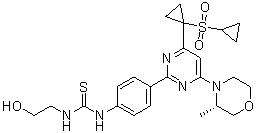
AZD3147 (AZD-3147) is an highly potent and selective dual inhibitor of mTORC1/2 with IC50 of 1.5 nM. It has favorable physicochemical and pharmacokinetic properties suitable for development as a potential clinical candidate. It was identified from a High throughput screening followed by a lead generation campaign which uncovered a novel series of urea containing morpholinopyrimidine compounds which act as potent and selective dual inhibitors of mTORC1 and mTORC2, with improved cellular potency, improved aqueous solubility, and good stability in human hepatocyte incubations.
Physicochemical Properties
| Molecular Formula | C24H31N5O4S2 |
| Molecular Weight | 517.664042711258 |
| Exact Mass | 517.181 |
| CAS # | 1101810-02-9 |
| PubChem CID | 25168990 |
| Appearance | Off-white to light yellow solid powder |
| Density | 1.5±0.1 g/cm3 |
| Boiling Point | 696.7±65.0 °C at 760 mmHg |
| Flash Point | 375.2±34.3 °C |
| Vapour Pressure | 0.0±2.3 mmHg at 25°C |
| Index of Refraction | 1.689 |
| LogP | -0.58 |
| Hydrogen Bond Donor Count | 3 |
| Hydrogen Bond Acceptor Count | 8 |
| Rotatable Bond Count | 8 |
| Heavy Atom Count | 35 |
| Complexity | 853 |
| Defined Atom Stereocenter Count | 1 |
| SMILES | C[C@H]1COCCN1C2=NC(=NC(=C2)C3(CC3)S(=O)(=O)C4CC4)C5=CC=C(C=C5)NC(=S)NCCO |
| InChi Key | JWGVUDPAMQEIJU-INIZCTEOSA-N |
| InChi Code | InChI=1S/C24H31N5O4S2/c1-16-15-33-13-11-29(16)21-14-20(24(8-9-24)35(31,32)19-6-7-19)27-22(28-21)17-2-4-18(5-3-17)26-23(34)25-10-12-30/h2-5,14,16,19,30H,6-13,15H2,1H3,(H2,25,26,34)/t16-/m0/s1 |
| Chemical Name | (S)-1-(4-(4-(1-(cyclopropylsulfonyl)cyclopropyl)-6-(3-methylmorpholino)pyrimidin-2-yl)phenyl)-3-(2-hydroxyethyl)thiourea |
| Synonyms | AZD-3147; AZD3147; AZD 3147. |
| HS Tariff Code | 2934.99.9001 |
| Storage |
Powder-20°C 3 years 4°C 2 years In solvent -80°C 6 months -20°C 1 month |
| Shipping Condition | Room temperature (This product is stable at ambient temperature for a few days during ordinary shipping and time spent in Customs) |
Biological Activity
| Targets |
AZD3147 is a dual inhibitor of mTOR complex 1 (mTORC1) and mTOR complex 2 (mTORC2). [2] |
| ln Vitro |
AZD3147 at doses over 1.5 nM (0-50 nM, 1 hour) attenuated the ciliary elongation mediated by fibroblast growth factor (FGF) in NIH3T3 cells [2]. Neuroblastoma cell lines Kelly and IMR-32 are inhibited by AZD3147, with IC50 values of 0.88 nM and 662.4 nM, respectively, [3]. Treatment of NIH3T3 cells with 250 nM AZD3147 for 1 hour prior to FGF2 stimulation partially rescued the FGF-mediated extension of primary cilia length. This effect was observed at a concentration higher than the reported IC50 of the inhibitor. [2] In IMCD3 cells stably expressing IFT20-GFP, treatment with AZD3147 was used to inhibit mTOR signaling, [2] |
| ln Vivo | AZD3147's pharmacokinetic parameters [1]. Cl (mL/min/kg) for mice and dogs 78 16 Vss (L/kg) 2.3 2.2 t1/2(h) 0.9 1.9 F% 61 73 |
| Cell Assay |
NIH3T3 cells were serum-starved and then treated with chemical inhibitors, including AZD3147, for 1 hour prior to the addition of FGF2 for 10 minutes. The activity of the inhibitors was confirmed by Western blot detection of phosphorylation states of target molecules in the respective inhibited pathways. [2] For cilia length analysis, NIH3T3 cells were treated with inhibitors, including AZD3147, and FGF2 for 12 hours. Cells were then fixed, immunostained for the ciliary membrane marker ARL13B, and ciliary length was measured in 3D. [2] |
| References |
[1]. Discovery of AZD3147: a potent, selective dual inhibitor of mTORC1 and mTORC2. J Med Chem. 2015 Mar 12;58(5):2326-49. [2]. Regulation of ciliary function by fibroblast growth factor signaling identifies FGFR3-related disorders achondroplasia and thanatophoric dysplasia as ciliopathies. Hum Mol Genet. 2018 Mar 15;27(6):1093-1105. [3]. Comparing mTOR inhibitor Rapamycin with Torin-2 within the RIST molecular-targeted regimen in neuroblastoma cells. Int J Med Sci. 2021 Jan 1;18(1):137-149. |
| Additional Infomation |
AZD3147 was used as a pharmacological tool to investigate the mechanism of FGF-mediated regulation of primary cilia length. Its ability to rescue FGF-mediated cilia extension at concentrations exceeding its reported IC50 suggests the potential involvement of off-target activities in the observed effect. [2] The study notes that in a model of sustained FGF signaling (ACH and TD chondrocytes), high-dose rapamycin (another mTOR inhibitor) rescued pathological cilia shortening. However, as the rapamycin concentration used exceeded its reported IC50, the exact role of mTOR signaling in FGF-mediated cilia regulation remains open for investigation. This context is provided in discussion of mTOR inhibition but does not directly report data on AZD3147. [2] |
Solubility Data
| Solubility (In Vitro) | May dissolve in DMSO (in most cases), if not, try other solvents such as H2O, Ethanol, or DMF with a minute amount of products to avoid loss of samples |
| Solubility (In Vivo) |
Note: Listed below are some common formulations that may be used to formulate products with low water solubility (e.g. < 1 mg/mL), you may test these formulations using a minute amount of products to avoid loss of samples. Injection Formulations (e.g. IP/IV/IM/SC) Injection Formulation 1: DMSO : Tween 80: Saline = 10 : 5 : 85 (i.e. 100 μL DMSO stock solution → 50 μL Tween 80 → 850 μL Saline) *Preparation of saline: Dissolve 0.9 g of sodium chloride in 100 mL ddH ₂ O to obtain a clear solution. Injection Formulation 2: DMSO : PEG300 :Tween 80 : Saline = 10 : 40 : 5 : 45 (i.e. 100 μL DMSO → 400 μLPEG300 → 50 μL Tween 80 → 450 μL Saline) Injection Formulation 3: DMSO : Corn oil = 10 : 90 (i.e. 100 μL DMSO → 900 μL Corn oil) Example: Take the Injection Formulation 3 (DMSO : Corn oil = 10 : 90) as an example, if 1 mL of 2.5 mg/mL working solution is to be prepared, you can take 100 μL 25 mg/mL DMSO stock solution and add to 900 μL corn oil, mix well to obtain a clear or suspension solution (2.5 mg/mL, ready for use in animals). Injection Formulation 4: DMSO : 20% SBE-β-CD in saline = 10 : 90 [i.e. 100 μL DMSO → 900 μL (20% SBE-β-CD in saline)] *Preparation of 20% SBE-β-CD in Saline (4°C,1 week): Dissolve 2 g SBE-β-CD in 10 mL saline to obtain a clear solution. Injection Formulation 5: 2-Hydroxypropyl-β-cyclodextrin : Saline = 50 : 50 (i.e. 500 μL 2-Hydroxypropyl-β-cyclodextrin → 500 μL Saline) Injection Formulation 6: DMSO : PEG300 : castor oil : Saline = 5 : 10 : 20 : 65 (i.e. 50 μL DMSO → 100 μLPEG300 → 200 μL castor oil → 650 μL Saline) Injection Formulation 7: Ethanol : Cremophor : Saline = 10: 10 : 80 (i.e. 100 μL Ethanol → 100 μL Cremophor → 800 μL Saline) Injection Formulation 8: Dissolve in Cremophor/Ethanol (50 : 50), then diluted by Saline Injection Formulation 9: EtOH : Corn oil = 10 : 90 (i.e. 100 μL EtOH → 900 μL Corn oil) Injection Formulation 10: EtOH : PEG300:Tween 80 : Saline = 10 : 40 : 5 : 45 (i.e. 100 μL EtOH → 400 μLPEG300 → 50 μL Tween 80 → 450 μL Saline) Oral Formulations Oral Formulation 1: Suspend in 0.5% CMC Na (carboxymethylcellulose sodium) Oral Formulation 2: Suspend in 0.5% Carboxymethyl cellulose Example: Take the Oral Formulation 1 (Suspend in 0.5% CMC Na) as an example, if 100 mL of 2.5 mg/mL working solution is to be prepared, you can first prepare 0.5% CMC Na solution by measuring 0.5 g CMC Na and dissolve it in 100 mL ddH2O to obtain a clear solution; then add 250 mg of the product to 100 mL 0.5% CMC Na solution, to make the suspension solution (2.5 mg/mL, ready for use in animals). Oral Formulation 3: Dissolved in PEG400 Oral Formulation 4: Suspend in 0.2% Carboxymethyl cellulose Oral Formulation 5: Dissolve in 0.25% Tween 80 and 0.5% Carboxymethyl cellulose Oral Formulation 6: Mixing with food powders Note: Please be aware that the above formulations are for reference only. InvivoChem strongly recommends customers to read literature methods/protocols carefully before determining which formulation you should use for in vivo studies, as different compounds have different solubility properties and have to be formulated differently. (Please use freshly prepared in vivo formulations for optimal results.) |
| Preparing Stock Solutions | 1 mg | 5 mg | 10 mg | |
| 1 mM | 1.9318 mL | 9.6588 mL | 19.3177 mL | |
| 5 mM | 0.3864 mL | 1.9318 mL | 3.8635 mL | |
| 10 mM | 0.1932 mL | 0.9659 mL | 1.9318 mL |