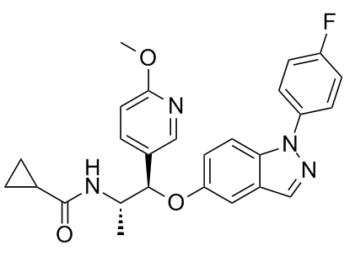
AZD2906 is a novel, potent and selective glucocorticoid receptor (GR) agonist which increases micronucleated immature erythrocytes in the bone marrow of rats. AZD2906 shows IC50s of 2.2, 0.3, 41.6 and 7.5 nM at GR in human, rat PBMC and human, rat whole blood, respectively. AZD2906 was found to increase the incidence of micronucleated immature erythrocytes (MIE) in the bone marrow of rats given two oral doses at the maximum tolerated level. Because GR agonists as a class are considered not to be genotoxic and AZD2906 showed no activity in the standard in vitro tests or in vivo in a rat liver comet assay, investigative studies were performed to compare AZD2906 with a reference traditional GR agonist, prednisolone. Emphasis was placed on blood and bone marrow parameters in these studies because GR activation has been reported to induce erythropoiesis which, in turn, is known to increase MIE in the bone marrow. Both compounds induced almost identical, small increases in micronucleus frequency at all doses tested. Directly comparable changes in haematological and bone marrow parameters were also seen with significant decreases in lymphoid cells in both compartments and significant increases in numbers of circulating neutrophils. Although no evidence of increased erythropoiesis was seen as increased immature erythrocyte numbers either in the blood or in the bone marrow, histopathological examination showed focal areas in the bone marrow where the erythroid population was enriched in association with an atrophic myeloid lineage. This could have been due to direct stimulation of the erythroid lineage or a secondary effect of myelosuppression inducing a rebound increase in erythropoiesis into the vacant haematopoietic cell compartment. It was concluded that the increased MIE frequencies induced by both AZD2906 and prednisolone are a consequence of their pharmacological effects on the bone marrow, either by directly inducing erythropoiesis or by some other unknown effect on cellular function, and do not indicate potential genotoxicity. This conclusion is supported by the lack of carcinogenic risk in man demonstrated by decades of clinical use of prednisolone and other GR agonists.
Physicochemical Properties
| Molecular Formula | C26H25FN4O3 |
| Molecular Weight | 460.500109434128 |
| Exact Mass | 460.191 |
| CAS # | 1034148-15-6 |
| Related CAS # | 1034148-15-6;1034149-96-6;1034148-16-7 (1S2R isomer); |
| PubChem CID | 25013811 |
| Appearance | Light yellow to yellow solid powder |
| LogP | 4.3 |
| Hydrogen Bond Donor Count | 1 |
| Hydrogen Bond Acceptor Count | 6 |
| Rotatable Bond Count | 8 |
| Heavy Atom Count | 34 |
| Complexity | 687 |
| Defined Atom Stereocenter Count | 2 |
| SMILES | FC1C=CC(=CC=1)N1C2C=CC(=CC=2C=N1)O[C@H](C1C=NC(=CC=1)OC)[C@H](C)NC(C1CC1)=O |
| InChi Key | YDRQCGICZKAGCQ-LMKMVOKYSA-N |
| InChi Code | InChI=1S/C26H25FN4O3/c1-16(30-26(32)17-3-4-17)25(18-5-12-24(33-2)28-14-18)34-22-10-11-23-19(13-22)15-29-31(23)21-8-6-20(27)7-9-21/h5-17,25H,3-4H2,1-2H3,(H,30,32)/t16-,25-/m0/s1 |
| Chemical Name | N-((1R,2S)-1-((1-(4-fluorophenyl)-1H-indazol-5-yl)oxy)-1-(6-methoxypyridin-3-yl)propan-2-yl)cyclopropanecarboxamide |
| Synonyms | AZD2906; AZD-2906; AZD 2906. |
| HS Tariff Code | 2934.99.9001 |
| Storage |
Powder-20°C 3 years 4°C 2 years In solvent -80°C 6 months -20°C 1 month |
| Shipping Condition | Room temperature (This product is stable at ambient temperature for a few days during ordinary shipping and time spent in Customs) |
Biological Activity
| ln Vitro | In human and rat PBMC and human and rat whole blood, AZD2906 is a selective glucocorticoid receptor (GR) with IC50 values of 2.2, 0.3, 41.6, and 7.5 nM, respectively [1]. |
| ln Vivo | After two days of therapy, AZD2906 (5, 25, 50 mg/kg, oral) can enhance the number of micronucleated immature erythrocytes (MIE) in rat bone marrow [1]. AZD2906 (5, 25 mg/kg, oral) causes moderate to severe cortical lymphocyte atrophy in the rat thymus and causes glycogen buildup in the livers of rats [1]. |
| Animal Protocol |
Animal/Disease Models: Male Wistar Han rat (10 weeks old) [1] Doses: 5, 25, 50 mg/kg Route of Administration: Orally for 2 days Experimental Results: All doses caused micronucleated immature erythrocytes (MIE) after analysis With the addition of standard 2000 IE. |
| References |
[1]. Micronucleus induction in the bone marrow of rats by pharmacological mechanisms. I: glucocorticoid receptor agonism. Mutagenesis. 2013 Mar;28(2):227-32. |
Solubility Data
| Solubility (In Vitro) | DMSO : ~125 mg/mL (~271.44 mM) |
| Solubility (In Vivo) |
Solubility in Formulation 1: ≥ 2.08 mg/mL (4.52 mM) (saturation unknown) in 10% DMSO + 40% PEG300 + 5% Tween80 + 45% Saline (add these co-solvents sequentially from left to right, and one by one), clear solution. For example, if 1 mL of working solution is to be prepared, you can add 100 μL of 20.8 mg/mL clear DMSO stock solution to 400 μL PEG300 and mix evenly; then add 50 μL Tween-80 to the above solution and mix evenly; then add 450 μL normal saline to adjust the volume to 1 mL. Preparation of saline: Dissolve 0.9 g of sodium chloride in 100 mL ddH₂ O to obtain a clear solution. Solubility in Formulation 2: ≥ 2.08 mg/mL (4.52 mM) (saturation unknown) in 10% DMSO + 90% (20% SBE-β-CD in Saline) (add these co-solvents sequentially from left to right, and one by one), clear solution. For example, if 1 mL of working solution is to be prepared, you can add 100 μL of 20.8 mg/mL clear DMSO stock solution to 900 μL of 20% SBE-β-CD physiological saline solution and mix evenly. Preparation of 20% SBE-β-CD in Saline (4°C,1 week): Dissolve 2 g SBE-β-CD in 10 mL saline to obtain a clear solution. Solubility in Formulation 3: ≥ 2.08 mg/mL (4.52 mM) (saturation unknown) in 10% DMSO + 90% Corn Oil (add these co-solvents sequentially from left to right, and one by one), clear solution. For example, if 1 mL of working solution is to be prepared, you can add 100 μL of 20.8 mg/mL clear DMSO stock solution to 900 μL of corn oil and mix evenly. (Please use freshly prepared in vivo formulations for optimal results.) |
| Preparing Stock Solutions | 1 mg | 5 mg | 10 mg | |
| 1 mM | 2.1716 mL | 10.8578 mL | 21.7155 mL | |
| 5 mM | 0.4343 mL | 2.1716 mL | 4.3431 mL | |
| 10 mM | 0.2172 mL | 1.0858 mL | 2.1716 mL |