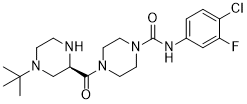
AZD2423 (AZD-2423) is a novel and potent negative allosteric modulator of CCR2 with the potential to be used in posttraumatic neuralgia. AZD2423 inhibited CCR2 Ca2+ flux with an IC50 of 1.2 nM. AZD2423 is an orally bioavailable non-competitive, negative allosteric modulator of the CCR2 chemokine receptor. CCR2 is a receptor for monocyte chemoattractant protein MCP-1 (CCL2) and the closely related proteins MCP-2 (CCL8), MCP-3 (CCL7), and MCP-4 (CCL13). Human CCR2 exists as two forms, CCR2a and CCR2b, which differ at their C-termini by alternative splicing. Evidence obtained from studies on leukocytes suggests that MCP-1 binds preferentially to CCR2 and mediates monocyte chemotaxis. Studies have implicated MCP-1-mediated monocyte infiltration in pain and a range of inflammatory diseases. AZD2423 has been developed for the oral treatment of neuropathic pain and chronic obstructive pulmonary disease (COPD). In pre-clinical studies, AZD2423 inhibited MCP-1 induced calcium mobilization and chemotaxis of THP-1 cell line with an IC50 of 4 nM. The AZD2423 affinity for CCR2 in human whole blood, measuring MCP-1 induced L-selectin shedding from monocytes, was the same. AZD2423 is highly selective (> 500-fold) for CCR2. AZD2423 demonstrated robust analgesia in two rodent models of neuropathic pain and a pain model of joint destruction against heat, mechanical and weight-bearing endpoints. A significant (> 500-fold) drop-off in potency was observed for several pre-clinical species (rat, mouse, dog, marmoset). Consequently several tool compounds have been used for most in vivo pharmacology studies; a tool CCR2 antagonist inhibited neuronal excitability in rat neuropathic models to heat, mechanical and electrical stimuli either via systemic administration or via administration directly to the spinal cord.
Physicochemical Properties
| Molecular Formula | C20H29CLFN5O2 |
| Molecular Weight | 425.927966833115 |
| Exact Mass | 425.199 |
| CAS # | 1229603-37-5 |
| PubChem CID | 46213922 |
| Appearance | Off-white to light yellow solid powder |
| LogP | 1.5 |
| Hydrogen Bond Donor Count | 2 |
| Hydrogen Bond Acceptor Count | 5 |
| Rotatable Bond Count | 3 |
| Heavy Atom Count | 29 |
| Complexity | 594 |
| Defined Atom Stereocenter Count | 1 |
| SMILES | ClC1C=CC(=CC=1F)NC(N1CCN(CC1)C([C@H]1CN(CCN1)C(C)(C)C)=O)=O |
| InChi Key | SRWQVWAIVQXPJY-QGZVFWFLSA-N |
| InChi Code | InChI=1S/C20H29ClFN5O2/c1-20(2,3)27-7-6-23-17(13-27)18(28)25-8-10-26(11-9-25)19(29)24-14-4-5-15(21)16(22)12-14/h4-5,12,17,23H,6-11,13H2,1-3H3,(H,24,29)/t17-/m1/s1 |
| Chemical Name | 4-[(2R)-4-tert-butylpiperazine-2-carbonyl]-N-(4-chloro-3-fluorophenyl)piperazine-1-carboxamide |
| Synonyms | AZD-2423 AZD2423 AZD 2423 |
| HS Tariff Code | 2934.99.9001 |
| Storage |
Powder-20°C 3 years 4°C 2 years In solvent -80°C 6 months -20°C 1 month |
| Shipping Condition | Room temperature (This product is stable at ambient temperature for a few days during ordinary shipping and time spent in Customs) |
Biological Activity
| ln Vitro | With an IC50 of 4 nM, AZD2423 inhibits the THP-1 cell line's MCP-1-induced calcium mobilization and chemotaxis[1]. |
| References |
[1]. AZD2423. [2]. John G. Cumming. CCR2 antagonists for the treatment of neuropathic pain: The discovery and development of AZD2423. [3]. A randomized, double-blind, placebo-controlled trial of a chemokine receptor 2 (CCR2) antagonist in posttraumatic neuralgia. Pain. 2013 May;154(5):761-7. |
Solubility Data
| Solubility (In Vitro) | DMSO : ~100 mg/mL (~234.78 mM) |
| Solubility (In Vivo) |
Solubility in Formulation 1: ≥ 2.5 mg/mL (5.87 mM) (saturation unknown) in 10% DMSO + 40% PEG300 + 5% Tween80 + 45% Saline (add these co-solvents sequentially from left to right, and one by one), clear solution. For example, if 1 mL of working solution is to be prepared, you can add 100 μL of 25.0 mg/mL clear DMSO stock solution to 400 μL PEG300 and mix evenly; then add 50 μL Tween-80 to the above solution and mix evenly; then add 450 μL normal saline to adjust the volume to 1 mL. Preparation of saline: Dissolve 0.9 g of sodium chloride in 100 mL ddH₂ O to obtain a clear solution. Solubility in Formulation 2: ≥ 2.5 mg/mL (5.87 mM) (saturation unknown) in 10% DMSO + 90% (20% SBE-β-CD in Saline) (add these co-solvents sequentially from left to right, and one by one), clear solution. For example, if 1 mL of working solution is to be prepared, you can add 100 μL of 25.0 mg/mL clear DMSO stock solution to 900 μL of 20% SBE-β-CD physiological saline solution and mix evenly. Preparation of 20% SBE-β-CD in Saline (4°C,1 week): Dissolve 2 g SBE-β-CD in 10 mL saline to obtain a clear solution. Solubility in Formulation 3: ≥ 2.5 mg/mL (5.87 mM) (saturation unknown) in 10% DMSO + 90% Corn Oil (add these co-solvents sequentially from left to right, and one by one), clear solution. For example, if 1 mL of working solution is to be prepared, you can add 100 μL of 25.0 mg/mL clear DMSO stock solution to 900 μL of corn oil and mix evenly. (Please use freshly prepared in vivo formulations for optimal results.) |
| Preparing Stock Solutions | 1 mg | 5 mg | 10 mg | |
| 1 mM | 2.3478 mL | 11.7390 mL | 23.4780 mL | |
| 5 mM | 0.4696 mL | 2.3478 mL | 4.6956 mL | |
| 10 mM | 0.2348 mL | 1.1739 mL | 2.3478 mL |