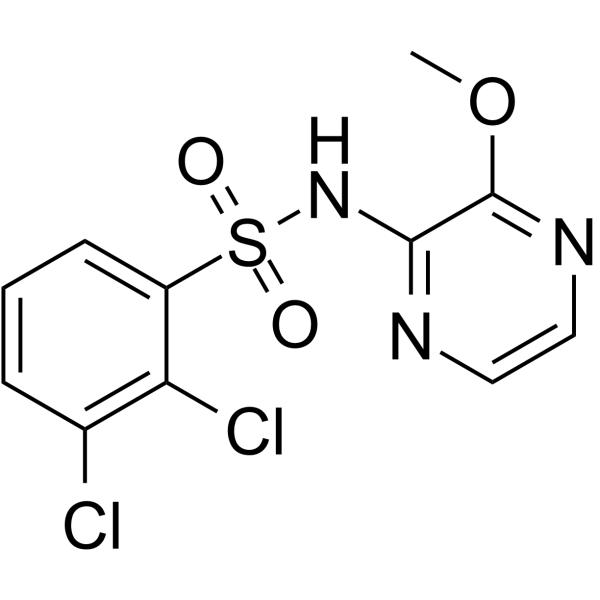
Physicochemical Properties
| Molecular Formula | C11H9CL2N3O3S |
| Molecular Weight | 334.18 |
| Exact Mass | 332.974 |
| CAS # | 566203-88-1 |
| PubChem CID | 10308720 |
| Appearance | White to off-white solid powder |
| Density | 1.6±0.1 g/cm3 |
| Boiling Point | 489.3±55.0 °C at 760 mmHg |
| Flash Point | 249.7±31.5 °C |
| Vapour Pressure | 0.0±1.2 mmHg at 25°C |
| Index of Refraction | 1.628 |
| LogP | 3.32 |
| Hydrogen Bond Donor Count | 1 |
| Hydrogen Bond Acceptor Count | 6 |
| Rotatable Bond Count | 4 |
| Heavy Atom Count | 20 |
| Complexity | 418 |
| Defined Atom Stereocenter Count | 0 |
| InChi Key | FLSMVCMSUNISFK-UHFFFAOYSA-N |
| InChi Code | InChI=1S/C11H9Cl2N3O3S/c1-19-11-10(14-5-6-15-11)16-20(17,18)8-4-2-3-7(12)9(8)13/h2-6H,1H3,(H,14,16) |
| Chemical Name | 2,3-dichloro-N-(3-methoxypyrazin-2-yl)benzenesulfonamide |
| HS Tariff Code | 2934.99.9001 |
| Storage |
Powder-20°C 3 years 4°C 2 years In solvent -80°C 6 months -20°C 1 month |
| Shipping Condition | Room temperature (This product is stable at ambient temperature for a few days during ordinary shipping and time spent in Customs) |
Biological Activity
| Targets | CCR4 |
| ln Vitro | With pIC50s of 7.5 and 6.3 against CCL22-induced Ca2+ influx in hCCR4-expressing CHO cells and CCL17- or CCL22-induced chemotaxis of primary human Th2 cells, respectively, AZD2098 potently suppresses chemokine-induced cellular responses[1]. |
| ln Vivo | Ovalbumin-sensitized rats treated with AZD2098 (73.5-5.0 μg/kg; po; BID; twice a day; 1 hour before and every 12 hours after antigen challenge) show effective suppression of antigen-induced inflammatory response, with alterations peaking at 7.5 µmol/kg following a dosage of 0.22 µmol/kg. |
| Animal Protocol |
Animal/Disease Models: Brown-Norway rats[1] Doses: 73.5 µg/kg, 250.6 µg/kg, 735.2 µg/kg, 1.0 mg/kg, 2.5 mg/kg, 5.0 mg/kg Route of Administration: Oral administration; twice a day; 1 hour before and every 12 hrs (hours) after antigen challenge Experimental Results: Exhibits efficacy against antigen-induced inflammatory response among ovalbumin-sensitized rats. |
| References |
[1]. Discovery of AZD-2098 and AZD-1678, Two Potent and Bioavailable CCR4 Receptor Antagonists. ACS Med Chem Lett. 2017 Sep 1;8(9):981-986. [2]. Asher Mullard. Cancer charity sees success re-prioritizing industry's shelved compounds. Nat Rev Drug Discov. 2014 May;13(5):319-21. |
Solubility Data
| Solubility (In Vitro) | DMSO: 100 mg/mL (299.24 mM) |
| Solubility (In Vivo) |
Solubility in Formulation 1: ≥ 2.5 mg/mL (7.48 mM) (saturation unknown) in 10% DMSO + 40% PEG300 + 5% Tween80 + 45% Saline (add these co-solvents sequentially from left to right, and one by one), clear solution. For example, if 1 mL of working solution is to be prepared, you can add 100 μL of 25.0 mg/mL clear DMSO stock solution to 400 μL PEG300 and mix evenly; then add 50 μL Tween-80 to the above solution and mix evenly; then add 450 μL normal saline to adjust the volume to 1 mL. Preparation of saline: Dissolve 0.9 g of sodium chloride in 100 mL ddH₂ O to obtain a clear solution. Solubility in Formulation 2: ≥ 2.5 mg/mL (7.48 mM) (saturation unknown) in 10% DMSO + 90% Corn Oil (add these co-solvents sequentially from left to right, and one by one), clear solution. For example, if 1 mL of working solution is to be prepared, you can add 100 μL of 25.0 mg/mL clear DMSO stock solution to 900 μL of corn oil and mix evenly. (Please use freshly prepared in vivo formulations for optimal results.) |
| Preparing Stock Solutions | 1 mg | 5 mg | 10 mg | |
| 1 mM | 2.9924 mL | 14.9620 mL | 29.9240 mL | |
| 5 mM | 0.5985 mL | 2.9924 mL | 5.9848 mL | |
| 10 mM | 0.2992 mL | 1.4962 mL | 2.9924 mL |