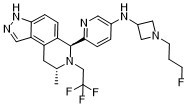
AZD-9833 is a novel, highly potent and orally bioavailable SERD (Selective Estrogen Receptor Degrader) and ER Antagonist. AZD-9833 is used for the study of ER+ HER2-advanced breast cancer. AZD-9833 was demonstrated to be a highly potent SERD that showed a pharmacological profile comparable to fulvestrant in its ability to degrade ERα in both MCF-7 and CAMA-1 cell lines. A stringent control of lipophilicity ensured that AZD-9833 had favorable physicochemical and preclinical pharmacokinetic properties for oral administration.
Physicochemical Properties
| Molecular Formula | C24H28F4N6 |
| Molecular Weight | 476.512938499451 |
| Exact Mass | 476.231 |
| CAS # | 2222844-89-3 |
| PubChem CID | 134453496 |
| Appearance | Off-white to light yellow solid powder |
| LogP | 4.2 |
| Hydrogen Bond Donor Count | 2 |
| Hydrogen Bond Acceptor Count | 9 |
| Rotatable Bond Count | 7 |
| Heavy Atom Count | 34 |
| Complexity | 674 |
| Defined Atom Stereocenter Count | 2 |
| SMILES | FC(CN1[C@H](C)CC2C3C=NNC=3C=CC=2[C@H]1C1C=CC(=CN=1)NC1CN(CCCF)C1)(F)F |
| InChi Key | WDHOIABIERMLGY-CMJOXMDJSA-N |
| InChi Code | InChI=1S/C24H28F4N6/c1-15-9-19-18(4-6-21-20(19)11-30-32-21)23(34(15)14-24(26,27)28)22-5-3-16(10-29-22)31-17-12-33(13-17)8-2-7-25/h3-6,10-11,15,17,23,31H,2,7-9,12-14H2,1H3,(H,30,32)/t15-,23+/m1/s1 |
| Chemical Name | N-(1-(3-fluoropropyl)azetidin-3-yl)-6-((6S,8R)-8-methyl-7-(2,2,2-trifluoroethyl)-6,7,8,9-tetrahydro-3H-pyrazolo[4,3-f]isoquinolin-6-yl)pyridin-3-amine |
| Synonyms | AZD9833 AZD-9833 AZD 9833 |
| HS Tariff Code | 2934.99.9001 |
| Storage |
Powder-20°C 3 years 4°C 2 years In solvent -80°C 6 months -20°C 1 month |
| Shipping Condition | Room temperature (This product is stable at ambient temperature for a few days during ordinary shipping and time spent in Customs) |
Biological Activity
| ln Vitro | The extract of camistrant is taken from US20180111931A1, Example 17[1]. |
| ln Vivo | In human parental MCF7 mice xenografts, camizestrant (oral; 0.2–50 mg/kg; 20 days) demonstrates dose-dependent antitumor effectiveness [1]. Tumor growth is reduced by camistrant (oral; 0.8–40 mg/kg; 30 days) in a dose-dependent manner. At doses more than 10 mg/kg, it virtually totally prevents tumor growth in mice [1]. |
| Animal Protocol |
Animal/Disease Models: Human ESR1 mutated breast cancer patient-derived female NSG mouse CTC174 cell xenograft [1] Doses: 0.8 mg/kg, 3 mg/kg, 10 mg/kg, 20 mg/kg, 40 mg/kg given Medication: Oral administration; 30 days; one time/day. Experimental Results: Inhibited tumor growth in a dose-dependent manner. |
| References |
[1]. Bernard Christophe Barlaam, etal. Chemical compounds. Patent US20180111931. |
| Additional Infomation | Camizestrant is an orally available selective estrogen receptor degrader (SERD), with potential antineoplastic activity. Upon administration, camizestrant binds to the estrogen receptor (ER) and induces a conformational change that results in the degradation of the receptor. This prevents ER-mediated signaling and inhibits the growth and survival of ER-expressing cancer cells. |
Solubility Data
| Solubility (In Vitro) | DMSO : ~100 mg/mL (~209.86 mM) |
| Solubility (In Vivo) |
Solubility in Formulation 1: ≥ 7.5 mg/mL (15.74 mM) (saturation unknown) in 10% DMSO + 40% PEG300 + 5% Tween80 + 45% Saline (add these co-solvents sequentially from left to right, and one by one), clear solution. For example, if 1 mL of working solution is to be prepared, you can add 100 μL of 75.0 mg/mL clear DMSO stock solution to 400 μL PEG300 and mix evenly; then add 50 μL Tween-80 to the above solution and mix evenly; then add 450 μL normal saline to adjust the volume to 1 mL. Preparation of saline: Dissolve 0.9 g of sodium chloride in 100 mL ddH₂ O to obtain a clear solution. Solubility in Formulation 2: 7.5 mg/mL (15.74 mM) in 10% DMSO + 90% (20% SBE-β-CD in Saline) (add these co-solvents sequentially from left to right, and one by one), suspension solution; with ultrasonication. For example, if 1 mL of working solution is to be prepared, you can add 100 μL of 75.0 mg/mL clear DMSO stock solution to 900 μL of 20% SBE-β-CD physiological saline solution and mix evenly. Preparation of 20% SBE-β-CD in Saline (4°C,1 week): Dissolve 2 g SBE-β-CD in 10 mL saline to obtain a clear solution. Solubility in Formulation 3: ≥ 7.5 mg/mL (15.74 mM) (saturation unknown) in 10% DMSO + 90% Corn Oil (add these co-solvents sequentially from left to right, and one by one), clear solution. For example, if 1 mL of working solution is to be prepared, you can add 100 μL of 75.0 mg/mL clear DMSO stock solution to 900 μL of corn oil and mix evenly. Solubility in Formulation 4: 2.5 mg/mL (5.25 mM) in 5% DMSO + 40% PEG300 + 5% Tween80 + 50% Saline (add these co-solvents sequentially from left to right, and one by one), suspension solution; with ultrasonication. Preparation of saline: Dissolve 0.9 g of sodium chloride in 100 mL ddH₂ O to obtain a clear solution. Solubility in Formulation 5: 2.5 mg/mL (5.25 mM) in 5% DMSO + 95% (20% SBE-β-CD in Saline) (add these co-solvents sequentially from left to right, and one by one), suspension solution; with ultrasonication.Preparation of 20% SBE-β-CD in Saline (4°C,1 week): Dissolve 2 g SBE-β-CD in 10 mL saline to obtain a clear solution. (Please use freshly prepared in vivo formulations for optimal results.) |
| Preparing Stock Solutions | 1 mg | 5 mg | 10 mg | |
| 1 mM | 2.0986 mL | 10.4930 mL | 20.9859 mL | |
| 5 mM | 0.4197 mL | 2.0986 mL | 4.1972 mL | |
| 10 mM | 0.2099 mL | 1.0493 mL | 2.0986 mL |