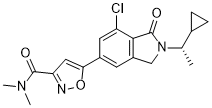
AZD-8418 is a novel and potent mGlu2 receptor PAM (positive allosteric modulators) that attenuates nicotine-taking and nicotine-seeking behavior.
Physicochemical Properties
| Exact Mass | 373.12 |
| Elemental Analysis | C, 61.05; H, 5.39; Cl, 9.48; N, 11.24; O, 12.84 |
| CAS # | 1198309-73-7 |
| Related CAS # | 1198309-73-7; |
| PubChem CID | 44556193 |
| Appearance | Solid powder |
| LogP | 2.7 |
| Hydrogen Bond Acceptor Count | 4 |
| Rotatable Bond Count | 4 |
| Heavy Atom Count | 26 |
| Complexity | 582 |
| Defined Atom Stereocenter Count | 1 |
| InChi Key | MCPBSUCAISQZQK-JTQLQIEISA-N |
| InChi Code | InChI=1S/C19H20ClN3O3/c1-10(11-4-5-11)23-9-13-6-12(7-14(20)17(13)19(23)25)16-8-15(21-26-16)18(24)22(2)3/h6-8,10-11H,4-5,9H2,1-3H3/t10-/m0/s1 |
| Chemical Name | 5-[7-chloro-2-[(1S)-1-cyclopropylethyl]-1-oxo-3H-isoindol-5-yl]-N,N-dimethyl-1,2-oxazole-3-carboxamide |
| Synonyms | AZD-8418, AZD8418; AZD-8418; AZD8418; 1198309-73-7; UNII-7U6B825568; 7U6B825568; Azd 8418; 5-(7-Chloro-2-((S)-1-cyclopropyl-ethyl)-1-oxo-2,3-dihydro-1H-isoindol-5-yl)-isoxazole-3-carboxylic acid dimethylamide; AZD 8418 [WHO-DD]; AZD 8418; |
| HS Tariff Code | 2934.99.9001 |
| Storage |
Powder-20°C 3 years 4°C 2 years In solvent -80°C 6 months -20°C 1 month |
| Shipping Condition | Room temperature (This product is stable at ambient temperature for a few days during ordinary shipping and time spent in Customs) |
Biological Activity
| Targets | mGlu2 receptor |
| ln Vitro |
In vitro electrophysiology tests [1] The mGlu2/3 receptor agonist DCG-IV induced inhibitory effects on fEPSPs in the pyramidal cells in the CA1 region of the hippocampus. The inhibitory effects of DCG-IV on synaptic transmission were potentiated by AZD8418 and AZD8529, with EC50 values of 0.86 and 1.4 μM, respectively (Fig. 2a). AZD8418 produced a greater maximal potentiation (79.9 ± 4.4) than AZD8529 (61.4 ± 4.3, p < 0.05). The mGlu2/3 receptor antagonist LY341495 (1 μM) effectively blocked the inhibition of fEPSPs that was induced by DCG-IV alone (10 nM) or the combination of DCG-IV with either AZD8529 (10 μM) or AZD8418 (10 μM; Fig. 2b). |
| ln Vivo | Acute treatment with AZD8418 (0.37, 1.12, 3.73, 7.46, and 14.92 mg/kg) and AZD8529 (1.75, 5.83, 17.5, and 58.3 mg/kg) deceased nicotine self-administration and had no effect on food-maintained responding. Chronic treatment with AZD8418 attenuated nicotine self-administration, but tolerance to this effect developed quickly. The inhibition of nicotine self-administration by chronic AZD8529 administration persisted throughout the 14 days of treatment. Chronic treatment with either PAMs inhibited food self-administration. AZD8418 (acute) and AZD8529 (acute and subchronic) blocked cue-induced reinstatement of nicotine- and food-seeking behavior. Conclusions: These findings indicate an important role for mGlu2 receptors in the reinforcing properties of self-administered nicotine and the motivational impact of cues that were previously associated with nicotine administration (i.e., cue-induced reinstatement of nicotine-seeking behavior). Thus, mGlu2 PAMs may be useful medications to assist people to quit tobacco smoking and prevent relapse [1]. |
| Cell Assay |
Slice recording [1] Slices were submerged in a slice chamber and bathed in 32 °C aCSF at a flow rate of 1–2 ml/min. The slices were held in place with a weight made of platinum wire. Schaeffer collateral fibers in the stratum radiatum were stimulated with a monopolar tungsten electrode (model 575300, 0.5–1 mΩ) connected to an isolated pulse stimulator (model 2100). Recordings of the extracellular population spike from pyramidal cells in layers of the CA1 were made with electrodes that were pulled from borosilicate glass (model TW150-4) and filled with 2 mM NaCl. The slices were stimulated with single 10 ms pulses that were delivered every 30 s. A baseline response was established (50–70 % of maximum), and then an approximately 15-min control period was recorded. Following the control period, the compounds were bath applied for 40 min or until a steady-state response was reached. |
| Animal Protocol |
Experimental design [1] Experiment 1: effects of acute AZD8418 and AZD8529 treatment on nicotine and food self-administration [1] After establishing stable nicotine or food self-administration (<20 % variability in responding over three consecutive days), the effects of acute AZD8418 (0, 0.37, 1.12, 3.73, 7.46, and 14.92 mg/kg) and AZD8529 (0, 1.75, 5.83, 17.5, and 58.3 mg/kg) treatment on nicotine and food self-administration were assessed using a within-subjects Latin square design. Four groups of naive rats were used to examine the effects of acute treatment with (i) AZD8418 on nicotine self-administration (n = 12) and food self-administration (n = 10) and (ii) AZD8529 on nicotine self-administration (n = 12) and food self-administration (n = 7). At least 5 days elapsed between drug administrations. Experiment 2: effects of chronic AZD8418 and AZD8529 treatment on nicotine and food self-administration [1] The effects of 14-day repeated AZD8418 and AZD8529 treatment regimens on nicotine and food self-administration were assessed using a between-subjects design. Four groups of naive rats were used to examine the effects of chronic treatment with (i) AZD8418 (0, 3.73, 7.46, and 14.92 mg/kg/day) on nicotine self-administration (n = 10–11/subgroup), (ii) AZD8418 (0 and 14.92 mg/kg/day) on food-self-administration (n = 10–11/subgroup), (iii) AZD8529 (0 and 58.3 mg/kg/day) on nicotine self-administration (n = 10–12/subgroup), and (iv) AZD8529 (0 and 58.3 mg/kg/day) on food self-administration (n = 8–13/subgroup). The subgroups for each tested compound were balanced for weight and nicotine/food intake before initiating the chronic treatments. Experiment 3: effects of acute AZD8418 and AZD8529 treatment on cue-induced reinstatement of nicotine- and food-seeking behavior [1] After completing experiment 1, nicotine self-administering rats were tested under extinction conditions. All of the rats reached the predetermined criterion of extinction (see above) by the end of the 10th extinction session. The first reinstatement session was conducted after vehicle administration to ensure that each subject exhibited robust reinstatement as defined above (>50 % increase in responding compared to the mean of the last three extinction sessions) before initiating the drug treatments. Only rats that exhibited robust nicotine-seeking behavior during this first reinstatement session were included in the remainder of the experiments. Each reinstatement session was preceded by three daily extinction sessions to re-extinguish responding. AZD8418 (0, 1.12, 3.73, 7.46, and 14.92 mg/kg) and AZD8529 (0, 1.75, 5.83, 17.5, and 58.3 mg/kg) were administered prior to each reinstatement session using a within-subjects Latin square design. Independent naive rats (n = 9–13/group) that were trained to self-administer food were used to assess the effects of AZD8418 (0, 3.73, 7.46, and 14.92 mg/kg) and AZD8529 (0, 1.75, 5.83, 17.5, and 58.3 mg/kg) on cue-induced reinstatement of food-seeking behavior using a between-subjects design because food-seeking behavior exhibits rapid extinction with repeated reinstatement testing (Bespalov et al. 2005). The groups were balanced for weight and food responding before treatment. Pharmacokinetic studies [1] AZD8529 (4.7 mg/kg) and AZD8418 (5 mg/kg) were administered orally by gavage to groups of male Wistar rats (n = 3–4), either as a single dose or as daily doses for 7 days. Tail vein blood samples (0.25 ml) were collected from all rats at 0.5, 1, 3, 6, 12, and 24 h after drug administration on day 1 or 7 of dosing. The plasma was prepared by centrifugation at 4 °C for 10 min at 1500×g within 30 min of blood sampling and analyzed for concentrations of AZD8529 or AZD8418 by a standard reverse-phase liquid chromatography and electrospray ionization tandem mass spectrometry (LC/MS/MS) method. AZD8418 was dissolved in 20 % (2-hydroxypropyl)-β-cyclodextrin and administered by oral gavage (p.o.) 1 h prior to testing. |
| ADME/Pharmacokinetics |
PK profiles of AZD8418 and AZD8529 [1] Peak plasma concentrations (T max) of AZD8418 were reached at 1 h post-administration after a single dose of 5 mg/kg. Peak plasma concentrations of AZD8529 were reached at 3 h post-administration after a single dose of 4.7 mg/kg. The peak plasma concentration (C max) for AZD8418 (690 ± 108 nM) was considerably higher than that for AZD8529 (158 ± 30 nM). Similarly, the area under the curve (AUC) for AZD8418 was also higher than that for AZD8529, indicating higher bioavailability of AZD8418 than that of AZD8529. Repeated daily administration of AZD8418 or AZD8529 for 7 days did not alter the T max or C max of plasma exposure. Based on findings of the PK studies, doses and pretreatment time were determined for AZD8418 (0, 0.37, 1.12, 3.73, 7.46, and 14.92 mg/kg; 1 h pretreatment) and AZD8529 (0, 1.75, 5.83, 17.5, and 58.3 mg/kg; 3 h pretreatment) administration to reflect differences in C max and T max. |
| References |
[1]. Attenuation of nicotine-taking and nicotine-seeking behavior by the mGlu2 receptor positive allosteric modulators AZD8418 and AZD8529 in rats. Psychopharmacology (Berl). 2016 May;233(10):1801-14. |
| Additional Infomation |
Azd8418 is under investigation in clinical trial NCT01027234 (This Study Will Assess the Safety and Tolerability of AZD8418 After Single Increasing Oral Doses).
AZD-8418 is a small molecule drug with a maximum clinical trial phase of I.
Rationale: Numerous medication development strategies seek to decrease nicotine consumption and prevent relapse to tobacco smoking by blocking glutamate transmission. Decreasing glutamate release by activating presynaptic inhibitory metabotropic glutamate (mGlu)2/3 receptors inhibits the reinforcing effects of nicotine and blocks cue-induced reinstatement of nicotine-seeking behavior in rats. However, the relative contribution of mGlu2 receptors in nicotine dependence is still unknown. Objectives: The present study evaluated the role of mGlu2 receptors in nicotine-taking and nicotine-seeking behavior using the novel, relatively selective mGlu2 positive allosteric modulators (PAMs) AZD8418 and AZD8529. [1] Acute administration of the novel selective mGlu2 receptor PAMs AZD8418 and AZD8529 decreased nicotine but not food self-administration. Chronic administration of these two compounds decreased nicotine taking and food taking, although the patterns of results were different for the two compounds. Specifically, chronic treatment with AZD8418 attenuated nicotine and food self-administration but tolerance to its effect on nicotine developed quickly. Chronic AZD8529 administration resulted in a larger effect on nicotine self-administration, compared to the effect on food self-administration, and this large effect persisted throughout the 14 days of drug treatment without tolerance. Furthermore, acute AZD8418 and AZD8529 treatment attenuated cue-induced reinstatement of nicotine- and food-seeking behavior. Similarly, subchronic administration of AZD8529 also decreased cue-induced reinstatement of nicotine and food seeking although the effects were more pronounced for the reinstatement of nicotine seeking than for the reinstatement of food seeking. Altogether, these results indicate that mGlu2 receptors play an important role in the reinforcing properties of nicotine and cue-induced reinstatement of nicotine seeking. [1] |
Solubility Data
| Solubility (In Vitro) | May dissolve in DMSO (in most cases), if not, try other solvents such as H2O, Ethanol, or DMF with a minute amount of products to avoid loss of samples |
| Solubility (In Vivo) |
Note: Listed below are some common formulations that may be used to formulate products with low water solubility (e.g. < 1 mg/mL), you may test these formulations using a minute amount of products to avoid loss of samples. Injection Formulations (e.g. IP/IV/IM/SC) Injection Formulation 1: DMSO : Tween 80: Saline = 10 : 5 : 85 (i.e. 100 μL DMSO stock solution → 50 μL Tween 80 → 850 μL Saline) *Preparation of saline: Dissolve 0.9 g of sodium chloride in 100 mL ddH ₂ O to obtain a clear solution. Injection Formulation 2: DMSO : PEG300 :Tween 80 : Saline = 10 : 40 : 5 : 45 (i.e. 100 μL DMSO → 400 μLPEG300 → 50 μL Tween 80 → 450 μL Saline) Injection Formulation 3: DMSO : Corn oil = 10 : 90 (i.e. 100 μL DMSO → 900 μL Corn oil) Example: Take the Injection Formulation 3 (DMSO : Corn oil = 10 : 90) as an example, if 1 mL of 2.5 mg/mL working solution is to be prepared, you can take 100 μL 25 mg/mL DMSO stock solution and add to 900 μL corn oil, mix well to obtain a clear or suspension solution (2.5 mg/mL, ready for use in animals). Injection Formulation 4: DMSO : 20% SBE-β-CD in saline = 10 : 90 [i.e. 100 μL DMSO → 900 μL (20% SBE-β-CD in saline)] *Preparation of 20% SBE-β-CD in Saline (4°C,1 week): Dissolve 2 g SBE-β-CD in 10 mL saline to obtain a clear solution. Injection Formulation 5: 2-Hydroxypropyl-β-cyclodextrin : Saline = 50 : 50 (i.e. 500 μL 2-Hydroxypropyl-β-cyclodextrin → 500 μL Saline) Injection Formulation 6: DMSO : PEG300 : castor oil : Saline = 5 : 10 : 20 : 65 (i.e. 50 μL DMSO → 100 μLPEG300 → 200 μL castor oil → 650 μL Saline) Injection Formulation 7: Ethanol : Cremophor : Saline = 10: 10 : 80 (i.e. 100 μL Ethanol → 100 μL Cremophor → 800 μL Saline) Injection Formulation 8: Dissolve in Cremophor/Ethanol (50 : 50), then diluted by Saline Injection Formulation 9: EtOH : Corn oil = 10 : 90 (i.e. 100 μL EtOH → 900 μL Corn oil) Injection Formulation 10: EtOH : PEG300:Tween 80 : Saline = 10 : 40 : 5 : 45 (i.e. 100 μL EtOH → 400 μLPEG300 → 50 μL Tween 80 → 450 μL Saline) Oral Formulations Oral Formulation 1: Suspend in 0.5% CMC Na (carboxymethylcellulose sodium) Oral Formulation 2: Suspend in 0.5% Carboxymethyl cellulose Example: Take the Oral Formulation 1 (Suspend in 0.5% CMC Na) as an example, if 100 mL of 2.5 mg/mL working solution is to be prepared, you can first prepare 0.5% CMC Na solution by measuring 0.5 g CMC Na and dissolve it in 100 mL ddH2O to obtain a clear solution; then add 250 mg of the product to 100 mL 0.5% CMC Na solution, to make the suspension solution (2.5 mg/mL, ready for use in animals). Oral Formulation 3: Dissolved in PEG400 Oral Formulation 4: Suspend in 0.2% Carboxymethyl cellulose Oral Formulation 5: Dissolve in 0.25% Tween 80 and 0.5% Carboxymethyl cellulose Oral Formulation 6: Mixing with food powders Note: Please be aware that the above formulations are for reference only. InvivoChem strongly recommends customers to read literature methods/protocols carefully before determining which formulation you should use for in vivo studies, as different compounds have different solubility properties and have to be formulated differently. (Please use freshly prepared in vivo formulations for optimal results.) |