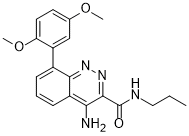
AZD-6280 is a novel, potent and selective GABAA(α2/3) receptor modulator, used for treatment of generalized anxiety disorder. Following administration of AZD6280 at 10 mg and 40 mg doses, prolactin levels increased significantly compared with placebo (difference 42.0%, 19.8%, and 32.8%, respectively), suggesting that the α2 and/or α3 receptor subtypes are involved in GABAergic modulation of prolactin secretion, although possible roles of the α1 and α5 receptor subtypes are not excluded. The increases in prolactin levels after administration of AZD7325 at 2 mg and 10 mg doses (difference 7.6% and 10.5%, respectively) did not reach statistical significance, suggesting that doses of AZD7325 or intrinsic efficacy at the α2 and α3 receptor subtypes may have been too low.
Physicochemical Properties
| Molecular Formula | C20H22N4O3 |
| Molecular Weight | 366.4137 |
| Exact Mass | 366.169 |
| CAS # | 942436-93-3 |
| PubChem CID | 23630026 |
| Appearance | Light yellow to yellow solid powder |
| LogP | 4.192 |
| Hydrogen Bond Donor Count | 2 |
| Hydrogen Bond Acceptor Count | 6 |
| Rotatable Bond Count | 6 |
| Heavy Atom Count | 27 |
| Complexity | 492 |
| Defined Atom Stereocenter Count | 0 |
| InChi Key | NVWCZRPXYVDQEE-UHFFFAOYSA-N |
| InChi Code | InChI=1S/C20H22N4O3/c1-4-10-22-20(25)19-17(21)14-7-5-6-13(18(14)23-24-19)15-11-12(26-2)8-9-16(15)27-3/h5-9,11H,4,10H2,1-3H3,(H2,21,23)(H,22,25) |
| Chemical Name | 4-amino-8-(2,5-dimethoxyphenyl)-N-propylcinnoline-3-carboxamide |
| HS Tariff Code | 2934.99.9001 |
| Storage |
Powder-20°C 3 years 4°C 2 years In solvent -80°C 6 months -20°C 1 month |
| Shipping Condition | Room temperature (This product is stable at ambient temperature for a few days during ordinary shipping and time spent in Customs) |
Biological Activity
| ln Vivo |
In a double-blind, placebo-controlled, randomized, crossover study involving healthy male volunteers, single oral doses of AZD6280 significantly increased plasma prolactin levels in a dose-dependent manner compared to placebo. Administration of a 10 mg dose resulted in a 19.8% increase (95% CI: 8.2% to 32.6%, P = 0.0007). Administration of a 40 mg dose resulted in a larger increase of 32.8% (95% CI: 20.0% to 47.0%, P < 0.0001). The increase suggests that modulation of α₂ and/or α₃ GABAA receptor subtypes is involved in the GABAergic control of the tuberoinfundibular dopaminergic pathway, which tonically inhibits prolactin secretion.[1] The prolactin increase observed after a 40 mg dose of AZD6280 was not statistically significantly different from the 42.0% increase observed after a 2 mg dose of the non-selective benzodiazepine lorazepam.[1] |
| ADME/Pharmacokinetics |
This article states that the prolactin study was part of larger phase 1 pharmacokinetic and pharmacodynamic studies for AZD6280. However, specific pharmacokinetic parameters (e.g., absorption, distribution, metabolism, excretion, half-life, oral bioavailability) for AZD6280 are not reported in this manuscript. The full PK results are noted to be reported elsewhere.[1] The drug was administered as a single oral dose. Subjects fasted for a minimum of 2.5 hours after a light standard breakfast until drug administration (typically between 11:00 and 12:00) and continued fasting until 4 hours post-dose.[1] |
| References |
[1]. The effects of the nonselective benzodiazepine lorazepam and the α2 /α3 subunit-selective GABAA receptor modulators AZD7325 and AZD6280 on plasma prolactin levels. Clin Pharmacol Drug Dev. 2015 Mar;4(2):149-54. doi: 10.1002/cpdd.134. Ep. |
| Additional Infomation |
AZD6280 has been used in trials studying the basic science of Anxiety. AZD6280 is a novel partial α₂/α₃ subunit-selective GABAA receptor modulator. Such compounds are hypothesized to provide anxiolytic effects with potentially less sedation than non-selective benzodiazepines and may have therapeutic potential in disorders like schizophrenia due to their proposed differential effects on dopaminergic circuits.[1] This study aimed to evaluate the effects of selective GABAA receptor modulators on prolactin secretion as an indirect measure of tuberoinfundibular dopaminergic pathway activity in humans.[1] The results indicate that AZD6280 can increase prolactin levels in healthy men, supporting the role of α₂/α₃-containing GABAA receptors in modulating this neuroendocrine pathway in vivo.[1] The effects of AZD6280 on prolactin were more pronounced than those of another α₂/α₃ modulator, AZD7325, tested in the same study, which may be related to differences in the doses used or intrinsic efficacy.[1] |
Solubility Data
| Solubility (In Vitro) | DMSO : ~62.5 mg/mL (~170.57 mM) |
| Solubility (In Vivo) |
Solubility in Formulation 1: ≥ 2.08 mg/mL (5.68 mM) (saturation unknown) in 10% DMSO + 40% PEG300 +5% Tween-80 + 45% Saline (add these co-solvents sequentially from left to right, and one by one), clear solution. For example, if 1 mL of working solution is to be prepared, you can add 100 μL of 20.8 mg/mL clear DMSO stock solution to 400 μL PEG300 and mix evenly; then add 50 μL Tween-80 + to the above solution and mix evenly; then add 450 μL normal saline to adjust the volume to 1 mL. Preparation of saline: Dissolve 0.9 g of sodium chloride in 100 mL ddH₂ O to obtain a clear solution. (Please use freshly prepared in vivo formulations for optimal results.) |
| Preparing Stock Solutions | 1 mg | 5 mg | 10 mg | |
| 1 mM | 2.7292 mL | 13.6459 mL | 27.2918 mL | |
| 5 mM | 0.5458 mL | 2.7292 mL | 5.4584 mL | |
| 10 mM | 0.2729 mL | 1.3646 mL | 2.7292 mL |