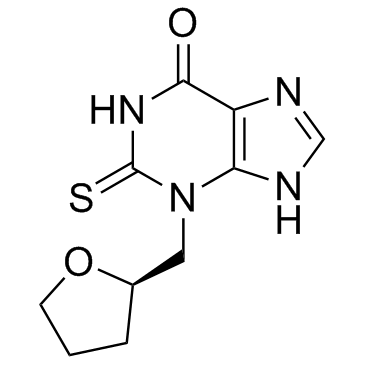
AZD5904 is a novel, potent, orally bioavailable, irreversible inhibitor of human MPO (Myeloperoxidase) with an IC50 of 140 nM and with similar potency in mouse and rat. It is 10 to 19-fold selective compared to the closely related lactoperoxidase and thyroid peroxidase; it shows >70-fold selectivity over a broad panel of other enzymes, ion channels, and receptors. In isolated human neutrophils, 1 μM inhibited PMA stimulated HOCl by >90%. In rats, a plasma concentration of ~5 μM decreased the in vivo formation of glutathione sulphonamide (a product of the reaction of HOCl with glutathione) from in situ zymosan activated peritoneum neutrophils.
Physicochemical Properties
| Molecular Formula | C10H12N4O2S |
| Molecular Weight | 252.292880058289 |
| Exact Mass | 252.068 |
| CAS # | 618913-30-7 |
| PubChem CID | 10264211 |
| Appearance | White to yellow solid powder |
| Density | 1.5±0.1 g/cm3 |
| Index of Refraction | 1.704 |
| LogP | -1.43 |
| Hydrogen Bond Donor Count | 2 |
| Hydrogen Bond Acceptor Count | 4 |
| Rotatable Bond Count | 2 |
| Heavy Atom Count | 17 |
| Complexity | 351 |
| Defined Atom Stereocenter Count | 1 |
| SMILES | C1C[C@@H](OC1)CN2C3=C(C(=O)NC2=S)NC=N3 |
| InChi Key | RSPDBEVKURKEII-ZCFIWIBFSA-N |
| InChi Code | InChI=1S/C10H12N4O2S/c15-9-7-8(12-5-11-7)14(10(17)13-9)4-6-2-1-3-16-6/h5-6H,1-4H2,(H,11,12)(H,13,15,17)/t6-/m1/s1 |
| Chemical Name | 3-[[(2R)-oxolan-2-yl]methyl]-2-sulfanylidene-7H-purin-6-one |
| HS Tariff Code | 2934.99.9001 |
| Storage |
Powder-20°C 3 years 4°C 2 years In solvent -80°C 6 months -20°C 1 month |
| Shipping Condition | Room temperature (This product is stable at ambient temperature for a few days during ordinary shipping and time spent in Customs) |
Biological Activity
| ln Vitro | The human myeloperoxidase (MPO) enzyme AZD5904 exhibits both irreversible and selective behavior. Its potency remains consistent across many models and topologies, with an IC50 of 140 nM. In addition to being >70 times more selective than a variety of other enzymes, ion channels, and receptors, AZD5904 is 10–19 times more selective than thyroid peroxidases and lactoperoxidases, which are closely related [1]. |
| References |
[1]. Myeloperoxidase (MPO) inhibitor. [2]. 2-thioxanthines are mechanism-based inactivators of myeloperoxidase that block oxidative stress during inflammation. J Biol Chem. 2011;286(43):37578-37589. [3]. Chai W, Aylor K, Liu Z, Gan LM, Michaëlsson E, Barrett E. Inhibiting myeloperoxidase prevents onset and reverses established high-fat diet-induced microvascular insulin resistance. Am J Physiol Endocrinol Metab. 2019;317(6):E1063-E1069. [4]. Inhibiting cardiac myeloperoxidase alleviates the relaxation defect in hypertrophic cardiomyocytes. Cardiovasc Res. 2022;118(2):517-530. |
Solubility Data
| Solubility (In Vitro) | DMSO : ~100 mg/mL (~396.37 mM) |
| Solubility (In Vivo) |
Solubility in Formulation 1: ≥ 2.08 mg/mL (8.24 mM) (saturation unknown) in 10% DMSO + 90% (20% SBE-β-CD in Saline) (add these co-solvents sequentially from left to right, and one by one), clear solution. For example, if 1 mL of working solution is to be prepared, you can add 100 μL of 20.8 mg/mL clear DMSO stock solution to 900 μL of 20% SBE-β-CD physiological saline solution and mix evenly. Preparation of 20% SBE-β-CD in Saline (4°C,1 week): Dissolve 2 g SBE-β-CD in 10 mL saline to obtain a clear solution. (Please use freshly prepared in vivo formulations for optimal results.) |
| Preparing Stock Solutions | 1 mg | 5 mg | 10 mg | |
| 1 mM | 3.9637 mL | 19.8185 mL | 39.6369 mL | |
| 5 mM | 0.7927 mL | 3.9637 mL | 7.9274 mL | |
| 10 mM | 0.3964 mL | 1.9818 mL | 3.9637 mL |