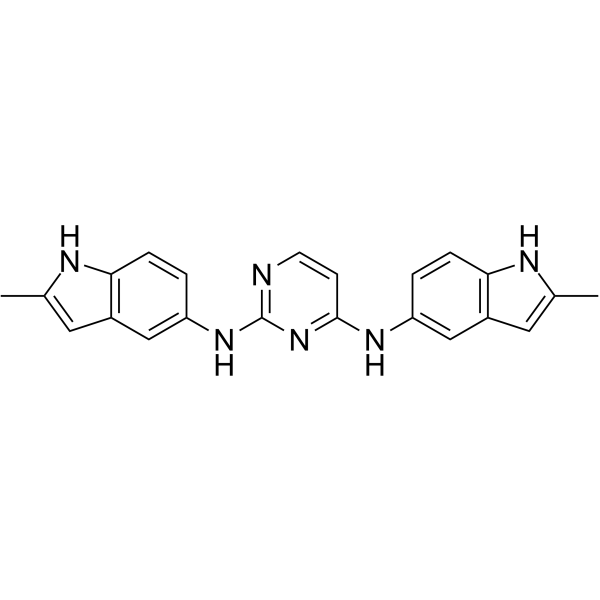
Physicochemical Properties
| Molecular Formula | C22H20N6 |
| Molecular Weight | 368.434403419495 |
| Exact Mass | 368.174 |
| CAS # | 1071098-42-4 |
| PubChem CID | 25104141 |
| Appearance | Light brown to brown solid powder |
| LogP | 5 |
| Hydrogen Bond Donor Count | 4 |
| Hydrogen Bond Acceptor Count | 4 |
| Rotatable Bond Count | 4 |
| Heavy Atom Count | 28 |
| Complexity | 529 |
| Defined Atom Stereocenter Count | 0 |
| SMILES | N1C(C)=CC2C=C(C=CC1=2)NC1C=CN=C(N=1)NC1C=CC2=C(C=1)C=C(C)N2 |
| InChi Key | SYWHWWKOIJCMKF-UHFFFAOYSA-N |
| InChi Code | InChI=1S/C22H20N6/c1-13-9-15-11-17(3-5-19(15)24-13)26-21-7-8-23-22(28-21)27-18-4-6-20-16(12-18)10-14(2)25-20/h3-12,24-25H,1-2H3,(H2,23,26,27,28) |
| Chemical Name | 2-N,4-N-bis(2-methyl-1H-indol-5-yl)pyrimidine-2,4-diamine |
| HS Tariff Code | 2934.99.9001 |
| Storage |
Powder-20°C 3 years 4°C 2 years In solvent -80°C 6 months -20°C 1 month |
| Shipping Condition | Room temperature (This product is stable at ambient temperature for a few days during ordinary shipping and time spent in Customs) |
Biological Activity
| ln Vitro | Human prostate cancer cell 22Rv1 growth is inhibited by AZA1 (Rac1/Cdc42-IN-1) (2-10 μM; 72 hours) [1]. EGF-stimulated 22Rv1 prostate cancer cells exhibit reduced phosphorylation of PAK1, AKT, and BAD upon treatment with AZA1 (2-10 μM; 24 hours) [1]. AZA1 (10 μM; 24 hours) suppresses Rac1- and Cdc42-dependent cell cycle events in 22Rv1 prostate cancer cells [1]. AZA1 inhibits the migration of prostate cancer cells PC-3, DU 145, and 22Rv1 that is dependent on Rac1 and Cdc42 [1]. AZA1 suppresses Rac1 and Cdc42 activity through PAK1/2 phosphorylation, consequently altering cell motility and actin rearrangement of prostate cancer cells [1]. |
| ln Vivo | AZA1 (Rac1/Cdc42-IN-1) (100 μg; i.p.; once daily for two weeks) efficiently suppresses the growth of human 22Rv1 xenografts and enhances mouse survival [1]. |
| Cell Assay |
Cell Proliferation Assay[1] Cell Types: 22Rv1 Prostate Cancer Cell Tested Concentrations: 2, 5, 10 μM Incubation Duration: 72 hrs (hours) Experimental Results: Inhibited the proliferation of 22Rv1 Prostate Cancer Cell in unstimulated and EGF-stimulated cancer cells in a dose-dependent manner. Western Blot Analysis[1] Cell Types: 22Rv1 prostate cancer cells (EGF stimulated) Tested Concentrations: 2, 5, 10 μM Incubation Duration: 24 hrs (hours) Experimental Results: diminished phosphorylation of PAK1, AKT and BAD in EGF-stimulated 22Rv1 prostate cancer cells. |
| Animal Protocol |
Animal/Disease Models: 5weeks old athymic nu/nu (nude) mice (carrying 22Rv1 prostate cancer cell xenografts) [1] Doses: 100 μg in 100 µl 30% DMSO one time/day for 2 weeks Experimental Results: AZA1 The inhibitory effect on tumor growth is significant. |
| References |
[1]. A Rac1/Cdc42 GTPase-specific small molecule inhibitor suppresses growth of primary human prostate cancer xenografts and prolongs survival in mice. PLoS One. 2013;8(9):e74924. Published 2013 Sep 11. [2]. Sialylation and glycosylation modulate cell adhesion and invasion to extracellular matrix in human malignant lymphoma: Dependency on integrin and the Rho GTPase family. Int J Oncol. 2015;47(6):2091‐2099. |
Solubility Data
| Solubility (In Vitro) | DMSO : ~50 mg/mL (~135.71 mM) |
| Solubility (In Vivo) |
Solubility in Formulation 1: ≥ 2.5 mg/mL (6.79 mM) (saturation unknown) in 10% DMSO + 40% PEG300 + 5% Tween80 + 45% Saline (add these co-solvents sequentially from left to right, and one by one), clear solution. For example, if 1 mL of working solution is to be prepared, you can add 100 μL of 25.0 mg/mL clear DMSO stock solution to 400 μL PEG300 and mix evenly; then add 50 μL Tween-80 to the above solution and mix evenly; then add 450 μL normal saline to adjust the volume to 1 mL. Preparation of saline: Dissolve 0.9 g of sodium chloride in 100 mL ddH₂ O to obtain a clear solution. Solubility in Formulation 2: ≥ 2.5 mg/mL (6.79 mM) (saturation unknown) in 10% DMSO + 90% (20% SBE-β-CD in Saline) (add these co-solvents sequentially from left to right, and one by one), clear solution. For example, if 1 mL of working solution is to be prepared, you can add 100 μL of 25.0 mg/mL clear DMSO stock solution to 900 μL of 20% SBE-β-CD physiological saline solution and mix evenly. Preparation of 20% SBE-β-CD in Saline (4°C,1 week): Dissolve 2 g SBE-β-CD in 10 mL saline to obtain a clear solution. (Please use freshly prepared in vivo formulations for optimal results.) |
| Preparing Stock Solutions | 1 mg | 5 mg | 10 mg | |
| 1 mM | 2.7142 mL | 13.5711 mL | 27.1422 mL | |
| 5 mM | 0.5428 mL | 2.7142 mL | 5.4284 mL | |
| 10 mM | 0.2714 mL | 1.3571 mL | 2.7142 mL |