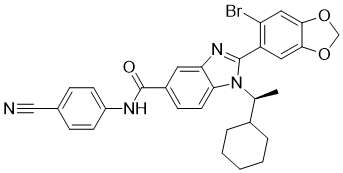
Physicochemical Properties
| Molecular Formula | C30H27BRN4O3 |
| Molecular Weight | 571.464386224747 |
| Exact Mass | 570.13 |
| Elemental Analysis | C, 63.05; H, 4.76; Br, 13.98; N, 9.80; O, 8.40 |
| CAS # | 2100284-59-9 |
| PubChem CID | 126961335 |
| Appearance | White to light brown solid powder |
| LogP | 6.9 |
| Hydrogen Bond Donor Count | 1 |
| Hydrogen Bond Acceptor Count | 5 |
| Rotatable Bond Count | 5 |
| Heavy Atom Count | 38 |
| Complexity | 882 |
| Defined Atom Stereocenter Count | 1 |
| SMILES | C[C@@H](C1CCCCC1)N2C3=C(C=C(C=C3)C(=O)NC4=CC=C(C=C4)C#N)N=C2C5=CC6=C(C=C5Br)OCO6 |
| InChi Key | FJAOGFGHTPYADT-SFHVURJKSA-N |
| InChi Code | InChI=1S/C30H27BrN4O3/c1-18(20-5-3-2-4-6-20)35-26-12-9-21(30(36)33-22-10-7-19(16-32)8-11-22)13-25(26)34-29(35)23-14-27-28(15-24(23)31)38-17-37-27/h7-15,18,20H,2-6,17H2,1H3,(H,33,36)/t18-/m0/s1 |
| Chemical Name | 2-(6-bromo-1,3-benzodioxol-5-yl)-N-(4-cyanophenyl)-1-[(1S)-1-cyclohexylethyl]benzimidazole-5-carboxamide |
| Synonyms | AZ-3451; AZ3451; AZ 3451 |
| HS Tariff Code | 2934.99.9001 |
| Storage |
Powder-20°C 3 years 4°C 2 years In solvent -80°C 6 months -20°C 1 month |
| Shipping Condition | Room temperature (This product is stable at ambient temperature for a few days during ordinary shipping and time spent in Customs) |
Biological Activity
| Targets | PAR2 ( IC50 = 23 nM ) |
| ln Vitro | AZ3451 is a PAR2 antagonist that affects apoptosis, autophagy, cellular senescence, and the inflammatory response in osteoarthritis (OA). AZ3451 stops cartilage deterioration, IL-1β-induced inflammatory response, and chondrocytes from prematurely senescing. By inducing autophagy, AZ3451 reduces the apoptosis of chondrocytes in vitro. NF-κB, PI3K/AKT/mTOR, and P38/MAPK pathways are all involved in AZ3451's protective effects. [2] |
| ln Vivo | In a rat osteoarthritis (OA) model, intra-articular injection of AZ3451 can reduce the cartilage degradation caused by surgery.[/2] |
| Cell Assay | The cartilage tissue of one-week-old Sprague-Dawley rats' knee joints is the source of primary rat chondrocytes. The cartilage pieces undergo sequential digestion using 0.2% trypsin and 0.25% collagenase II dissolved in Dulbecco's Modified Eagle Medium (DMEM) culture medium. The freed chondrocytes are gathered and incubated in DMEM enhanced with 10% FBS, 100 units/ml of penicillin, and 100 μg/ml of streptomycin. The cells are treated with 10 μM AZ3451 in the presence or absence of 10 ng/mL IL-1β up to about 80% confluences. In our experiment, we utilize chondrocytes from passages 1-3 in order to prevent phenotypic loss. |
| Animal Protocol |
male 8-week-old Sprague–Dawley rats 100 μl (50 μg/ml) intra-articular injection |
| References |
[1]. Nature . 2017 May 4;545(7652):112-115. [2]. Aging (Albany NY) . 2019 Dec 16;11(24):12532-12545. |
| Additional Infomation | AZ3451 is a member of the class of benzimidazoles that is 1H-benzimidazole substituted by (1S)-1-cyclohexylethyl, 6-bromo-1,3-benzodioxol-5-yl, and 4-(cyanoanilino)acyl groups at positions 1, 2 and 5, respectively. It is an allosteric modulator of protease-activated receptor 2 (IC50 = 23 nM) and exhibits anti-osteoarthritis properties. It has a role as an anti-inflammatory agent, a PAR2 negative allosteric modulator and an autophagy inducer. It is a secondary carboxamide, a nitrile, a member of benzimidazoles, a member of benzodioxoles and an organobromine compound. |
Solubility Data
| Solubility (In Vitro) |
DMSO: ~100 mg/mL (~175.0 mM) Ethanol: ~100 mg/mL |
| Solubility (In Vivo) |
Solubility in Formulation 1: ≥ 2.08 mg/mL (3.64 mM) (saturation unknown) in 10% DMSO + 40% PEG300 + 5% Tween80 + 45% Saline (add these co-solvents sequentially from left to right, and one by one), clear solution. For example, if 1 mL of working solution is to be prepared, you can add 100 μL of 20.8 mg/mL clear DMSO stock solution to 400 μL PEG300 and mix evenly; then add 50 μL Tween-80 to the above solution and mix evenly; then add 450 μL normal saline to adjust the volume to 1 mL. Preparation of saline: Dissolve 0.9 g of sodium chloride in 100 mL ddH₂ O to obtain a clear solution. Solubility in Formulation 2: ≥ 2.08 mg/mL (3.64 mM) (saturation unknown) in 10% DMSO + 90% Corn Oil (add these co-solvents sequentially from left to right, and one by one), clear solution. For example, if 1 mL of working solution is to be prepared, you can add 100 μL of 20.8 mg/mL clear DMSO stock solution to 900 μL of corn oil and mix evenly. (Please use freshly prepared in vivo formulations for optimal results.) |
| Preparing Stock Solutions | 1 mg | 5 mg | 10 mg | |
| 1 mM | 1.7499 mL | 8.7495 mL | 17.4990 mL | |
| 5 mM | 0.3500 mL | 1.7499 mL | 3.4998 mL | |
| 10 mM | 0.1750 mL | 0.8750 mL | 1.7499 mL |