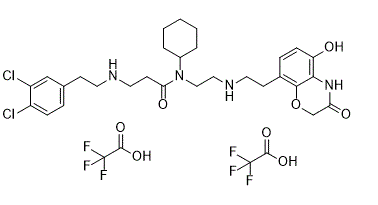
AZ-505 (AZ505) 2TFA, the ditrifluoroacetate salt of AZ-505, is an SMYD2 (SET and MYND domain-containing protein 2) inhibitor with anticancer activity. It inhibits SMYD2 with an IC50 of 0.12 μM. SMYD2 has a crucial role in tumor cell proliferation by its overexpression and highlight its usefulness as a prognostic factor and potential therapeutic target in gastric cancer.
Physicochemical Properties
| Molecular Formula | C29H38CL2N4O4 |
| Molecular Weight | 805.5891 |
| Exact Mass | 804.212 |
| CAS # | 1035227-44-1 |
| Related CAS # | AZ505;1035227-43-0 |
| PubChem CID | 78357790 |
| Appearance | White to light yellow solid powder |
| LogP | 5.412 |
| Hydrogen Bond Donor Count | 6 |
| Hydrogen Bond Acceptor Count | 16 |
| Rotatable Bond Count | 13 |
| Heavy Atom Count | 53 |
| Complexity | 855 |
| Defined Atom Stereocenter Count | 0 |
| InChi Key | LTZSXVZCRINTGV-UHFFFAOYSA-N |
| InChi Code | InChI=1S/C29H38Cl2N4O4.2C2HF3O2/c30-23-8-6-20(18-24(23)31)10-13-32-15-12-27(38)35(22-4-2-1-3-5-22)17-16-33-14-11-21-7-9-25(36)28-29(21)39-19-26(37)34-282*3-2(4,5)1(6)7/h6-9,18,22,32-33,36H,1-5,10-17,19H2,(H,34,37)2*(H,6,7) |
| Chemical Name | N-cyclohexyl-3-((3,4-dichlorophenethyl)amino)-N-(2-((2-(5-hydroxy-3-oxo-3,4-dihydro-2H-benzo[b][1,4]oxazin-8-yl)ethyl)amino)ethyl)propanamide bis(2,2,2-trifluoroacetate) |
| Synonyms | AZ505 ditrifluoroacetate salt AZ 505 2TFA salt AZ-505 2TFA salt |
| HS Tariff Code | 2934.99.9001 |
| Storage |
Powder-20°C 3 years 4°C 2 years In solvent -80°C 6 months -20°C 1 month Note: Please store this product in a sealed and protected environment, avoid exposure to moisture. |
| Shipping Condition | Room temperature (This product is stable at ambient temperature for a few days during ordinary shipping and time spent in Customs) |
Biological Activity
| ln Vitro | In vitro, AZ505 ditrifluoroacetate has activity at submicromolar doses and is a highly selective drug. When it comes to other histone methyltransferases like DOT1L (IC50>83.3 μM), SMYD3 (IC50>83.3 μM), and AZ505 Ditrifluoroacetate, the latter has an IC50 more than 600 times higher than that of SMYD2. The IC50 of AZ505 ditrifluoroacetate against SMYD2 is 0.12 μM. IC50 greater than 83.3 μM)[1]. With an IC50 of 0.12 μM, AZ505 ditrifluacetate is a strong and specific SMYD2 inhibitor. There are five members of the human lysine methyltransferase family known as SMYD (SET and MYND domain-containing protein) (SMYD1-5). Moreover, AZ505 ditrifluoroacetate failed to stop a set of protein lysine methyltransferases from doing their job. With a Kd of 0.5 μM, AZ505 ditrifluoroacetate was proposed for ITC binding investigations. By contrast, the p53 substrate peptide's predicted Kd is 3.7 μM. The primary mechanism of AZ505 ditrifluoroacetate's binding to SMYD2 is entropy, which generally implies that hydrophobic interactions with a small number of particular hydrogen bonds mediate the binding [2]. |
| References |
[1]. Overexpression of SMYD2 contributes to malignant outcome in gastric cancer. Br J Cancer. 2015 Jan 20;112(2):357-64. [2]. Structural basis of substrate methylation and inhibition of SMYD2. Structure. 2011 Sep 7;19(9):1262-73. |
Solubility Data
| Solubility (In Vitro) | DMSO : ≥ 125 mg/mL (~155.17 mM) |
| Solubility (In Vivo) |
Solubility in Formulation 1: ≥ 2.08 mg/mL (2.58 mM) (saturation unknown) in 10% DMSO + 40% PEG300 + 5% Tween80 + 45% Saline (add these co-solvents sequentially from left to right, and one by one), clear solution. For example, if 1 mL of working solution is to be prepared, you can add 100 μL of 20.8 mg/mL clear DMSO stock solution to 400 μL PEG300 and mix evenly; then add 50 μL Tween-80 to the above solution and mix evenly; then add 450 μL normal saline to adjust the volume to 1 mL. Preparation of saline: Dissolve 0.9 g of sodium chloride in 100 mL ddH₂ O to obtain a clear solution. Solubility in Formulation 2: ≥ 2.08 mg/mL (2.58 mM) (saturation unknown) in 10% DMSO + 90% (20% SBE-β-CD in Saline) (add these co-solvents sequentially from left to right, and one by one), clear solution. For example, if 1 mL of working solution is to be prepared, you can add 100 μL of 20.8 mg/mL clear DMSO stock solution to 900 μL of 20% SBE-β-CD physiological saline solution and mix evenly. Preparation of 20% SBE-β-CD in Saline (4°C,1 week): Dissolve 2 g SBE-β-CD in 10 mL saline to obtain a clear solution. Solubility in Formulation 3: ≥ 2.08 mg/mL (2.58 mM) (saturation unknown) in 10% DMSO + 90% Corn Oil (add these co-solvents sequentially from left to right, and one by one), clear solution. For example, if 1 mL of working solution is to be prepared, you can add 100 μL of 20.8 mg/mL clear DMSO stock solution to 900 μL of corn oil and mix evenly. (Please use freshly prepared in vivo formulations for optimal results.) |
| Preparing Stock Solutions | 1 mg | 5 mg | 10 mg | |
| 1 mM | 1.2413 mL | 6.2066 mL | 12.4133 mL | |
| 5 mM | 0.2483 mL | 1.2413 mL | 2.4827 mL | |
| 10 mM | 0.1241 mL | 0.6207 mL | 1.2413 mL |