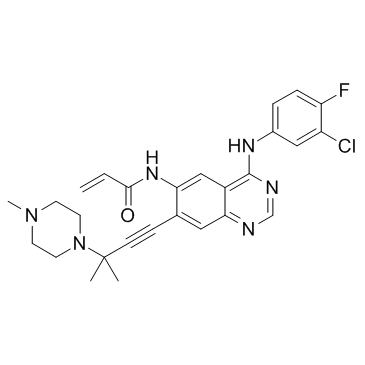
Physicochemical Properties
| Molecular Formula | C27H28CLFN6O |
| Molecular Weight | 507.0022 |
| Exact Mass | 506.199 |
| CAS # | 451492-95-8 |
| Related CAS # | AV-412;451493-31-5 |
| PubChem CID | 9806229 |
| Appearance | White to yellow solid powder |
| Density | 1.3±0.1 g/cm3 |
| Boiling Point | 672.9±55.0 °C at 760 mmHg |
| Flash Point | 360.7±31.5 °C |
| Vapour Pressure | 0.0±2.1 mmHg at 25°C |
| Index of Refraction | 1.663 |
| LogP | 5.22 |
| Hydrogen Bond Donor Count | 2 |
| Hydrogen Bond Acceptor Count | 7 |
| Rotatable Bond Count | 7 |
| Heavy Atom Count | 36 |
| Complexity | 850 |
| Defined Atom Stereocenter Count | 0 |
| InChi Key | ZAJXXUDARPGGOC-UHFFFAOYSA-N |
| InChi Code | InChI=1S/C27H28ClFN6O/c1-5-25(36)33-23-16-20-24(30-17-31-26(20)32-19-6-7-22(29)21(28)15-19)14-18(23)8-9-27(2,3)35-12-10-34(4)11-13-35/h5-7,14-17H,1,10-13H2,2-4H3,(H,33,36)(H,30,31,32) |
| Chemical Name | N-[4-(3-chloro-4-fluoroanilino)-7-[3-methyl-3-(4-methylpiperazin-1-yl)but-1-ynyl]quinazolin-6-yl]prop-2-enamide |
| Synonyms | AV-412 |
| HS Tariff Code | 2934.99.9001 |
| Storage |
Powder-20°C 3 years 4°C 2 years In solvent -80°C 6 months -20°C 1 month |
| Shipping Condition | Room temperature (This product is stable at ambient temperature for a few days during ordinary shipping and time spent in Customs) |
Biological Activity
| Targets |
EGFR (IC50 = 0.75 nM); EGFR L858R (IC50 = 0.5 nM); EGFR T790M (IC50 = 0.79 nM); EGFR L858R/T790M (IC50 = 2.3 nM); ErbB2 (IC50 = 19 nM) - AV-412 (also named MP-412) targets epidermal growth factor receptor (EGFR) tyrosine kinase (IC50: 1.2 nM for recombinant human EGFR kinase) [1] - AV-412 targets ErbB2 (HER2) tyrosine kinase (IC50: 2.3 nM for recombinant human ErbB2 kinase) [1] |
| ln Vitro |
AV-412 has an IC50 of 43 nM for EGFR and 282 nM for ErbB2 to inhibit the autophosphorylation of these proteins. With an IC50 of 100 nM, AV-412 also suppresses the proliferation of cells that is dependent on epidermal growth factor (EGF). With a double mutation of EGFR (L858R and T790M), the gefitinib-resistant H1975 cell line is mutated against EGFR. AV-412 reverses EGFR signal. - Dual kinase inhibition: AV-412 (0.1–100 nM) dose-dependently inhibited recombinant human EGFR and ErbB2 kinase activity. At 10 nM, it inhibited EGFR activity by ~92% and ErbB2 by ~88%, with high selectivity (inhibition of other kinases like Src, VEGFR2 <10% at 100 nM) [1] - Antiproliferative activity: AV-412 inhibited proliferation of EGFR-overexpressing (A431, IC50: 8.5 nM) and ErbB2-overexpressing (SK-BR-3, IC50: 6.2 nM; BT474, IC50: 7.8 nM) cancer cell lines (MTT assay, 72-hour treatment). It had no significant effect on normal human fibroblasts (MRC-5, IC50 >1000 nM) [1] - Signaling pathway inhibition: AV-412 (5–20 nM) downregulated phosphorylation of EGFR (p-EGFR) and ErbB2 (p-ErbB2) in A431 and SK-BR-3 cells (western blot, 4-hour treatment). At 20 nM, p-EGFR was reduced by ~85% (A431) and p-ErbB2 by ~80% (SK-BR-3), with downstream p-AKT and p-ERK also decreased by ~75% and ~70%, respectively [1] |
| ln Vivo |
AV-412 (30 mg/kg) completely inhibits the tumor growth of the A431 and BT-474 cell lines, which overexpress EGFR and ErbB2, respectively, in animal studies using cancer xenograft models. EGFR and ErbB2 autophosphorylation is inhibited by AV-412 at a dose that is consistent with its antitumor efficacy. AV-412 exhibits significant effects when different dosing schedules are used; however, a once-weekly schedule does not show the same effects, indicating that frequent dosing is preferable for this compound. Additionally, on the ErbB2-overexpressing breast cancer KPL-4 cell line, which is resistant to gefitinib, AV-412 exhibits a strong antitumor effect[1]. - Nude mouse xenograft models: 1. A431 (EGFR-overexpressing) xenografts: Mice (n=6/group) were orally administered AV-412 at 25, 50 mg/kg once daily for 21 days. High-dose AV-412 reduced tumor volume by ~65% and tumor weight by ~60% vs. vehicle control. Tumor tissues showed ~80% lower p-EGFR (immunohistochemistry) [1] 2. SK-BR-3 (ErbB2-overexpressing) xenografts: 50 mg/kg AV-412 (oral, daily, 21 days) reduced tumor volume by ~62% and weight by ~58% vs. control. Western blot of tumor lysates showed decreased p-ErbB2, p-AKT, and p-ERK [1] |
| Enzyme Assay |
Purified EGFR from A431 cell membranes and recombinant intracellular kinase domains of EGFR, EGFR L858R , EGFR T790M , and EGFR L858R/T790M are utilized. With the exception of EGFR T790M , which uses 250 µM of the GGMEDIYFEFMGGKKK peptide substrate, kinase reactions are conducted in 8 mM MOPS (pH 7.0), 0.2 mM ethylenediaminetetraacetic acid (EDTA), 10 mM MnCl2, 10 mM Mg acetate, 0.1 mg/mL poly(Glu, Tyr) 4:1, [γ 33 P-ATP], and 5–10 mU of enzyme. The addition of ATP starts the phosphorylation process, which lasts for 40 minutes at room temperature. After adding 3% phosphoric acid to halt the reaction, aliquots of the reaction mixture are spotted onto a filtermat. The filter is scintillation counted after being rinsed to get rid of any non-specifically bound peptides[1]. - EGFR/ErbB2 kinase activity assay: Recombinant human EGFR/ErbB2 kinase (catalytic domain) was mixed with reaction buffer containing ATP (10 μM), fluorescently labeled peptide substrate (EGFR/ErbB2-specific), and AV-412 (0.01–100 nM). The mixture was incubated at 30°C for 60 minutes. Reaction was terminated with stop buffer, and fluorescence intensity of phosphorylated substrate was measured (excitation 485 nm, emission 535 nm). Inhibition rate was calculated by comparing with vehicle control, and IC50 values were determined via nonlinear regression [1] |
| Cell Assay |
In order to investigate how AV-412 affects growth factor-dependent cell proliferation, A431 and A7r5 cells are cultivated for 24 hours at 37°C with 50 ng/mL platelet-derived growth factor and 1 ng/mL epidermal growth factor, respectively. Measurements are made of the 3H-thymidine incorporation during this time[1]. - Cell proliferation assay (MTT method): Cancer cells (A431, SK-BR-3, BT474) and normal fibroblasts (MRC-5) were seeded in 96-well plates (5×10³ cells/well) and cultured overnight. AV-412 (0.1–1000 nM) was added, and cells were incubated for 72 hours. MTT reagent (5 mg/mL) was added, incubated for 4 hours, supernatant removed, and DMSO added to dissolve formazan. Absorbance at 570 nm was measured to calculate cell viability and IC50 [1] - Signaling pathway detection (western blot): A431/SK-BR-3 cells were seeded in 6-well plates (2×10⁵ cells/well) and treated with AV-412 (5, 10, 20 nM) for 4 hours. Cells were lysed with RIPA buffer (protease/phosphatase inhibitors), total protein quantified, separated by SDS-PAGE, transferred to PVDF membrane. Membranes were incubated with primary antibodies (p-EGFR, EGFR, p-ErbB2, ErbB2, p-AKT, AKT, p-ERK, ERK) and HRP-conjugated secondary antibodies. Chemiluminescence detection was performed, and band intensity quantified [1] |
| Animal Protocol |
Mice: In research investigating the relationship between the dosing regimen and TE-8 tumor efficacy, AV-412 is given once weekly, once daily, or once every other day for a period of two weeks. One day following the last treatment, the mice are killed, and the tumors are removed and weighed. Tumor-bearing mice are given a single injection of AV-412, and 4 hours later, the tumors are removed for analysis of tumor phosphorylation[1]. - A431/SK-BR-3 xenograft models: BALB/c nude mice (4–6 weeks old, female) were subcutaneously injected with 1×10⁷ A431 or 2×10⁶ SK-BR-3 cells (suspended in PBS+Matrigel). When tumors reached ~100 mm³, mice were randomly divided into 3 groups (n=6/group): vehicle (5% DMSO + 30% PEG400 + 65% normal saline), AV-412 25 mg/kg, AV-412 50 mg/kg. AV-412 was administered via oral gavage once daily for 21 days. Tumor volume (length×width²/2) and mouse body weight were measured every 3 days. After treatment, mice were euthanized, tumors excised and weighed, and tumor tissues collected for western blot/immunohistochemistry [1] |
| Toxicity/Toxicokinetics |
- In vivo toxicity: During the 21-day xenograft experiment, AV-412 (25, 50 mg/kg) caused no significant mouse weight loss (<5% vs. vehicle) or abnormal pathological changes in heart, liver, kidney, or spleen (hematoxylin-eosin staining) [1] - Plasma protein binding: AV-412 showed ~92% plasma protein binding in human plasma (ultrafiltration method) [1] |
| References |
[1]. Pharmacological characterization of MP-412 (AV-412), a dual epidermal growth factor receptorand ErbB2 tyrosine kinase inhibitor. Cancer Sci. 2007 Dec;98(12):1977-84. |
| Additional Infomation |
- AV-412 (MP-412) is a small-molecule dual inhibitor of EGFR and ErbB2 tyrosine kinases, designed to treat cancers driven by overexpression or activation of these two receptors [1] - Its antitumor mechanism involves inhibiting EGFR/ErbB2-mediated downstream signaling (AKT/ERK pathways), thereby suppressing cancer cell proliferation and inducing G1 phase cell cycle arrest (flow cytometry analysis in A431 cells showed G1 phase cells increased by ~40% at 20 nM AV-412) [1] |
Solubility Data
| Solubility (In Vitro) | DMSO: ≥ 28 mg/mL (~33 mM) |
| Solubility (In Vivo) |
Solubility in Formulation 1: ≥ 2.5 mg/mL (4.93 mM) (saturation unknown) in 10% DMSO + 40% PEG300 +5% Tween-80 + 45% Saline (add these co-solvents sequentially from left to right, and one by one), clear solution. For example, if 1 mL of working solution is to be prepared, you can add 100 μL of 25.0 mg/mL clear DMSO stock solution to 400 μL PEG300 and mix evenly; then add 50 μL Tween-80 + to the above solution and mix evenly; then add 450 μL normal saline to adjust the volume to 1 mL. Preparation of saline: Dissolve 0.9 g of sodium chloride in 100 mL ddH₂ O to obtain a clear solution. (Please use freshly prepared in vivo formulations for optimal results.) |
| Preparing Stock Solutions | 1 mg | 5 mg | 10 mg | |
| 1 mM | 1.9724 mL | 9.8619 mL | 19.7239 mL | |
| 5 mM | 0.3945 mL | 1.9724 mL | 3.9448 mL | |
| 10 mM | 0.1972 mL | 0.9862 mL | 1.9724 mL |