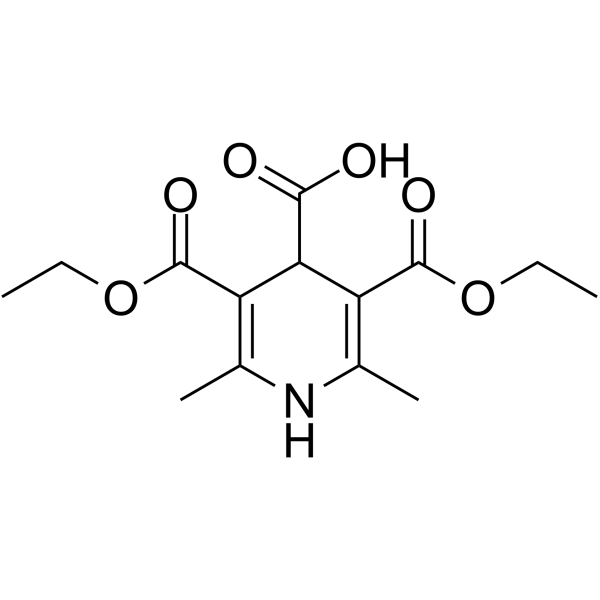
AV-153 free acid is an analog of 1,4-dihydropyridine (1,4-DHP) with antimutagenic activity. AV-153 intercalates to DNA in a single strand break and reduces DNA damage, stimulates DNA repair in human cells in vitro. AV-153 interacts with thymine and cytosine and has an influence on poly(ADP)ribosylation. AV-153 has anti-cancer activity.
Physicochemical Properties
| Molecular Formula | C₁₄H₁₉NO₆ |
| Molecular Weight | 297.30 |
| Exact Mass | 297.121 |
| CAS # | 19350-66-4 |
| Related CAS # | AV-153;27296-05-5 |
| PubChem CID | 168683 |
| Appearance | White to light yellow solid powder |
| Density | 1.23g/cm3 |
| Boiling Point | 450.5ºC at 760mmHg |
| Flash Point | 226.3ºC |
| Vapour Pressure | 2.26E-09mmHg at 25°C |
| Index of Refraction | 1.51 |
| LogP | 1.293 |
| Hydrogen Bond Donor Count | 2 |
| Hydrogen Bond Acceptor Count | 7 |
| Rotatable Bond Count | 7 |
| Heavy Atom Count | 21 |
| Complexity | 492 |
| Defined Atom Stereocenter Count | 0 |
| InChi Key | USGQSNVLGQWBEC-UHFFFAOYSA-N |
| InChi Code | InChI=1S/C14H19NO6/c1-5-20-13(18)9-7(3)15-8(4)10(11(9)12(16)17)14(19)21-6-2/h11,15H,5-6H2,1-4H3,(H,16,17) |
| Chemical Name | 3,5-bis(ethoxycarbonyl)-2,6-dimethyl-1,4-dihydropyridine-4-carboxylic acid |
| Synonyms | AV 153; AV-153; AV153 |
| HS Tariff Code | 2934.99.9001 |
| Storage |
Powder-20°C 3 years 4°C 2 years In solvent -80°C 6 months -20°C 1 month |
| Shipping Condition | Room temperature (This product is stable at ambient temperature for a few days during ordinary shipping and time spent in Customs) |
Biological Activity
| ln Vitro | Ava-153 free base (1 nM to 10 μM; 3 hours) decreases spontaneously generated DNA single-strand breaks (SSB) levels in peripheral blood lymphocytes or HL-60 cells by 13–67% [1]. The IC50 values of AV-153 free base on Raji and HL-60 cells are 14.9 mM and 10.3 mM, respectively[1]. |
| References |
[1]. A 1,4-dihydropyridine Derivative Reduces DNA Damage and Stimulates DNA Repair in Human Cells in Vitro. Mutat Res. 2005 Nov 10;587(1-2):52-8. [2]. DNA-binding Studies of AV-153, an Antimutagenic and DNA Repair-Stimulating Derivative of 1,4-dihydropiridine. Chem Biol Interact. 2014 Sep 5;220:200-7. [3]. Antioxidative 1,4-Dihydropyridine Derivatives Modulate Oxidative Stress and Growth of Human Osteoblast-Like Cells In Vitro. Antioxidants (Basel). 2018 Sep 19;7(9):123. |
Solubility Data
| Solubility (In Vitro) | DMSO : ~250 mg/mL (~840.90 mM) |
| Solubility (In Vivo) |
Solubility in Formulation 1: ≥ 2.08 mg/mL (7.00 mM) (saturation unknown) in 10% DMSO + 40% PEG300 + 5% Tween80 + 45% Saline (add these co-solvents sequentially from left to right, and one by one), clear solution. For example, if 1 mL of working solution is to be prepared, you can add 100 μL of 20.8 mg/mL clear DMSO stock solution to 400 μL PEG300 and mix evenly; then add 50 μL Tween-80 to the above solution and mix evenly; then add 450 μL normal saline to adjust the volume to 1 mL. Preparation of saline: Dissolve 0.9 g of sodium chloride in 100 mL ddH₂ O to obtain a clear solution. Solubility in Formulation 2: ≥ 2.08 mg/mL (7.00 mM) (saturation unknown) in 10% DMSO + 90% Corn Oil (add these co-solvents sequentially from left to right, and one by one), clear solution. For example, if 1 mL of working solution is to be prepared, you can add 100 μL of 20.8 mg/mL clear DMSO stock solution to 900 μL of corn oil and mix evenly. (Please use freshly prepared in vivo formulations for optimal results.) |
| Preparing Stock Solutions | 1 mg | 5 mg | 10 mg | |
| 1 mM | 3.3636 mL | 16.8180 mL | 33.6361 mL | |
| 5 mM | 0.6727 mL | 3.3636 mL | 6.7272 mL | |
| 10 mM | 0.3364 mL | 1.6818 mL | 3.3636 mL |