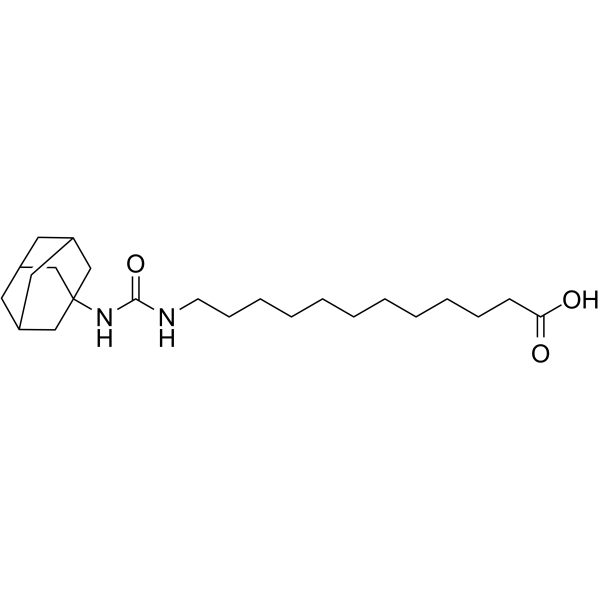
AUDA is a novel and potent soluble epoxide hydrolase (sEH) inhibitor with anti-inflammatory activity. It exhibts IC50s of 18 and 69 nM for the mouse and human sEH, respectively.
Physicochemical Properties
| Molecular Formula | C23H40N2O3 |
| Molecular Weight | 392.575306892395 |
| Exact Mass | 392.303 |
| CAS # | 479413-70-2 |
| PubChem CID | 10069117 |
| Appearance | White to off-white solid powder |
| Density | 1.1±0.1 g/cm3 |
| Boiling Point | 592.7±19.0 °C at 760 mmHg |
| Flash Point | 312.3±21.5 °C |
| Vapour Pressure | 0.0±3.6 mmHg at 25°C |
| Index of Refraction | 1.534 |
| LogP | 5.61 |
| Hydrogen Bond Donor Count | 3 |
| Hydrogen Bond Acceptor Count | 3 |
| Rotatable Bond Count | 13 |
| Heavy Atom Count | 28 |
| Complexity | 479 |
| Defined Atom Stereocenter Count | 0 |
| InChi Key | XLGSEOAVLVTJDH-UHFFFAOYSA-N |
| InChi Code | InChI=1S/C23H40N2O3/c26-21(27)10-8-6-4-2-1-3-5-7-9-11-24-22(28)25-23-15-18-12-19(16-23)14-20(13-18)17-23/h18-20H,1-17H2,(H,26,27)(H2,24,25,28) |
| Chemical Name | 12-(1-adamantylcarbamoylamino)dodecanoic acid |
| HS Tariff Code | 2934.99.9001 |
| Storage |
Powder-20°C 3 years 4°C 2 years In solvent -80°C 6 months -20°C 1 month |
| Shipping Condition | Room temperature (This product is stable at ambient temperature for a few days during ordinary shipping and time spent in Customs) |
Biological Activity
| ln Vitro | Rat VSMCs exposed to PDGF are inhibited in their proliferation in a dose-dependent manner by AUDA (0.3-10 μg/mL; 48 hours) [2]. COX-2 expression is dose-dependently upregulated by AUDA (0.3–10 μg/mL; 30 minutes) [2]. HCAEC's ability to migrate is improved by AUDA (10, 50, and 100 μM) in a dose-dependent way [3]. The capacity of HCAECs to adhere is greatly enhanced by AUDA [3]. |
| ln Vivo | AUDA (ip; 10 mg/kg; 14 days) lowers the expression levels of IL-1β, MMP-9, and TNF-α [3]. |
| Cell Assay |
Cell proliferation assay [2] Cell Types: Vascular smooth muscle cells (VSMC) Tested Concentrations: 0.3, 1, 3, 10 μg/mL Incubation Duration: 48 hrs (hours) Experimental Results: The proliferation of rat VSMCs exposed to PDGF was dose-dependently inhibited. Western Blot Analysis[2] Cell Types: VSMC Tested Concentrations: 1, 3, 10, 30 μg/mL Incubation Duration: 30 minutes Experimental Results: COX-2 expression was up-regulated in a dose-dependent manner. |
| Animal Protocol |
Animal/Disease Models: Male (wild-type) C57BL/6 mice (age, 4-6 weeks; body weight, 18-20 g) [3] Doses: 10 mg/kg Route of Administration: intraperitoneal (ip) injection; 14-day Experimental Results: TNF -α, MMP-9 and IL-1β expression levels were diminished. |
| References |
[1]. Structural refinement of inhibitors of urea-based soluble epoxide hydrolases.Biochem Pharmacol. 2002 May 1;63(9):1599-608. [2]. Differential Effects of sEH Inhibitors on the Proliferation and Migration of Vascular Smooth Muscle Cells.Int J Mol Sci. 2017 Dec 11;18(12). [3]. Vascular repair and anti-inflammatory effects of soluble epoxide hydrolase inhibitor.Exp Ther Med. 2019 May;17(5):3580-3588. |
| Additional Infomation | AUDA is a medium-chain fatty acid. |
Solubility Data
| Solubility (In Vitro) | DMSO : ~125 mg/mL (~318.41 mM) |
| Solubility (In Vivo) |
Solubility in Formulation 1: 2.08 mg/mL (5.30 mM) in 10% DMSO + 40% PEG300 + 5% Tween80 + 45% Saline (add these co-solvents sequentially from left to right, and one by one), suspension solution; with sonication. For example, if 1 mL of working solution is to be prepared, you can add 100 μL of 20.8 mg/mL clear DMSO stock solution to 400 μL PEG300 and mix evenly; then add 50 μL Tween-80 to the above solution and mix evenly; then add 450 μL normal saline to adjust the volume to 1 mL. Preparation of saline: Dissolve 0.9 g of sodium chloride in 100 mL ddH₂ O to obtain a clear solution. Solubility in Formulation 2: ≥ 2.08 mg/mL (5.30 mM) (saturation unknown) in 10% DMSO + 90% (20% SBE-β-CD in Saline) (add these co-solvents sequentially from left to right, and one by one), clear solution. For example, if 1 mL of working solution is to be prepared, you can add 100 μL of 20.8 mg/mL clear DMSO stock solution to 900 μL of 20% SBE-β-CD physiological saline solution and mix evenly. Preparation of 20% SBE-β-CD in Saline (4°C,1 week): Dissolve 2 g SBE-β-CD in 10 mL saline to obtain a clear solution. Solubility in Formulation 3: ≥ 2.08 mg/mL (5.30 mM) (saturation unknown) in 10% DMSO + 90% Corn Oil (add these co-solvents sequentially from left to right, and one by one), clear solution. For example, if 1 mL of working solution is to be prepared, you can add 100 μL of 20.8 mg/mL clear DMSO stock solution to 900 μL of corn oil and mix evenly. (Please use freshly prepared in vivo formulations for optimal results.) |
| Preparing Stock Solutions | 1 mg | 5 mg | 10 mg | |
| 1 mM | 2.5473 mL | 12.7363 mL | 25.4725 mL | |
| 5 mM | 0.5095 mL | 2.5473 mL | 5.0945 mL | |
| 10 mM | 0.2547 mL | 1.2736 mL | 2.5473 mL |