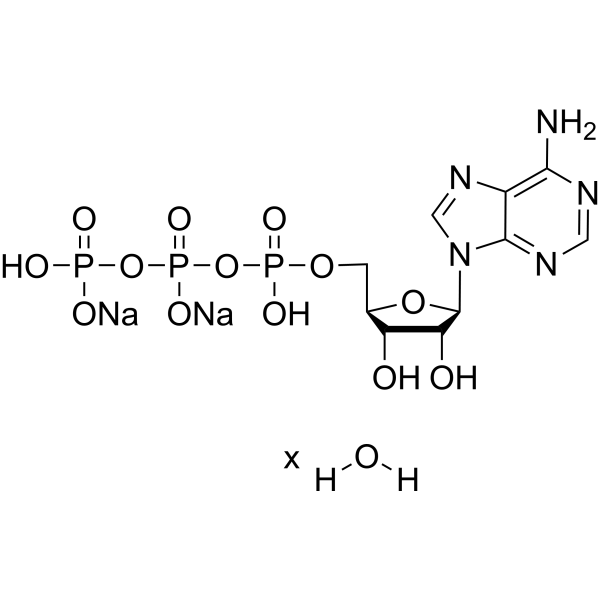
Physicochemical Properties
| Molecular Formula | C10H16N5NA2O14P3 |
| Molecular Weight | 569.160 |
| Exact Mass | 568.97 |
| Elemental Analysis | C, 21.10; H, 2.83; N, 12.30; Na, 8.08; O, 39.35; P, 16.33 |
| CAS # | 34369-07-8 |
| Related CAS # | ATP disodium salt;987-65-5;ATP disodium trihydrate;51963-61-2;ATP dimagnesium;74804-12-9;ATP-13C10,15N5 disodium;ATP disodium salt hydrate;34369-07-8;ATP dipotassium;42373-41-1;ATP ditromethamine;102047-34-7;ATP-13C10,15N5;752972-20-6 |
| PubChem CID | 16218877 |
| Appearance | White to off-white solid powder |
| Boiling Point | 951.4ºC at 760mmHg |
| Melting Point | 176ºC (dec.)(lit.) |
| Flash Point | 529.2ºC |
| LogP | 0 |
| Hydrogen Bond Donor Count | 6 |
| Hydrogen Bond Acceptor Count | 18 |
| Rotatable Bond Count | 8 |
| Heavy Atom Count | 34 |
| Complexity | 789 |
| Defined Atom Stereocenter Count | 4 |
| SMILES | O[C@@H]([C@H]([C@H](N1C=NC2=C(N=CN=C21)N)O3)O)[C@H]3COP([O-])(OP(O)(OP([O-])(O)=O)=O)=O.[H]O[H].[Na+].[Na+] |
| InChi Key | NTBQNWBHIXNPRU-MSQVLRTGSA-L |
| InChi Code | InChI=1S/C10H16N5O13P3.2Na.H2O/c11-8-5-9(13-2-12-8)15(3-14-5)10-7(17)6(16)4(26-10)1-25-30(21,22)28-31(23,24)27-29(18,19)20;;;/h2-4,6-7,10,16-17H,1H2,(H,21,22)(H,23,24)(H2,11,12,13)(H2,18,19,20);;;1H2/q;2*+1;/p-2/t4-,6-,7-,10-;;;/m1.../s1 |
| Chemical Name | O[C@@H]([C@H]([C@H](N1C=NC2=C(N=CN=C21)N)O3)O)[C@H]3COP([O-])(OP(O)(OP([O-])(O)=O)=O)=O.[H]O[H].[Na+].[Na+] |
| Synonyms | 34369-07-8; ATP disodium salt; ATP disodium salt hydrate; Adenosine 5'-triphosphate disodium salt hydrate; MFCD00150755; Adenosine 5'-triphosphate disodium salt hydrate; disodium;[[[(2R,3S,4R,5R)-5-(6-aminopurin-9-yl)-3,4-dihydroxyoxolan-2-yl]methoxy-hydroxyphosphoryl]oxy-oxidophosphoryl] hydrogen phosphate;hydrate; ATP (disodium salt hydrate); |
| HS Tariff Code | 2934.99.9001 |
| Storage |
Powder-20°C 3 years 4°C 2 years In solvent -80°C 6 months -20°C 1 month Note: Please store this product in a sealed and protected environment, avoid exposure to moisture. |
| Shipping Condition | Room temperature (This product is stable at ambient temperature for a few days during ordinary shipping and time spent in Customs) |
Biological Activity
| Targets |
Endogenous Metabolite NLRP3 inflammasome [3][4] |
| ln Vitro |
When combined with LPS (1 μg/ml), ATP disodium salt hydrate (5 mM) for one hour had a synergistic effect on activating the NLRP3 inflammasome in HGFs[3]. In vitro, bone marrow derived macrophages (BMDMs) secrete interleukin 1β, KC, and MIP-2 in response to ATP disodium salt hydrate (2 mM; 0.5-24 hours) in a way that is dependent on caspase-1 activation[4]. In vitro neutrophil chemotaxis is both directly and indirectly induced by ATP disodium salt hydrate, which also stimulates the release of cytokines and chemokines as well as inflammasome activation[4].
- NLRP3 inflammasome activation: In human gingival fibroblasts, ATP (5 mM) co-administered with Porphyromonas gingivalis LPS triggered NLRP3 inflammasome activation, as evidenced by caspase-1 cleavage and IL-1β secretion. This process was inhibited by doxycycline [3]. - ATP disodium salt hydrate (5 mM) synergized with Porphyromonas gingivalis-lipopolysaccharide (Pg-LPS) to induce NLRP3 inflammasome activation in human gingival fibroblasts, significantly increasing IL-1β secretion (detected by ELISA) and upregulating the expression of NLRP3 and cleaved caspase-1 (p10) (detected by Western blot) [3] - ATP disodium salt hydrate acts as an endogenous signaling molecule that triggers inflammasome activation in immune cells, promoting the release of pro-inflammatory cytokines (IL-1β, IL-18) to participate in immune response and inflammation regulation [2][4] - At concentrations used in experimental settings (1-5 mM), ATP disodium salt hydrate did not affect the viability of human gingival fibroblasts (detected by CCK-8 assay) [3] |
| ln Vivo |
Mice who receive 50 mg/kg of ATP disodium salt hydrate intraperitoneally are protected from bacterial infection[4]. ?In vivo neutrophil recruitment and the release of KC, MIP-2, and IL1β are induced by ATP disodium salt hydrate[4].
- Bacterial infection protection: Intraperitoneal injection of ATP (20 mg/kg) in mice significantly improved survival rates (60% vs. 20% in control) and reduced bacterial burden in a peritoneal Escherichia coli infection model. Protection was abolished in NLRP3 knockout mice, confirming NLRP3-dependent mechanism [4]. - In mice infected with Escherichia coli or Staphylococcus aureus, intraperitoneal injection of ATP disodium salt hydrate (50 mg/kg) significantly improved survival rate (from ~30% to ~70%) compared with the control group. It enhanced bacterial clearance by activating the NLRP3 inflammasome, increasing serum IL-1β and IL-18 levels, and promoting the recruitment of neutrophils to infection sites [4] - ATP disodium salt hydrate (50 mg/kg, intraperitoneal injection) activated the NLRP3 inflammasome in mouse peritoneal macrophages and splenocytes, as evidenced by increased cleaved caspase-1 and mature IL-1β expression (detected by Western blot and ELISA) [4] |
| Enzyme Assay |
Human health is under constant threat of a wide variety of dangers, both self and nonself. The immune system is occupied with protecting the host against such dangers in order to preserve human health. For that purpose, the immune system is equipped with a diverse array of both cellular and non-cellular effectors that are in continuous communication with each other. The naturally occurring nucleotide adenosine 5'-triphosphate (ATP) and its metabolite adenosine (Ado) probably constitute an intrinsic part of this extensive immunological network through purinergic signaling by their cognate receptors, which are widely expressed throughout the body. This review provides a thorough overview of the effects of ATP and Ado on major immune cell types. The overwhelming evidence indicates that ATP and Ado are important endogenous signaling molecules in immunity and inflammation. Although the role of ATP and Ado during the course of inflammatory and immune responses in vivo appears to be extremely complex, we propose that their immunological role is both interdependent and multifaceted, meaning that the nature of their effects may shift from immunostimulatory to immunoregulatory or vice versa depending on extracellular concentrations as well as on expression patterns of purinergic receptors and ecto-enzymes. Purinergic signaling thus contributes to the fine-tuning of inflammatory and immune responses in such a way that the danger to the host is eliminated efficiently with minimal damage to healthy tissues. [2] - NLRP3 inflammasome activation-related enzyme assay: Human gingival fibroblasts were seeded and pretreated with Pg-LPS (1 μg/mL) for 6 hours to prime the inflammasome. ATP disodium salt hydrate (1-5 mM) was then added, and cells were incubated for another 24 hours. Cell supernatants were collected to measure IL-1β concentration by ELISA. Cell lysates were used for Western blot to detect the activation of caspase-1 (cleaved p10 fragment) [3] - ATP-mediated signaling enzyme assay: Immune cells (peritoneal macrophages) were isolated from mice and treated with ATP disodium salt hydrate (10 mM) for 1 hour. The activity of caspase-1 was measured by a colorimetric assay based on the cleavage of a specific substrate, and the results were normalized to total protein concentration [4] |
| Cell Assay |
- Gingival fibroblast stimulation: Human gingival fibroblasts were primed with LPS (1 μg/mL) for 3 hours, followed by ATP (5 mM) treatment for 30 minutes. Cell lysates were analyzed by Western blot for caspase-1 p20 and IL-1β, while supernatants were assayed for secreted IL-1β [3]. - Human gingival fibroblast assay: Cells were cultured in complete medium and pretreated with Pg-LPS (1 μg/mL) for 6 hours. ATP disodium salt hydrate (1, 3, 5 mM) was added, and cells were incubated for 24 hours. CCK-8 assay was used to evaluate cell viability; ELISA for IL-1β secretion; Western blot for NLRP3, pro-caspase-1, and cleaved caspase-1 (p10) expression [3] - Mouse peritoneal macrophage assay: Peritoneal macrophages were isolated from mice and seeded in 6-well plates. Cells were treated with ATP disodium salt hydrate (5, 10 mM) for 1 hour, or primed with LPS (1 μg/mL) for 3 hours followed by ATP disodium salt hydrate (10 mM) stimulation for 1 hour. Cell supernatants were collected for IL-1β ELISA; cell lysates for Western blot analysis of inflammasome components [4] |
| Animal Protocol |
Animal/Disease Models: Fourweeks old Kunming mice (18-22 g)[4] Doses: 50 mg/kg Route of Administration: intraperitoneal (ip)injection, before bacterial (E. coli) challenge Experimental Results: Protected mice from bacterial infection. - Mouse infection model: ATP was dissolved in sterile saline and administered intraperitoneally (20 mg/kg) to C57BL/6 mice 1 hour before intraperitoneal injection of E. coli (1×10⁹ CFU). Survival was monitored for 72 hours, and peritoneal lavage fluid was cultured to quantify bacterial counts [4]. - Bacterial infection model: C57BL/6 mice (6-8 weeks old) were intraperitoneally injected with Escherichia coli (1×10⁸ CFU/mouse) or Staphylococcus aureus (5×10⁷ CFU/mouse) to induce systemic infection. ATP disodium salt hydrate was dissolved in sterile normal saline, and intraperitoneally injected at 50 mg/kg immediately after bacterial infection. Survival rate was recorded for 7 days [4] - Inflammasome activation model: Mice were intraperitoneally injected with ATP disodium salt hydrate (50 mg/kg) or vehicle. After 6 hours, mice were sacrificed, and peritoneal macrophages and splenocytes were collected for Western blot and ELISA to detect NLRP3 inflammasome activation markers [4] - For cytokine detection: Serum was collected from infected mice at 24 hours post-infection, and IL-1β, IL-18, and TNF-α levels were measured by ELISA [4] |
| Toxicity/Toxicokinetics |
- In in vivo experiments, intraperitoneal injection of ATP disodium salt hydrate at 50 mg/kg did not cause significant changes in mouse body weight, food intake, or serum levels of ALT, AST, Cr, and BUN, indicating no obvious acute hepatotoxicity or nephrotoxicity [4] - In vitro, ATP disodium salt hydrate did not induce cytotoxicity in human gingival fibroblasts at concentrations up to 5 mM [3] |
| References |
[1]. ATP synthesis and storage. Purinergic Signal. 2012 Sep;8(3):343-57. [2]. Adenosine 5'-triphosphate and adenosine as endogenous signaling molecules in immunity and inflammation. Pharmacol Ther. 2006 Nov;112(2):358-404. [3]. Doxycycline inhibits NAcht Leucine-rich repeat Protein 3 inflammasome activation and interleukin-1β production induced by Porphyromonas gingivalis-lipopolysaccharide and adenosine triphosphate in human gingival fibroblasts. Arch Oral Biol. 2019 Nov;107:104514. [4]. Adenosine-5'-Triphosphate (ATP) Protects Mice against Bacterial Infection by Activation of the NLRP3 Inflammasome. PLoS One. 2013; 8(5): e63759. |
| Additional Infomation |
Since 1929, when it was discovered that ATP is a substrate for muscle contraction, the knowledge about this purine nucleotide has been greatly expanded. Many aspects of cell metabolism revolve around ATP production and consumption. It is important to understand the concepts of glucose and oxygen consumption in aerobic and anaerobic life and to link bioenergetics with the vast amount of reactions occurring within cells. ATP is universally seen as the energy exchange factor that connects anabolism and catabolism but also fuels processes such as motile contraction, phosphorylations, and active transport. It is also a signalling molecule in the purinergic signalling mechanisms. In this review, we will discuss all the main mechanisms of ATP production linked to ADP phosphorylation as well the regulation of these mechanisms during stress conditions and in connection with calcium signalling events. Recent advances regarding ATP storage and its special significance for purinergic signalling will also be reviewed. [1] It has been established that Adenosine-5'-triphosphate (ATP) can activate the NLRP3 inflammasome. However, the physiological effect of extracellular ATP on NLRP3 inflammasome activation has not yet been investigated. In the present study, we found that ATP was indeed released during bacterial infection. By using a murine peritonitis model, we also found that ATP promotes the fight against bacterial infection in mice. ATP induced the secretion of IL-1β and chemokines by murine bone marrow-derived macrophages in vitro. Furthermore, the intraperitoneal injection of ATP elevated the levels of IL-1β and chemokines in the mouse peritoneal lavage. Neutrophils were rapidly recruited to the peritoneum after ATP injection. In addition, the effects on cytokine and chemokine secretion and neutrophil recruitment were markedly attenuated by the pre-administration of the caspase-1 inhibitor Ac-YVAD-cho. Ac-YVAD-cho also significantly attenuated the protective effect of ATP against bacterial infection. In the present study, we demonstrated a protective role for ATP during bacterial infection and this effect was related to NLRP3 inflammasome activation. Together, these results suggest a role for ATP in initiating the immune response in hosts suffering from infections. [4] - Mechanism of action: ATP acts as a danger-associated molecular pattern (DAMP) to activate P2X7 receptors, leading to potassium efflux and NLRP3 inflammasome assembly. This promotes caspase-1 activation and IL-1β/IL-18 secretion, enhancing host defense against bacterial infection [2, 4]. - Immunomodulatory role: Extracellular ATP can either promote inflammation via P2X7 signaling or suppress it through adenosine-mediated pathways, depending on local concentration and cell context [2]. - ATP disodium salt hydrate is the hydrated disodium salt form of adenosine 5'-triphosphate (ATP), an endogenous nucleotide that serves as a key energy source for cellular processes and a signaling molecule in immunity and inflammation [1][2] - Its core biological functions include: participating in intracellular ATP synthesis and storage to maintain energy metabolism [1]; acting as a danger-associated molecular pattern (DAMP) to activate the NLRP3 inflammasome, regulating immune responses and host defense against bacterial infections [3][4]; mediating intercellular signaling in immune and inflammatory reactions [2] - ATP disodium salt hydrate is widely used as a research tool to induce inflammasome activation in in vitro and in vivo experimental models [3][4] |
Solubility Data
| Solubility (In Vitro) | H2O : ~100 mg/mL |
| Solubility (In Vivo) |
Solubility in Formulation 1: 100 mg/mL (Infinity mM) in PBS (add these co-solvents sequentially from left to right, and one by one), clear solution; with sonication. (Please use freshly prepared in vivo formulations for optimal results.) |
| Preparing Stock Solutions | 1 mg | 5 mg | 10 mg | |
| 1 mM | 1.7570 mL | 8.7849 mL | 17.5698 mL | |
| 5 mM | 0.3514 mL | 1.7570 mL | 3.5140 mL | |
| 10 mM | 0.1757 mL | 0.8785 mL | 1.7570 mL |