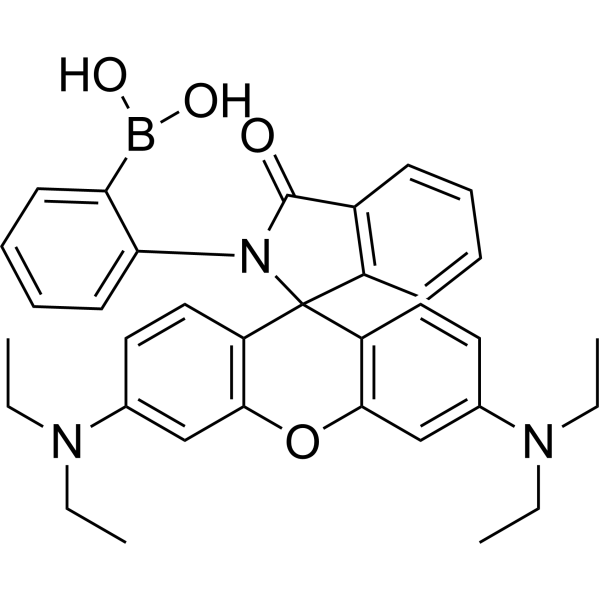
Physicochemical Properties
| Molecular Formula | C34H36BN3O4 |
| Molecular Weight | 561.478348731995 |
| Exact Mass | 561.279 |
| CAS # | 1847485-97-5 |
| PubChem CID | 132274056 |
| Appearance | Pale purple to purple solid powder |
| Hydrogen Bond Donor Count | 2 |
| Hydrogen Bond Acceptor Count | 6 |
| Rotatable Bond Count | 8 |
| Heavy Atom Count | 42 |
| Complexity | 893 |
| Defined Atom Stereocenter Count | 0 |
| SMILES | O1C2C=C(C=CC=2C2(C3C=CC(=CC1=3)N(CC)CC)C1C=CC=CC=1C(N2C1C=CC=CC=1B(O)O)=O)N(CC)CC |
| InChi Key | SSNKNUIFMZUJTL-UHFFFAOYSA-N |
| InChi Code | InChI=1S/C34H36BN3O4/c1-5-36(6-2)23-17-19-27-31(21-23)42-32-22-24(37(7-3)8-4)18-20-28(32)34(27)26-14-10-9-13-25(26)33(39)38(34)30-16-12-11-15-29(30)35(40)41/h9-22,40-41H,5-8H2,1-4H3 |
| Chemical Name | [2-[3',6'-bis(diethylamino)-3-oxospiro[isoindole-1,9'-xanthene]-2-yl]phenyl]boronic acid |
| Synonyms | ATP-Red 1; 1847485-97-5; [2-[3',6'-bis(diethylamino)-3-oxospiro[isoindole-1,9'-xanthene]-2-yl]phenyl]boronic acid; (2-(3',6'-Bis(diethylamino)-3-oxospiro[isoindoline-1,9'-xanthen]-2-yl)phenyl)boronic acid; |
| HS Tariff Code | 2934.99.9001 |
| Storage |
Powder-20°C 3 years 4°C 2 years In solvent -80°C 6 months -20°C 1 month Note: This product requires protection from light (avoid light exposure) during transportation and storage. |
| Shipping Condition | Room temperature (This product is stable at ambient temperature for a few days during ordinary shipping and time spent in Customs) |
Biological Activity
| Targets | Fluorescent probe/dye |
| ln Vitro | ATP-Red 1 is a switchable fluorescent probe with multiple binding sites that may respond selectively and quickly to ATP levels in living cells. The highest absorption and emission wavelengths are 570/566 and 590/585 nm, respectively. ATP-Red 1 has strong membrane permeability, and its fluorescence intensity increases by 5.6 times in the presence of 5 mM ATP. After KCN inhibited OXPHOS, ATP-Red 1 (2.5 μM, 20 minutes) showed lower fluorescence, resulting in reduced mitochondrial ATP levels in OSCC cells [1]. |
| Cell Assay |
1. Solution Preparation 1.1 Stock Solution Preparation • Solvent: DMSO • Concentration: Recommended 10 mM • Storage: Aliquot and store at -20°C or -80°C, protected from light. Avoid repeated freeze-thaw cycles. 1.2 Working Solution Preparation • Dilute the stock solution in PBS or serum-free cell culture medium to a final concentration of 1–10 µM (optimize based on experimental conditions). • Note: Prepare working solution immediately before use and protect from light. ________________________________________ 2. Cell Staining Protocol 2.1 Cell Preparation • Suspend cells in 100 µL PBS in a 96-well plate at a density of 2×10⁵ cells per well. 2.2 ATP-Red 1 Staining • Add ATP-Red 1 to achieve a final concentration of 5–10 µM. 2.3 Incubation • Incubate cells at room temperature or 37°C for 15 min (extend to 30 min for live-cell imaging). 2.4 Solution Removal • Remove the ATP-Red 1 working solution after incubation. 2.5 Fluorescence Detection • Analyze using a fluorescence microscope (Ex/Em = 510/590 nm). |
| References |
[1]. A Multisite-Binding Switchable Fluorescent Probe for Monitoring Mitochondrial ATP Level Fluctuation in Live Cells. Angew Chem Int Ed Engl. 2016 Jan 26;55(5):1773-6. |
| Additional Infomation | Adenosine triphosphate (ATP), commonly produced in mitochondria, is required by almost all the living organisms; thus fluorescent probes for monitoring mitochondrial ATP levels fluctuation are essential and highly desired. Herein, we report a multisite-binding switchable fluorescent probe, ATP-Red 1, which selectively and rapidly responds to intracellular concentrations of ATP. Live-cell imaging indicated that ATP-Red 1 mainly localized to mitochondria with good biocompatibility and membrane penetration. In particular, with the help of ATP-Red 1, we successfully observed not only the decreased mitochondrial ATP levels in the presence of KCN and starvation state, but also the increased mitochondrial ATP levels in the early stage of cell apoptosis. These results indicate that ATP-Red 1 is a useful tool for investigating ATP-relevant biological processes. [1] |
Solubility Data
| Solubility (In Vitro) | DMSO : ~50 mg/mL (~89.05 mM) |
| Solubility (In Vivo) |
Solubility in Formulation 1: ≥ 2.5 mg/mL (4.45 mM) (saturation unknown) in 10% DMSO + 40% PEG300 + 5% Tween80 + 45% Saline (add these co-solvents sequentially from left to right, and one by one), clear solution. For example, if 1 mL of working solution is to be prepared, you can add 100 μL of 25.0 mg/mL clear DMSO stock solution to 400 μL PEG300 and mix evenly; then add 50 μL Tween-80 to the above solution and mix evenly; then add 450 μL normal saline to adjust the volume to 1 mL. Preparation of saline: Dissolve 0.9 g of sodium chloride in 100 mL ddH₂ O to obtain a clear solution. Solubility in Formulation 2: ≥ 2.5 mg/mL (4.45 mM) (saturation unknown) in 10% DMSO + 90% Corn Oil (add these co-solvents sequentially from left to right, and one by one), clear solution. For example, if 1 mL of working solution is to be prepared, you can add 100 μL of 25.0 mg/mL clear DMSO stock solution to 900 μL of corn oil and mix evenly. (Please use freshly prepared in vivo formulations for optimal results.) |
| Preparing Stock Solutions | 1 mg | 5 mg | 10 mg | |
| 1 mM | 1.7810 mL | 8.9050 mL | 17.8101 mL | |
| 5 mM | 0.3562 mL | 1.7810 mL | 3.5620 mL | |
| 10 mM | 0.1781 mL | 0.8905 mL | 1.7810 mL |