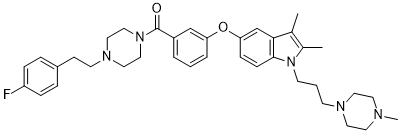
ATM-3507 is a novel and potent tropomyosin inhibitor, which targets Tpm3.1-containing filaments, with IC50s from 3.83-6.84 μM in human melanoma cell lines.
Physicochemical Properties
| Molecular Formula | C37H46FN5O2 |
| Molecular Weight | 611.791852474213 |
| Exact Mass | 611.363 |
| CAS # | 1861449-70-8 |
| Related CAS # | ATM-3507 trihydrochloride;2438679-30-0 |
| PubChem CID | 118666864 |
| Appearance | Light yellow to yellow solid powder |
| LogP | 5.8 |
| Hydrogen Bond Donor Count | 0 |
| Hydrogen Bond Acceptor Count | 6 |
| Rotatable Bond Count | 10 |
| Heavy Atom Count | 45 |
| Complexity | 917 |
| Defined Atom Stereocenter Count | 0 |
| SMILES | FC1C=CC(=CC=1)CCN1CCN(C(C2C=CC=C(C=2)OC2C=CC3=C(C=2)C(C)=C(C)N3CCCN2CCN(C)CC2)=O)CC1 |
| InChi Key | FNEHSJQRIWHZKS-UHFFFAOYSA-N |
| InChi Code | InChI=1S/C37H46FN5O2/c1-28-29(2)43(16-5-15-40-20-18-39(3)19-21-40)36-13-12-34(27-35(28)36)45-33-7-4-6-31(26-33)37(44)42-24-22-41(23-25-42)17-14-30-8-10-32(38)11-9-30/h4,6-13,26-27H,5,14-25H2,1-3H3 |
| Chemical Name | (3-((2,3-Dimethyl-1-(3-(4-methylpiperazin-1-yl)propyl)-1H-indol-5-yl)oxy)phenyl)(4-(4-fluorophenethyl)piperazin-1-yl)methanone |
| Synonyms | ATM3507 ATM 3507 ATM-3507 |
| HS Tariff Code | 2934.99.9001 |
| Storage |
Powder-20°C 3 years 4°C 2 years In solvent -80°C 6 months -20°C 1 month Note: This product requires protection from light (avoid light exposure) during transportation and storage. |
| Shipping Condition | Room temperature (This product is stable at ambient temperature for a few days during ordinary shipping and time spent in Customs) |
Biological Activity
| ln Vitro | The relative expression of Tpm3.1 and other isoforms varies throughout these cell lines. Once the IC50 values for TR100 and ATM-3507 (CHLA-20: 4.99±0.45μM, CHP-134: 3.83±0.67μM, CHLA-90: 6.84±2.37μM, SK-N-BE(2): 5.00±in) were established for each neuroblastoma cell line, testing at the level of each drug alone resulted in less than 50% of neuroblastoma cells being killed by the combination of tropomyosin inhibitor and vincristine (0.42ϼM). In CHLA-20 cells, the combination of vincristine and two tropomyosin inhibitors was totally lethal. The Chou-Talalay approach revealed some degree of synergy in all four cell lines. The effects were comparable to those of paclitaxel with TR100 or ATM-3507, and they were not exclusive to vinca alkaloids [1]. |
| ln Vivo | TR100 and ATM-3507 have maximum tolerated doses (MTDs) of 60 and 150 mg/kg, respectively. When compared to each treatment alone, the study discovered that applying either combination greatly slowed the growth of tumors and increased animal survival. Mice treated with ATM-3507 had a median survival of 18 days, whereas mice treated with the combination had a median survival of over 49 days. ATM-3507 intravenous infusions administered twice a week were also found to exhibit combined efficacy. The impact on body weight was marginal for each treatment or combination. Following an intravenous injection of ATM-3507 at a dose of 30 mg/kg, the drug levels in Balb/c mice (n = 3 per time point) were assessed. In the terminal elimination phase, ATM-3507 has an average half-life of 5.01 hours. In plasma, the mean AUC0-t was 14,548 ng/h/mL. ATM-3507 has a t1/2 of 5.01 hours and a Cmax of 5,758 ng/mL. ATM-3507 was found to have a steady-state plasma clearance of 33.8 mL/min/kg and a volume of distribution of 7.23 L/kg [1]. |
| References |
[1]. Identification of Cancer-Targeted Tropomyosin Inhibitors and Their Synergy with Microtubule Drugs.Mol Cancer Ther. 2017 Aug;16(8):1555-1565. |
Solubility Data
| Solubility (In Vitro) | DMSO : ~33.33 mg/mL (~54.48 mM) |
| Solubility (In Vivo) |
Note: Listed below are some common formulations that may be used to formulate products with low water solubility (e.g. < 1 mg/mL), you may test these formulations using a minute amount of products to avoid loss of samples. Injection Formulations (e.g. IP/IV/IM/SC) Injection Formulation 1: DMSO : Tween 80: Saline = 10 : 5 : 85 (i.e. 100 μL DMSO stock solution → 50 μL Tween 80 → 850 μL Saline) *Preparation of saline: Dissolve 0.9 g of sodium chloride in 100 mL ddH ₂ O to obtain a clear solution. Injection Formulation 2: DMSO : PEG300 :Tween 80 : Saline = 10 : 40 : 5 : 45 (i.e. 100 μL DMSO → 400 μLPEG300 → 50 μL Tween 80 → 450 μL Saline) Injection Formulation 3: DMSO : Corn oil = 10 : 90 (i.e. 100 μL DMSO → 900 μL Corn oil) Example: Take the Injection Formulation 3 (DMSO : Corn oil = 10 : 90) as an example, if 1 mL of 2.5 mg/mL working solution is to be prepared, you can take 100 μL 25 mg/mL DMSO stock solution and add to 900 μL corn oil, mix well to obtain a clear or suspension solution (2.5 mg/mL, ready for use in animals). Injection Formulation 4: DMSO : 20% SBE-β-CD in saline = 10 : 90 [i.e. 100 μL DMSO → 900 μL (20% SBE-β-CD in saline)] *Preparation of 20% SBE-β-CD in Saline (4°C,1 week): Dissolve 2 g SBE-β-CD in 10 mL saline to obtain a clear solution. Injection Formulation 5: 2-Hydroxypropyl-β-cyclodextrin : Saline = 50 : 50 (i.e. 500 μL 2-Hydroxypropyl-β-cyclodextrin → 500 μL Saline) Injection Formulation 6: DMSO : PEG300 : castor oil : Saline = 5 : 10 : 20 : 65 (i.e. 50 μL DMSO → 100 μLPEG300 → 200 μL castor oil → 650 μL Saline) Injection Formulation 7: Ethanol : Cremophor : Saline = 10: 10 : 80 (i.e. 100 μL Ethanol → 100 μL Cremophor → 800 μL Saline) Injection Formulation 8: Dissolve in Cremophor/Ethanol (50 : 50), then diluted by Saline Injection Formulation 9: EtOH : Corn oil = 10 : 90 (i.e. 100 μL EtOH → 900 μL Corn oil) Injection Formulation 10: EtOH : PEG300:Tween 80 : Saline = 10 : 40 : 5 : 45 (i.e. 100 μL EtOH → 400 μLPEG300 → 50 μL Tween 80 → 450 μL Saline) Oral Formulations Oral Formulation 1: Suspend in 0.5% CMC Na (carboxymethylcellulose sodium) Oral Formulation 2: Suspend in 0.5% Carboxymethyl cellulose Example: Take the Oral Formulation 1 (Suspend in 0.5% CMC Na) as an example, if 100 mL of 2.5 mg/mL working solution is to be prepared, you can first prepare 0.5% CMC Na solution by measuring 0.5 g CMC Na and dissolve it in 100 mL ddH2O to obtain a clear solution; then add 250 mg of the product to 100 mL 0.5% CMC Na solution, to make the suspension solution (2.5 mg/mL, ready for use in animals). Oral Formulation 3: Dissolved in PEG400 Oral Formulation 4: Suspend in 0.2% Carboxymethyl cellulose Oral Formulation 5: Dissolve in 0.25% Tween 80 and 0.5% Carboxymethyl cellulose Oral Formulation 6: Mixing with food powders Note: Please be aware that the above formulations are for reference only. InvivoChem strongly recommends customers to read literature methods/protocols carefully before determining which formulation you should use for in vivo studies, as different compounds have different solubility properties and have to be formulated differently. (Please use freshly prepared in vivo formulations for optimal results.) |
| Preparing Stock Solutions | 1 mg | 5 mg | 10 mg | |
| 1 mM | 1.6345 mL | 8.1727 mL | 16.3455 mL | |
| 5 mM | 0.3269 mL | 1.6345 mL | 3.2691 mL | |
| 10 mM | 0.1635 mL | 0.8173 mL | 1.6345 mL |