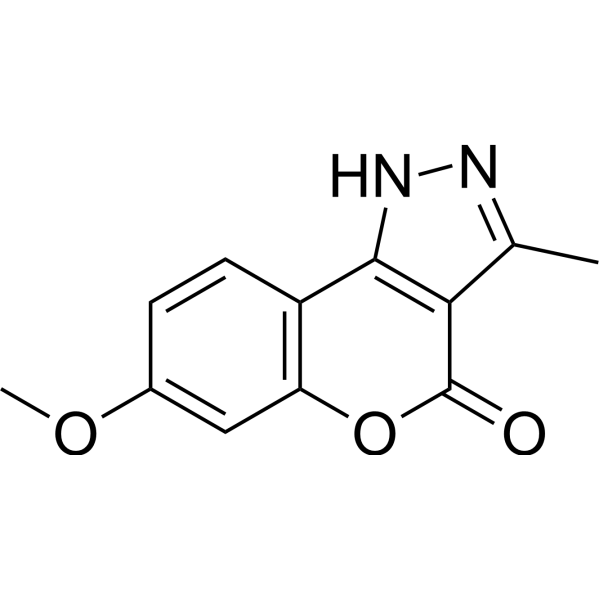
Physicochemical Properties
| Molecular Formula | C12H10N2O3 |
| Molecular Weight | 230.22 |
| Appearance | White to light yellow solid powder |
| HS Tariff Code | 2934.99.9001 |
| Storage |
Powder-20°C 3 years 4°C 2 years In solvent -80°C 6 months -20°C 1 month |
| Shipping Condition | Room temperature (This product is stable at ambient temperature for a few days during ordinary shipping and time spent in Customs) |
Biological Activity
| ln Vitro | In 3T3-L1 cells, ATF3 inducer 1 (compound 16c) (50 μM; 8 days) stimulates the expression of ATF3 mRNA and protein[1]. |
| ln Vivo | ATF3 inducer 1 (40 mg/kg; intraperitoneally; three times per week for ten weeks) has anti-metabolic syndrome (MetS) action in mice[1]. |
| Cell Assay |
Western Blot Analysis[1] Cell Types: 3T3-L1 cells Tested Concentrations: 50 μM Incubation Duration: 8 days Experimental Results: Increased the ATF3 protein and ATF3 mRNA expression, demonstrated no lipid accumulation. |
| Animal Protocol |
Animal/Disease Models: Eightweeks old C57BL/6 male mice[ 1] Doses: 40 mg/kg Route of Administration: Ip; three times a week for 10-weeks Experimental Results: diminished the bodyweight and the size of epididymal white adipose tissue (eWAT) adipocytes was Dramatically diminished. |
| References |
[1]. Exploration and biological evaluation of 7-methoxy-3-methyl-1H-chromeno[4,3-c]pyrazol-4-one as an activating transcription factor 3 inducer for managing metabolic syndrome. Eur J Med Chem. 2022 Nov 25;246:114951. |
Solubility Data
| Solubility (In Vitro) | DMSO :~65 mg/mL (~282.34 mM) |
| Solubility (In Vivo) |
Solubility in Formulation 1: ≥ 2.08 mg/mL (9.03 mM) (saturation unknown) in 10% DMSO + 40% PEG300 + 5% Tween80 + 45% Saline (add these co-solvents sequentially from left to right, and one by one), clear solution. For example, if 1 mL of working solution is to be prepared, you can add 100 μL of 20.8 mg/mL clear DMSO stock solution to 400 μL PEG300 and mix evenly; then add 50 μL Tween-80 to the above solution and mix evenly; then add 450 μL normal saline to adjust the volume to 1 mL. Preparation of saline: Dissolve 0.9 g of sodium chloride in 100 mL ddH₂ O to obtain a clear solution. Solubility in Formulation 2: ≥ 2.08 mg/mL (9.03 mM) (saturation unknown) in 10% DMSO + 90% Corn Oil (add these co-solvents sequentially from left to right, and one by one), clear solution. For example, if 1 mL of working solution is to be prepared, you can add 100 μL of 20.8 mg/mL clear DMSO stock solution to 900 μL of corn oil and mix evenly. (Please use freshly prepared in vivo formulations for optimal results.) |
| Preparing Stock Solutions | 1 mg | 5 mg | 10 mg | |
| 1 mM | 4.3437 mL | 21.7184 mL | 43.4367 mL | |
| 5 mM | 0.8687 mL | 4.3437 mL | 8.6873 mL | |
| 10 mM | 0.4344 mL | 2.1718 mL | 4.3437 mL |