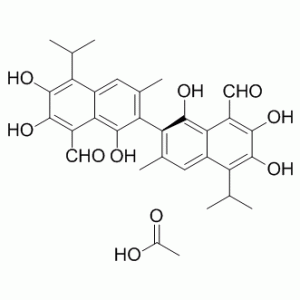
AT-101 [(R)-(-)-Gossypol acetic acid, the levorotatory isomer of a natural product Gossypol], is a novel, oral and potent inhibitor of Bcl-2, Bcl-xL and Mcl-1 with Ki of 0.32 μM, 0.48 μM and 0.18 μM in cell-free assays; it shows no inhibition against BIR3 and BID. Gossypol's R-(-) enantiomer, AT-101, has potential antineoplastic activity and is orally bioavailable. R-(-)-gossypol functions as a BH3 mimetic, attaching to the hydrophobic surface binding groove BH3 of the anti-apoptotic proteins Bcl-2 and Bcl-xL and preventing them from heterodimerizing with pro-apoptotic Bcl-2 family members like Bad, Bid, and Bim. This may stop tumor cell growth and trigger apoptosis in tumor cells. A polyphenolic substance called racemic gossypol was discovered in cottonseed.
Physicochemical Properties
| Molecular Formula | C30H30O8.C2H4O2 | |
| Molecular Weight | 578.61 | |
| Exact Mass | 578.215 | |
| Elemental Analysis | C, 66.43; H, 5.92; O, 27.65 | |
| CAS # | 866541-93-7 | |
| Related CAS # | (S)-Gossypol (acetic acid);1189561-66-7;Gossypol (acetic acid);12542-36-8;(R)-(-)-Gossypol;90141-22-3 | |
| PubChem CID | 227456 | |
| Appearance | Light yellow to brown solid powder | |
| LogP | 6.473 | |
| Hydrogen Bond Donor Count | 7 | |
| Hydrogen Bond Acceptor Count | 10 | |
| Rotatable Bond Count | 5 | |
| Heavy Atom Count | 42 | |
| Complexity | 811 | |
| Defined Atom Stereocenter Count | 0 | |
| SMILES | O=CC1C2C(=CC(C)=C(C3C(C)=CC4C(=C(C(=C(C=4C(C)C)O)O)C=O)C=3O)C=2O)C(C(C)C)=C(O)C=1O.O=C(C)O |
|
| InChi Key | NIOHNDKHQHVLKA-UHFFFAOYSA-N | |
| InChi Code | InChI=1S/C30H30O8.C2H4O2/c1-11(2)19-15-7-13(5)21(27(35)23(15)17(9-31)25(33)29(19)37)22-14(6)8-16-20(12(3)4)30(38)26(34)18(10-32)24(16)28(22)36;1-2(3)4/h7-12,33-38H,1-6H3;1H3,(H,3,4) | |
| Chemical Name | acetic acid compound with (S)-1,1',6,6',7,7'-hexahydroxy-5,5'-diisopropyl-3,3'-dimethyl-[2,2'-binaphthalene]-8,8'-dicarbaldehyde (1:1) | |
| Synonyms |
|
|
| HS Tariff Code | 2934.99.9001 | |
| Storage |
Powder-20°C 3 years 4°C 2 years In solvent -80°C 6 months -20°C 1 month Note: (1). This product requires protection from light (avoid light exposure) during transportation and storage.(2). Please store this product in a sealed and protected environment (e.g. under nitrogen), avoid exposure to moisture.(3). This product is not stable in solution, please use freshly prepared working solution for optimal results. |
|
| Shipping Condition | Room temperature (This product is stable at ambient temperature for a few days during ordinary shipping and time spent in Customs) |
Biological Activity
| Targets | Mcl-1 (Ki=170 nM); Bcl-2 (Ki=260 nM); Bcl-xL (Ki=480 nM); Autophagy |
| ln Vitro | The (+)-Gossypol and (R)-(-)-Gossypol enantiomers are the two forms of the naturally occurring racemic Gossypol. Gossypol (AT-101) and (+) are in (R)-(-) AT-101 is more effective than (+)-Gossypol in inhibiting cell growth and inducing apoptosis, possibly as a result of the influence of serum in the cell culture experiments. Although both AT-101 and (+)-Gossypol bind to Bcl-2 or Bcl-xL with similar binding affinities. In 6-day MTT assays, Gossypol's racemic form and each of its enantiomers are evaluated against UM-SCC-6 and UM-SCC-14A. The (+)-Gossypol and (R)-(-)-Gossypol enantiomers are the two forms of the naturally occurring racemic Gossypol. Gossypol (AT-101) and (+) are in (R)-(-) AT-101 is more effective than (+)-Gossypol in inhibiting cell growth and inducing apoptosis, possibly as a result of the influence of serum in the cell culture experiments. Although both AT-101 and (+)-Gossypol bind to Bcl-2 or Bcl-xL with similar binding affinities. In 6-day MTT assays, Gossypol's racemic form and each of its enantiomers are evaluated against UM-SCC-6 and UM-SCC-14A. Human fibroblast cell line growth was 50% inhibited by AT-101 doses that were 2- to 10-fold higher than those needed for HNSCC cell line growth. (R)-(-)-Gossypol (AT-101) concentrations are 2- to 3-fold higher than for HNSCC cell lines to inhibit human oral keratinocyte growth by 50%. In ten UM-SCC cell lines in a 6-day MTT assay, (R)-(-)-Gossypol (AT-101) inhibits cell growth in a dose-dependent manner over a range of 0.5 to 10 M. A very sensitive group of cell lines have an IC50 of 2–5 M, while a less sensitive group have IC50 clusters around 10 M[1]. The Bcl-2, Mcl-1, and Bcl-xL proteins bind to (R)-(-)-Gossypol (AT-101) with Ki values of 260–30 nM, 170–10 nM, and 480–40 nM, respectively[2]. |
| Enzyme Assay | For this assay, the 21-residue BH3 peptide QEDIIRNIARHLAQVGDSMDR derived from Bid labeled with 6-carboxyfluorescein succinimidyl ester (FAM-Bid) and recombinant proteins derived from human Bcl-2,Bcl-X L,and Mcl-1 are employed. It is determined that FAM-Bid has a Ki of 11 nM to Bcl-2 protein,25 nM to Bcl-XL protein,and 5.7 nM to Mcl-1 protein. The competitive binding assay for Bcl-XL is same as that for Bcl-2 with the following exceptions: 30 nM Bcl-XL protein and 2.5 nM FAM-Bid peptide in the following assay buffer [50 mM Tris-Bis (pH 7.4) and 0.01% bovine gamma-globulin]. |
| Cell Assay | Two representative UM-SCC cell lines, UM-SCC-6 and UM-SCC-14A, are continuously exposed to 0 (vehicle control), 5 or 10 μM (±)-Gossypol, (R)-(-)-Gossypol or (+)-Gossypol in a 6-day MTT cell survival assay. |
| Animal Protocol |
~40 mg/kg Administered via i.v. or i.p. Athymic NCr-nu/nu mice bearing SK-Mel-147 melanoma xenografts |
| References |
[1]. In vitro effects of the BH3 mimetic, (-)-Gossypol, on head and neck squamous cell carcinoma cells. Clin Cancer Res. 2004 Nov 15;10(22):7757-63. [2]. Apogossypolone, a nonpeptidic small molecule inhibitor targeting Bcl-2 family proteins, effectively inhibits growth of diffuse large cell lymphoma cells in vitro and in vivo. Cancer Biol Ther. 2008 Sep;7(9):1418-26. |
| Additional Infomation |
Gossypol Acetic Acid is the naturally occurring acetic acid form of gossypol, and an orally available polyphenolic aldehyde derived mostly from cottonseed with potential antineoplastic activity. The biologic activities of gossypol acetic acid are similar to those of gossypol and include suppression of DNA replication, inhibition of tumor cell proliferation, and male contraceptive effects. (NCI04) R-(-)-Gossypol Acetic Acid is the orally bioavailable solvate of the R-(-) enantiomer of gossypol and acetic acid with potential antineoplastic activity. As a BH3 mimetic, R-(-)-gossypol binds to the hydrophobic surface binding groove BH3 of the anti-apoptotic proteins Bcl-2 and Bcl-xL, blocking their heterodimerization with pro-apoptotic members of the Bcl-2 family of proteins such as Bad, Bid, and Bim; this may result in the inhibition of tumor cell proliferation and the induction of tumor cell apoptosis. Racemic gossypol is a polyphenolic compound isolated from cottonseed. |
Solubility Data
| Solubility (In Vitro) |
|
|||
| Solubility (In Vivo) |
Solubility in Formulation 1: ≥ 1.25 mg/mL (2.16 mM) (saturation unknown) in 10% DMSO + 40% PEG300 + 5% Tween80 + 45% Saline (add these co-solvents sequentially from left to right, and one by one), clear solution. For example, if 1 mL of working solution is to be prepared, you can add 100 μL of 12.5 mg/mL clear DMSO stock solution to 400 μL PEG300 and mix evenly; then add 50 μL Tween-80 to the above solution and mix evenly; then add 450 μL normal saline to adjust the volume to 1 mL. Preparation of saline: Dissolve 0.9 g of sodium chloride in 100 mL ddH₂ O to obtain a clear solution. Solubility in Formulation 2: 1.25 mg/mL (2.16 mM) in 10% DMSO + 90% (20% SBE-β-CD in Saline) (add these co-solvents sequentially from left to right, and one by one), suspension solution; with ultrasonication. For example, if 1 mL of working solution is to be prepared, you can add 100 μL of 12.5 mg/mL clear DMSO stock solution to 900 μL of 20% SBE-β-CD physiological saline solution and mix evenly. Preparation of 20% SBE-β-CD in Saline (4°C,1 week): Dissolve 2 g SBE-β-CD in 10 mL saline to obtain a clear solution. Solubility in Formulation 3: 0.5% CMC: 30mg/mL (Please use freshly prepared in vivo formulations for optimal results.) |
| Preparing Stock Solutions | 1 mg | 5 mg | 10 mg | |
| 1 mM | 1.7283 mL | 8.6414 mL | 17.2828 mL | |
| 5 mM | 0.3457 mL | 1.7283 mL | 3.4566 mL | |
| 10 mM | 0.1728 mL | 0.8641 mL | 1.7283 mL |