|
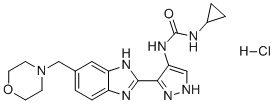
AT9283 is a novel, potent multikinase inhibitor with potential antineoplastic activity and has the potential for the treatment of multiple myeloma. It inhibits JAK2/3 with IC50 of 1.2 nM/1.1 nM in cell-free assays. AT9283 binds to and inhibits Aurora kinases A and B, JAK2 and the kinase BCR-ABL, which may result in the inhibition of cellular division and proliferation and the induction of apoptosis in tumor cells that overexpress these kinases.
|
Physicochemical Properties
| Molecular Formula |
C19H24CLN7O2
|
| Molecular Weight |
417.89
|
| Exact Mass |
417.167
|
| CAS # |
896466-61-8
|
| Related CAS # |
896466-61-8 (HCl);896466-04-9;896466-76-5 (lactate);
|
| PubChem CID |
135461257
|
| Appearance |
Typically exists as solid at room temperature
|
| Hydrogen Bond Donor Count |
5
|
| Hydrogen Bond Acceptor Count |
5
|
| Rotatable Bond Count |
5
|
| Heavy Atom Count |
29
|
| Complexity |
554
|
| Defined Atom Stereocenter Count |
0
|
| SMILES |
O=C(NC1CC1)NC2=CNN=C2C=3NC4=C(N3)C=C(C=C4)CN5CCOCC5.Cl
|
| InChi Key |
NHFNYIVVGIXBPD-UHFFFAOYSA-N
|
| InChi Code |
InChI=1S/C19H23N7O2.ClH/c27-19(21-13-2-3-13)24-16-10-20-25-17(16)18-22-14-4-1-12(9-15(14)23-18)11-26-5-7-28-8-6-26;/h1,4,9-10,13H,2-3,5-8,11H2,(H,20,25)(H,22,23)(H2,21,24,27);1H
|
| Chemical Name |
1-cyclopropyl-3-[5-[6-(morpholin-4-ylmethyl)-1H-benzimidazol-2-yl]-1H-pyrazol-4-yl]urea;hydrochloride
|
| Synonyms |
| AT9283; AT 9283; AT-9283HCl |
|
| HS Tariff Code |
2934.99.9001
|
| Storage |
Powder-20°C 3 years
4°C 2 years
In solvent -80°C 6 months
-20°C 1 month
|
| Shipping Condition |
Room temperature (This product is stable at ambient temperature for a few days during ordinary shipping and time spent in Customs)
|
|
Biological Activity
| ln Vitro |
In vitro activity: AT9283 leads to a clear polyploid phenotype by inhibiting the activity of Aurora B kinase in HCT116 cells with IC50 of 30 nM. Furthermore, AT9283 also produces the potent inhibition on HCT116 colony formation.
Kinase Assay: Assays for Aurora A and B are performed in a DELFIA format. Aurora A enzyme is incubated with AT9283 and 3 μM cross-tide substrate (biotin-CGPKGPGRRGRRRTSSFAEG) in 10 mM MOPS, pH 7, 0.1 mg/mL BSA, 0.001% Brij-35, 0.5% glycerol, 0.2 mM EDTA, 10 mM MgCl2, 0.01% β-mercaptoethanol, 15 μM ATP, and 2.5% DMSO. Aurora B enzyme is incubated with AT9283, 3 μM of the above substrate in 25 mM Tris, pH 8.5, 5 mM MgCl2, 0.1 mg/mL BSA, 0.025% Tween-20, 1 mM DTT, 15 μM ATP, and 2.5% DMSO. Reactions are allowed to proceed for 60 minutes and 45-90 minutes for Aurora A and Aurora B, respectively, before quenching with EDTA. The reaction mixtures are then transferred to a neutravidin-coated plate, and phosphorylated peptide is quantified by means of a phospho-specific antibody and a europium labeled secondary antibody using time-resolved fluorescence (excitation, 337 nm; emission, 620 nm). IC50 values for the control compounds are 92 nM (Aurora A assay) and 17 nM (Aurora B).
Cell Assay: HCT 116 cells are cultured in DMEM + 10% FBS + GLUTAMAX I. Black 96-well flat-bottomed (clear) tissue culture treated plates are seeded in 200 μL of medium and incubated for approximately 16 hours at 37°C in a humidified atmosphere of 5% CO2 in air. Cells are treated with test compound at nine different concentrations (spanning 1 nM to 10 μM, plus DMSO vehicle control) and then incubated for 72 hours. Polyploidy morphological observations of the cells are then noted. The concentration of AT9283 required to produce a distinct polyploid phenotype is reported. Cells are seeded at a concentration of 75−100 cells/mL relevant culture media onto 6- or 24-well tissue culture plates and allowed to recover for 16 hours. Test compound (11 concentrations spanning 0.1 nM to 10 μM) or vehicle control (DMSO) is added to duplicate wells to give a final DMSO concentration of 0.1%. Following compound addition, colonies are allowed to grow between 10 and 14 days for optimum discrete colony counting. Colonies are fixed in 2 mL of Carnoys fixative (25% acetic acid, 75% MeOH) and stained in 2 mL of 0.4% w/v crystal violet. The numbers of colonies in each well is counted. IC50 values are calculated by sigmoidal dose-response (variable slope) IC50 curves using Prism Graphpad software. |
|
| ln Vivo |
| In HCT116 human colon carcinoma xenograft bearing mice, AT9283 treatment (15 mg/kg and 20 mg/kg) for 16 days results in a significant tumor growth inhibition of 67% and 76%, respectively. In addition, AT9283 also exhibits a significantly longer half-life in tumors(2.5 hours) compared with plasma (0.5 hour) and modest oral bioavailability in mice (Fp.o. = 24%). |
|
| Animal Protocol |
| Dissolved in 10% DMSO, 20% water, 70% hydroxypropyl- β-cyclodextrin (25% w/v aq).; 15 and 20 mg/kg; administrated i.p. | | HCT116 cells are injected s.c. Into the hind flank of male BALB/c mice. | |
|
| References |
J Med Chem.2009 Jan 22;52(2):379-88.
|
|
Solubility Data
| Solubility (In Vitro) |
| DMSO: >50 mg/mL | | Water:N/A | | Ethanol:N/A |
|
| Solubility (In Vivo) |
| 2% DMSO+30% PEG 300+ddH2O:5mg/mL |
(Please use freshly prepared in vivo formulations for optimal results.)
|
| Preparing Stock Solutions |
|
1 mg |
5 mg |
10 mg |
| 1 mM |
2.3930 mL |
11.9649 mL |
23.9297 mL |
| 5 mM |
0.4786 mL |
2.3930 mL |
4.7859 mL |
| 10 mM |
0.2393 mL |
1.1965 mL |
2.3930 mL |
*Note: Please select an appropriate solvent for the preparation of stock solution based on your experiment needs. For most products, DMSO can be used for preparing stock solutions (e.g. 5 mM, 10 mM, or 20 mM concentration); some products with high aqueous solubility may be dissolved in water directly. Solubility information is available at the above Solubility Data section. Once the stock solution is prepared, aliquot it to routine usage volumes and store at -20°C or -80°C. Avoid repeated freeze and thaw cycles. |