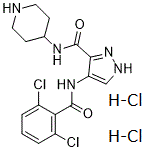
AT-7519 diHCl is a novel and potent multi-CDK (cyclin-dependent kinase) inhibitor for Cdk1/cyclin B, Cdk2/Cyclin A, Cdk3/Cyclin E, Cdk4/Cyclin D1, Cdk5/p35, and Cdk6/Cyclin D3 with IC50s of 210, 47, 100, 13, 170, and<10 nM for CDK1, CDK2, CDK4 to CDK6, and CDK9, respectively. All non-Cdk kinases except GSK3β are inactive against AT7519, an ATP competitive Cdk inhibitor. Many human tumor cell lines, including SW620, exhibit strong antiproliferative activity in response to AT7519. Regardless of transcription inhibition, AT7519 induces apoptosis through downregulating GSK-3β phosphorylation, which in turn activates GSK-3β.
Physicochemical Properties
| Molecular Formula | C16H18CL3N5O2 |
| Molecular Weight | 418.71 |
| Exact Mass | 417.052608 |
| Elemental Analysis | C, 45.90; H, 4.33; Cl, 25.40; N, 16.73; O, 7.64 |
| CAS # | 902135-91-5 |
| Related CAS # | AT7519;844442-38-2;AT7519 TFA;1431697-85-6 |
| PubChem CID | 25033099 |
| Appearance | white solid powder |
| Density | 1.5±0.1 g/cm3 |
| Boiling Point | 586.0±50.0 °C at 760 mmHg |
| Flash Point | 308.2±30.1 °C |
| Vapour Pressure | 0.0±1.6 mmHg at 25°C |
| Index of Refraction | 1.654 |
| LogP | 0.95 |
| Hydrogen Bond Donor Count | 5 |
| Hydrogen Bond Acceptor Count | 4 |
| Rotatable Bond Count | 4 |
| Heavy Atom Count | 26 |
| Complexity | 479 |
| Defined Atom Stereocenter Count | 0 |
| SMILES | 0 |
| InChi Key | PAOFPNGYBWGKCO-UHFFFAOYSA-N |
| InChi Code | InChI=1S/C16H17Cl2N5O2.ClH/c17-10-2-1-3-11(18)13(10)15(24)22-12-8-20-23-14(12)16(25)21-9-4-6-19-7-5-9;/h1-3,8-9,19H,4-7H2,(H,20,23)(H,21,25)(H,22,24);1H |
| Chemical Name | 4-[(2,6-dichlorobenzoyl)amino]-N-piperidin-4-yl-1H-pyrazole-5-carboxamide;hydrochloride |
| Synonyms | AT-7519 diHCl; AT7519; AT 7519; AT-7519 |
| HS Tariff Code | 2934.99.9001 |
| Storage |
Powder-20°C 3 years 4°C 2 years In solvent -80°C 6 months -20°C 1 month Note: Please store this product in a sealed and protected environment, avoid exposure to moisture. |
| Shipping Condition | Room temperature (This product is stable at ambient temperature for a few days during ordinary shipping and time spent in Customs) |
Biological Activity
| Targets | CDK9/Cyclin T (IC50 = 10 nM); CDK5/p35 (IC50 = 13 nM); cdk2/cyclin A (IC50 = 47 nM); Cdk4/cyclin D1 (IC50 = 100 nM); cdk6/cyclin D3 (IC50 = 170 nM); Cdk1/cyclin B (IC50 = 210 nM); CDK7/Cyclin H/MAT1 (IC50 = 2400 nM); GSK3β (IC50 = 89 nM) |
| ln Vitro | In MM cells, AT7519 Hydrochloride (0–4 μM) causes dose-dependent cytotoxicity with an IC50 range from 0.5–2 μM. This cytotoxicity is linked to GSK-3β activation and is not reliant on inflection point blockage. Time-induced induction of MM cells is achieved by AT7519 Hydrochloride (0.5 μM). Additionally, in MM.1S cells, AT7519 Hydrochloride (0.5 μM) partially inhibits RNA production and prevents RNA polymerase II CTD from being phosphorylated [1]. Human tumor cell lines' cell cycle progression is inhibited by AT7519 hydrochloric acid (250 nM). Human tumor cell lines likewise develop liver cancer when exposed to AT7519 hydrochloric acid [2]. Cellular effects are induced in blank cell lines by AT7519 hydrochloric acid (100-700 nM). In human tumor cell lines, AT7519 hydrochloride also suppresses transcription. Furthermore, RNA polymerase II is inhibited and antioxidant protein levels are decreased by AT7519 Hydrochronide [3]. |
| ln Vivo | In a human MM xenograft model, AT7519 hydrochloride suppresses the growth of tumors [1]. Early-stage HCT116 tumor xenografts are inhibited in their growth by AT7519 hydrochloride (4.6 and 9.1 mg/kg/dose). Target CDKs are likewise inhibited by AT7519 Hydrochloride (10 mg/kg, ip) in BALB/c nude mice with HCT116 tumors[2]. |
| Enzyme Assay | Kinase assays using radiometric filter binding are conducted for CDK1, CDK2, and GSK3-β. The format of the assays is ELISA for CDKs 4 and 6, and DELFIA for CDK 5. The relevant CDK and 0.12 μg/mL Histone H1 are incubated for 2 or 4 hours, respectively, in 20 mM MOPS, pH 7.2, 25 mM β-glycerophosphate, 5 mM EDTA, 15 mM MgCl2, 1 mM sodium orthovanadate, 1 mM DTT, 0.1 mg/mL BSA, 45 μM ATP (0.78 Ci/mmol), and various concentrations of AT7519. In order to test GSK3-β, the appropriate enzyme and 5 μM glycogen synthase peptide 2 are added, and the mixture is incubated for three hours at 10 mM MOPS pH 7.0, 0.1 mg/mL BSA, 0.001% Brij-35, 0.5% glycerol, 0.2 mM EDTA, 10 mM MgCl2, 0.01% β-mercaptoethanol, 15 μM ATP (2.31 Ci/mmol), all of which are tested. Millipore MAPH filter plates are used to filter the assay reactions after an excess of orthophosphoric acid is added to stop the reaction. After that, the plates are cleaned, scintillant is added, and radioactivity is determined using a Packard TopCount scintillation counting device. For a duration of 30 minutes, CDK5, CDK5/p35, 1μM of a biotinylated Histone H1 peptide (Biotin-PKTPKKAKKL), pH 7.5, 25 mM Tris-HCl, 0.025% Brij-35, 0.1 mg/mL BSA, 1 mM DTT, 15 μM ATP, and various concentrations of AT7519 are incubated. Time-resolved fluorescence at λex=335nm, λem=620nm is used to stop the assay reactions using EDTA, transfer the mixture to Neutravidin-coated plates, and quantify the phosphorylated peptide using a rabbit phospho-cdk1 substrate polyclonal antibody and DELFIA europium-labelled anti-rabbit IgG secondary antibody. Plates are coated with GST-pRb769-921 and blocked with Superblock for the CDK 4 and 6 assays. In order to initiate the reaction, ATP is added to CDK4 or 6. The incubation conditions include 15 mM MgCl2, 50 mM HEPES, pH 7.4, 1 mM DTT, 1 mM EGTA, pH 8.0, 0.02% Triton X-100, 2.5% DMSO, and various concentrations of AT7519. Reactions are halted by adding 0.5 M EDTA pH 8.0 after 30 minutes. After that, plates are cleaned and incubated for one hour with a secondary antibody (alkaline phosphatase linked anti-rabbit) and another hour with the primary antibody (anti-p-Rb Serine 780) diluted in Superblock. Fluorescence is measured on a Spectramax Gemini plate reader at excitation of 450 nm and emission of 580 nm after plates are developed using the Attophos system. Using GraphPad Prism software, IC50 values are computed from replicate curves in every scenario. |
| Cell Assay | The 3-(4,5-dimethylthiazol-2-yl)-2,5 diphenyl tetrasodium bromide (MTT) dye absorbance is used to measure the effects of AT7519 on the viability of MM cell lines, primary MM cells, and PBMNCs. Triiodothymidine uptake (3H-TdR) is used to quantify DNA synthesis. MM cells (2–3 × 10⁴ cells/well) are cultured for 24 or 48 hours at 37°C in 96-well culture plates with media and varying concentrations of AT7519, recombinant IL-6 (10 ng/mL), or IGF-1 (50 ng/mL). 3H-TdR incorporation is then measured. |
| Animal Protocol | In order to assess the in vivo anti-MM activity of AT7519, 5×10⁶ MM.1S cells are subcutaneously injected into male SCID mice using 100 μL of serum-free RPMI 1640 medium. Mice are treated intraperitoneally (IP) with vehicle or AT7519 dissolved in 0.9% saline solution when tumors are detectable. Ten mice in the first group receive a daily dose of 15 mg/kg for two weeks, while the second group receives a daily dose of 15 mg/kg three times a week for four weeks in a row. The carrier is given to the control group separately at the same time. Tumor volume is calculated using the formula V= 0.5 a × b2, where a represents the tumor's long diameter and b its short diameter. Tumor size is measured every other day in two dimensions using calipers. When a tumor is ulcerated or grows to a size of 2 cm3, the animal is killed. From the first day of treatment until death, survival and tumor growth are assessed. |
| References |
[1]. AT7519, A novel small molecule multi-cyclin-dependent kinase inhibitor, induces apoptosis in multiple myeloma via GSK-3beta activation and RNA polymerase II inhibition. Oncogene. 2010 Apr 22;29(16):2325-36. [2]. Biological characterization of AT7519, a small-molecule inhibitor of cyclin-dependent kinases, in human tumor cell lines. Biological characterization of AT7519, a small-molecule inhibitor of cyclin-dependent kinases, in human tumor cell lines. [3]. AT7519, a cyclin-dependent kinase inhibitor, exerts its effects by transcriptional inhibition in leukemia cell lines and patient samples. Mol Cancer Ther. 2010 Apr;9(4):920-8. |
Solubility Data
| Solubility (In Vitro) |
DMSO: ~52 mg/mL (~124.2 mM) Ethanol: ~28 mg/mL (~66.9 mM) Water: ~43 mg/mL (~102.7 mM) |
| Solubility (In Vivo) | Saline: 30mg/mL (Please use freshly prepared in vivo formulations for optimal results.) |
| Preparing Stock Solutions | 1 mg | 5 mg | 10 mg | |
| 1 mM | 2.3883 mL | 11.9414 mL | 23.8829 mL | |
| 5 mM | 0.4777 mL | 2.3883 mL | 4.7766 mL | |
| 10 mM | 0.2388 mL | 1.1941 mL | 2.3883 mL |