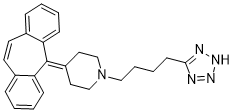
Physicochemical Properties
| Exact Mass | 397.226 |
| Elemental Analysis | C, 75.54; H, 6.85; N, 17.62 |
| CAS # | 162640-98-4 |
| PubChem CID | 11741525 |
| Appearance | White to off-white solid powder |
| Density | 1.2±0.1 g/cm3 |
| Boiling Point | 620.4±65.0 °C at 760 mmHg |
| Flash Point | 329.0±34.3 °C |
| Vapour Pressure | 0.0±1.8 mmHg at 25°C |
| Index of Refraction | 1.646 |
| LogP | 5.84 |
| Hydrogen Bond Donor Count | 1 |
| Hydrogen Bond Acceptor Count | 4 |
| Rotatable Bond Count | 5 |
| Heavy Atom Count | 30 |
| Complexity | 591 |
| Defined Atom Stereocenter Count | 0 |
| InChi Key | LQNGMDUIRLSESZ-UHFFFAOYSA-N |
| InChi Code | InChI=1S/C25H27N5/c1-3-9-22-19(7-1)12-13-20-8-2-4-10-23(20)25(22)21-14-17-30(18-15-21)16-6-5-11-24-26-28-29-27-24/h1-4,7-10,12-13H,5-6,11,14-18H2,(H,26,27,28,29) |
| Chemical Name | 1-[4-(2H-tetrazol-5-yl)butyl]-4-(2-tricyclo[9.4.0.03,8]pentadeca-1(15),3,5,7,9,11,13-heptaenylidene)piperidine |
| Synonyms | AT-56 AT56 AT 56 |
| HS Tariff Code | 2934.99.9001 |
| Storage |
Powder-20°C 3 years 4°C 2 years In solvent -80°C 6 months -20°C 1 month |
| Shipping Condition | Room temperature (This product is stable at ambient temperature for a few days during ordinary shipping and time spent in Customs) |
Biological Activity
| ln Vitro | In human medulloblastoma TE-671 cells expressing L-PGDS, AT-56 (1-30 μM; 10 min) dose-dependently suppresses PGD2 synthesis with an IC50 of roughly 3 μM [1]. |
| ln Vivo | AT-56 (1-30 mg/kg; oral) reduces PGD2 production in the stab-injured brain [1]. AT-56 (1-10 mg/kg; oral) suppresses L-PGDS-mediated allergic airway inflammation in mice [1]. AT-56 (10 mg/kg; oral) has a Cmax (2.15 μg/ml), half-life (1.71 hours), and excellent oral bioavailability (82%) [1]. |
| Animal Protocol |
Animal/Disease Models: H-PGDS KO mice with stab brain injury (14-16 weeks, 25-30 g, C57BL/6 strain) [1] Doses: 0, 1, 3, 10, 30 mg/kg administered Method: Po 1 hour before stabbing Experimental Results:Inhibited L-PGDS response in the brain. Using 30 mg/kg AT-56 diminished the total amount of PGD2 in the brain to 40%. Animal/Disease Models: Human L-PGDS overexpressing TG mice (male, 14-16 weeks, 25-30 g) [1] Doses: 0, 1, 10 mg/kg Route of Administration: 1 hour before and 24 hrs (hrs (hours)) after antigen exposure Hourly oral Experimental Results: Prevention of eosinophil infiltration by inhibition of transgenic human L-PGDS. Animal/Disease Models: Male C57BL/6 mice (7 weeks, 22-26 g) [1] Doses: 10 mg/kg orally, 2 mg/kg intravenously (iv) (iv)(iv) (pharmacokinetic/PK/PK analysis) Dosing methods: oral and intravenous (iv) (iv)injection Experimental Results: Oral bioavailability (82%); Cmax (2.15 μg/ml); T1/2 (1.71 hrs (hrs (hours)), oral); T1/2 (2.35 hrs (hrs (hours)), intravenous (iv) (iv)injection). |
| References |
[1]. Biochemical, functional, and pharmacological characterization of AT-56, an orally active and selective inhibitor of lipocalin-type prostaglandin D synthase. J Biol Chem. 2009 Mar 20; 284(12): 7623-30. |
Solubility Data
| Solubility (In Vitro) | DMSO : ~100 mg/mL (~251.56 mM) |
| Solubility (In Vivo) |
Solubility in Formulation 1: ≥ 2.5 mg/mL (6.29 mM) (saturation unknown) in 10% DMSO + 40% PEG300 + 5% Tween80 + 45% Saline (add these co-solvents sequentially from left to right, and one by one), clear solution. For example, if 1 mL of working solution is to be prepared, you can add 100 μL of 25.0 mg/mL clear DMSO stock solution to 400 μL PEG300 and mix evenly; then add 50 μL Tween-80 to the above solution and mix evenly; then add 450 μL normal saline to adjust the volume to 1 mL. Preparation of saline: Dissolve 0.9 g of sodium chloride in 100 mL ddH₂ O to obtain a clear solution. Solubility in Formulation 2: ≥ 2.5 mg/mL (6.29 mM) (saturation unknown) in 10% DMSO + 90% (20% SBE-β-CD in Saline) (add these co-solvents sequentially from left to right, and one by one), clear solution. For example, if 1 mL of working solution is to be prepared, you can add 100 μL of 25.0 mg/mL clear DMSO stock solution to 900 μL of 20% SBE-β-CD physiological saline solution and mix evenly. Preparation of 20% SBE-β-CD in Saline (4°C,1 week): Dissolve 2 g SBE-β-CD in 10 mL saline to obtain a clear solution. Solubility in Formulation 3: ≥ 2.5 mg/mL (6.29 mM) (saturation unknown) in 10% DMSO + 90% Corn Oil (add these co-solvents sequentially from left to right, and one by one), clear solution. For example, if 1 mL of working solution is to be prepared, you can add 100 μL of 25.0 mg/mL clear DMSO stock solution to 900 μL of corn oil and mix evenly. (Please use freshly prepared in vivo formulations for optimal results.) |