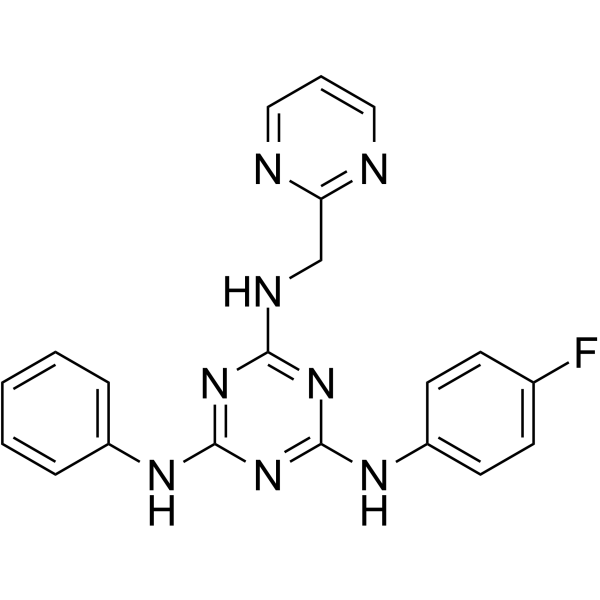
Physicochemical Properties
| Molecular Formula | C20H17FN8 |
| Molecular Weight | 388.40 |
| Exact Mass | 388.156 |
| CAS # | 792184-90-8 |
| PubChem CID | 46913817 |
| Appearance | White to off-white solid powder |
| Density | 1.4±0.1 g/cm3 |
| Boiling Point | 600.5±65.0 °C at 760 mmHg |
| Flash Point | 317.0±34.3 °C |
| Vapour Pressure | 0.0±1.7 mmHg at 25°C |
| Index of Refraction | 1.739 |
| LogP | 2.26 |
| Hydrogen Bond Donor Count | 3 |
| Hydrogen Bond Acceptor Count | 9 |
| Rotatable Bond Count | 7 |
| Heavy Atom Count | 29 |
| Complexity | 463 |
| Defined Atom Stereocenter Count | 0 |
| InChi Key | APYUZVKHUKMAIJ-UHFFFAOYSA-N |
| InChi Code | InChI=1S/C20H17FN8/c21-14-7-9-16(10-8-14)26-20-28-18(24-13-17-22-11-4-12-23-17)27-19(29-20)25-15-5-2-1-3-6-15/h1-12H,13H2,(H3,24,25,26,27,28,29) |
| Chemical Name | 2-N-(4-fluorophenyl)-4-N-phenyl-6-N-(pyrimidin-2-ylmethyl)-1,3,5-triazine-2,4,6-triamine |
| HS Tariff Code | 2934.99.9001 |
| Storage |
Powder-20°C 3 years 4°C 2 years In solvent -80°C 6 months -20°C 1 month |
| Shipping Condition | Room temperature (This product is stable at ambient temperature for a few days during ordinary shipping and time spent in Customs) |
Biological Activity
| ln Vitro | In CHO cells expressing KCNH3, ASP2905 potently suppresses potassium currents (IC50 of 9.0 nM). 55 transmembrane proteins had modest binding affinities with ASP2905 (≤10 μM). In cultured rat hippocampus neurons, ASP2905 (0.1 µM, 1 µM) reduces the frequency of spontaneous inhibitory postsynaptic currents[1]. |
| ln Vivo | Treatment with ASP2905 prevents phencyclidine-induced hyperlocomotion. It considerably reduces the length of immobility time that phencyclidine causes in mice put through the forced swimming test[2]. |
| Animal Protocol |
Animal/Disease Models: Male ddY mice (aged 4-5 weeks) injected with Phencyclidine hydrochloride (PCP)[2] Doses: 0.01 mg/kg, 0.03 mg/kg, 0.1 mg/kg, 0.3 mg/kg Route of Administration: Oral administration; once Experimental Results: Inhibited hyperlocomotion induced by Phencyclidine. |
| References |
[1]. Neurochemical and neuropharmacological characterization of ASP2905, a novel potent selective inhibitor of the potassium channel KCNH3. Eur J Pharmacol. 2017 Sep 5;810:26-35. [2]. ASP2905, a specific inhibitor of the potassium channel Kv12.2 encoded by the Kcnh3 gene, is psychoactive in mice. Behav Brain Res. 2020 Jan 27;378:112315. |
Solubility Data
| Solubility (In Vitro) | DMSO: 100 mg/mL (257.47 mM) |
| Solubility (In Vivo) |
Solubility in Formulation 1: ≥ 2.5 mg/mL (6.44 mM) (saturation unknown) in 10% DMSO + 40% PEG300 + 5% Tween80 + 45% Saline (add these co-solvents sequentially from left to right, and one by one), clear solution. For example, if 1 mL of working solution is to be prepared, you can add 100 μL of 25.0 mg/mL clear DMSO stock solution to 400 μL PEG300 and mix evenly; then add 50 μL Tween-80 to the above solution and mix evenly; then add 450 μL normal saline to adjust the volume to 1 mL. Preparation of saline: Dissolve 0.9 g of sodium chloride in 100 mL ddH₂ O to obtain a clear solution. Solubility in Formulation 2: ≥ 2.5 mg/mL (6.44 mM) (saturation unknown) in 10% DMSO + 90% Corn Oil (add these co-solvents sequentially from left to right, and one by one), clear solution. For example, if 1 mL of working solution is to be prepared, you can add 100 μL of 25.0 mg/mL clear DMSO stock solution to 900 μL of corn oil and mix evenly. (Please use freshly prepared in vivo formulations for optimal results.) |
| Preparing Stock Solutions | 1 mg | 5 mg | 10 mg | |
| 1 mM | 2.5747 mL | 12.8733 mL | 25.7467 mL | |
| 5 mM | 0.5149 mL | 2.5747 mL | 5.1493 mL | |
| 10 mM | 0.2575 mL | 1.2873 mL | 2.5747 mL |