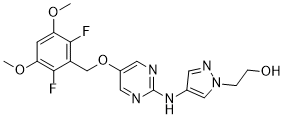
ASP5878 is a novel, potent, selective and orally bioactive inhibitor of FGFR 1, 2, 3, and 4, with IC50 values of 0.47 nM, 0.6 nM, 0.74 nM and 3.5 nM for FGFR 1, 2, 3, and 4 kinase activity. Potential antineoplastic activity exists for ASP5878. FGFR3-dependent urothelial cancer can be treated with ASP5878 either with or without chemoresistance. For patients with hepatocellular carcinoma whose tumors express fibroblast growth factor 19, ASP5878 is a potentially useful therapeutic agent.
Physicochemical Properties
| Molecular Formula | C18H19F2N5O4 |
| Molecular Weight | 407.37137055397 |
| Exact Mass | 407.14 |
| Elemental Analysis | C, 53.07; H, 4.70; F, 9.33; N, 17.19; O, 15.71 |
| CAS # | 1453208-66-6 |
| Related CAS # | 1453208-66-6;ASP5878 HCl; |
| PubChem CID | 71736582 |
| Appearance | Light yellow to yellow solid powder |
| LogP | 1.2 |
| Hydrogen Bond Donor Count | 2 |
| Hydrogen Bond Acceptor Count | 10 |
| Rotatable Bond Count | 9 |
| Heavy Atom Count | 29 |
| Complexity | 473 |
| Defined Atom Stereocenter Count | 0 |
| InChi Key | VDZZYOJYLLNBTD-UHFFFAOYSA-N |
| InChi Code | InChI=1S/C18H19F2N5O4/c1-27-14-5-15(28-2)17(20)13(16(14)19)10-29-12-7-21-18(22-8-12)24-11-6-23-25(9-11)3-4-26/h5-9,26H,3-4,10H2,1-2H3,(H,21,22,24) |
| Chemical Name | 2-[4-[[5-[(2,6-difluoro-3,5-dimethoxyphenyl)methoxy]pyrimidin-2-yl]amino]pyrazol-1-yl]ethanol |
| Synonyms | ASP5878; ASP-5878; ASP 5878 |
| HS Tariff Code | 2934.99.9001 |
| Storage |
Powder-20°C 3 years 4°C 2 years In solvent -80°C 6 months -20°C 1 month |
| Shipping Condition | Room temperature (This product is stable at ambient temperature for a few days during ordinary shipping and time spent in Customs) |
Biological Activity
| Targets |
FGFR1 (IC50 = 0.47 nM); FGFR2 (IC50 = 0.6 nM); FGFR3 (IC50 = 0.74 nM); FGFR4 (IC50 = 3.5 nM) Fibroblast growth factor receptors 1, 2, 3, and 4 (FGFR1, FGFR2, FGFR3, FGFR4). IC50 values: FGFR4 (3.5 nmol/L), FGFR1 (0.47 nmol/L), FGFR2 (0.60 nmol/L), FGFR3 (0.74 nmol/L), FGFR3 (K650E) (1.6 nmol/L), FGFR3 (K650M) (4.2 nmol/L), VEGFR2 (25 nmol/L), FGFR4 (N535K) (78 nmol/L), FMS (150 nmol/L). Other tested tyrosine kinases showed <50% inhibition at 200 nmol/L of ASP5878. |
| ln Vitro |
Most HCC cell lines have strong anti-apoptotic action from ASP5878 [1]. In humans, ASP5878 suppresses FGFR4 phosphorylation in a way dependent on concentration. FRS2 mobility is altered, phosphorylation is inhibited, and ERK phosphorylation is inhibited as a result of ASP5878 administration [1]. ASP5878 potently suppressed the growth of FGF19-expressing hepatocellular carcinoma (HCC) cell lines Hep3B2.1-7 (IC50 = 8.5 nmol/L), HuH-7 (IC50 = 27 nmol/L), and JHH-7 (IC50 = 21 nmol/L). HCC cell lines without FGF19 expression (JHH-5, PLC/PRF/5) showed much lower sensitivity to ASP5878 (IC50 = 410 and 730 nmol/L, respectively). In Hep3B2.1-7 cells, ASP5878 inhibited phosphorylation of FGFR4 and its downstream signaling molecules (phospho-FRS2, phospho-ERK) in a concentration-dependent manner and induced apoptosis, as evidenced by PARP cleavage at 48 hours post-treatment. Similar effects on signaling and apoptosis were confirmed in HuH-7 and JHH-7 cell lines. |
| ln Vivo |
In Hep3B2.1-7 subcutaneous xenograft and HCC orthotopic xenograft models, ASP5878 (3 mg/kg, bridge, once daily) showed antitumor activity [1]. In HCC, ASP5878 induces FGF19 contraction and expression. In a Hep3B2.1-7 subcutaneous xenograft mouse model, once-daily oral administration of ASP5878 at 3 mg/kg induced sustained tumor regression (88% regression). No body weight loss was observed over 14 days. In a HuH-7 orthotopic xenograft model, once-daily oral administration of ASP5878 at 3 mg/kg induced complete tumor regression, with bioluminescent signals reaching background levels by day 31 and sustained for the 90-day dosing period. This treatment dramatically extended survival, with 100% of mice alive at day 90 compared to all vehicle-treated mice dead by day 52. In a Hep3B2.1-7 xenograft model where treatment was switched from sorafenib (10 mg/kg) to ASP5878 (3 mg/kg) on day 14, ASP5878 induced 83% tumor regression by day 52 relative to tumor size on day 14. Pharmacodynamic analysis in Hep3B2.1-7 tumors showed that a single oral dose of ASP5878 (1 and 3 mg/kg) inhibited the mobility shift of FRS2 and suppressed ERK phosphorylation at 6 hours post-dose. |
| Enzyme Assay |
The inhibitory activity of ASP5878 against 128 serine/threonine kinases was measured using a mobility shift assay kit. IC50 values were determined for kinases that were inhibited by more than 50% at a concentration of 200 nmol/L of ASP5878. |
| Cell Assay |
Cell viability assay [1] Cell Types: Human liver cancer cell line. Tested Concentrations: 0-1000 nM. Incubation Duration: 5 days. Experimental Results: HuH-7, Hep3B2.1-7 and JHH-7 cell lines demonstrated strong sensitivity to ASP5878, with IC50 values of 27, 8.5 and 21 nmol/L respectively. At 1000 nM, the growth inhibition rate of HLF was 64%, and the growth inhibition rate of other ASP5878-sensitive cell lines was higher than 95%. For cell growth assays, various HCC cell lines were seeded in 96-well plates and incubated overnight. Cells were treated with ASP5878 for 5 days, and cell viability was measured using a luminescent cell viability assay. For Western blotting and ELISA, cells were lysed with a buffer containing phosphatase and protease inhibitors. Protein levels were determined by immunoblotting using specific antibodies. For phosphorylated and total FGFR4, immunoprecipitation was performed using an FGFR4 antibody or an isotype control, followed by immunoblotting or a sandwich ELISA assay. Hep3B2.1-7 cells were treated with ASP5878 for 2 hours to analyze phospho-FRS2, FRS2, phospho-ERK, ERK, and GAPDH. PARP cleavage was assessed after 48 hours of treatment. |
| Animal Protocol |
Animal/Disease Models: HCC orthotopic xenograft model (mouse) [1]. Doses: 3 mg/kg. Route of Administration: po (po (oral gavage)) one time/day for 24 days. Experimental Results: Mice treated with vehicle and sorafenib demonstrated lower tumor burden compared to vehicle. Induces sustained tumor regression without tumor regrowth. For subcutaneous xenograft models, Hep3B2.1-7 cells were suspended in a 1:1 mixture of Matrigel and PBS and inoculated into the flank of nude mice. ASP5878 was suspended in 0.5% methyl cellulose and administered orally once daily after tumor establishment. For the sorafenib switch study, Hep3B2.1-7 xenograft-bearing mice were treated with vehicle or sorafenib (10 mg/kg, suspended in 12.5% Cremophor EL/12.5% ethanol) orally once daily from days 0 to 13. On day 14, groups were switched to receive vehicle, continued sorafenib, or ASP5878 (3 mg/kg in 0.5% MC) orally once daily until day 52. For the orthotopic xenograft model, HuH-7 cells expressing luciferase were suspended in 100% Matrigel and inoculated into the hepatic parenchyma of mice. One week later, mice received vehicle, sorafenib (30 mg/kg), or ASP5878 (3 mg/kg) orally once daily for 91 days. Tumor growth was monitored via bioluminescent imaging. Tumor volume was calculated using the formula: length × width² × 0.5. |
| Toxicity/Toxicokinetics |
In repeated dose studies in rodents, increased serum phosphate (hyperphosphatemia) was observed following administration of ASP5878. This effect is consistent with the mechanism of action of FGFR inhibitors. |
| References |
[1]. ASP5878, a Novel Inhibitor of FGFR1, 2, 3, and 4, Inhibits the Growth of FGF19-Expressing Hepatocellular Carcinoma. Mol Cancer Ther. 2017 Jan;16(1):68-75. |
| Additional Infomation |
FGFR Inhibitor ASP5878 is an orally bioavailable inhibitor of the fibroblast growth factor receptor (FGFR), with potential antineoplastic activity. Upon oral administration, FGFR inhibitor ASP5878 binds to and inhibits FGFR, which results in the inhibition of FGFR-mediated signal transduction pathways. This inhibits proliferation in FGFR-overexpressing tumor cells. FGFR, a family of receptor tyrosine kinases upregulated in many tumor cell types, plays a key role in cellular proliferation and survival. ASP5878 is a novel, potent, and selective inhibitor of FGFR tyrosine kinases 1, 2, 3, and 4, under development for the treatment of HCC. Its activity is particularly pronounced against HCC with FGF19 overexpression, which acts as an oncogenic driver and a potential predictive biomarker for response. ASP5878 is categorized as a "pan-FGFR1, 2, 3, and 4 inhibitor." Its advantage over FGFR4-selective inhibitors may lie in its potential efficacy against HCC subsets driven by FGFR1, 2, or 3. ASP5878 was under evaluation in phase I clinical trials at the time of publication to assess safety, pharmacokinetics, pharmacodynamics, and to determine the recommended phase II dose. |
Solubility Data
| Solubility (In Vitro) |
DMSO: ~81 mg/mL (~198.8 mM) Ethanol: ~4 mg/mL (~9.8 mM) |
| Solubility (In Vivo) |
Solubility in Formulation 1: ≥ 2.08 mg/mL (5.11 mM) (saturation unknown) in 10% DMSO + 40% PEG300 + 5% Tween80 + 45% Saline (add these co-solvents sequentially from left to right, and one by one), clear solution. For example, if 1 mL of working solution is to be prepared, you can add 100 μL of 20.8 mg/mL clear DMSO stock solution to 400 μL PEG300 and mix evenly; then add 50 μL Tween-80 to the above solution and mix evenly; then add 450 μL normal saline to adjust the volume to 1 mL. Preparation of saline: Dissolve 0.9 g of sodium chloride in 100 mL ddH₂ O to obtain a clear solution. Solubility in Formulation 2: ≥ 2.08 mg/mL (5.11 mM) (saturation unknown) in 10% DMSO + 90% Corn Oil (add these co-solvents sequentially from left to right, and one by one), clear solution. For example, if 1 mL of working solution is to be prepared, you can add 100 μL of 20.8 mg/mL clear DMSO stock solution to 900 μL of corn oil and mix evenly. (Please use freshly prepared in vivo formulations for optimal results.) |
| Preparing Stock Solutions | 1 mg | 5 mg | 10 mg | |
| 1 mM | 2.4548 mL | 12.2739 mL | 24.5477 mL | |
| 5 mM | 0.4910 mL | 2.4548 mL | 4.9095 mL | |
| 10 mM | 0.2455 mL | 1.2274 mL | 2.4548 mL |