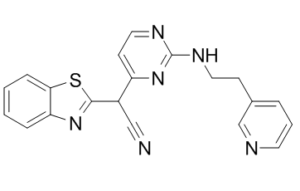
Physicochemical Properties
| Molecular Formula | C20H16N6S | |
| Molecular Weight | 372.45 | |
| Exact Mass | 372.116 | |
| Elemental Analysis | C, 64.50; H, 4.33; N, 22.56; S, 8.61 | |
| CAS # | 345987-15-7 | |
| Related CAS # |
|
|
| PubChem CID | 10109823 | |
| Appearance | Light yellow to yellow solid powder | |
| LogP | 3.213 | |
| Hydrogen Bond Donor Count | 1 | |
| Hydrogen Bond Acceptor Count | 7 | |
| Rotatable Bond Count | 6 | |
| Heavy Atom Count | 27 | |
| Complexity | 522 | |
| Defined Atom Stereocenter Count | 0 | |
| SMILES | N#CC(C1=CC=NC(NCCC2=CC=CN=C2)=N1)C3=NC4=CC=CC=C4S3 |
|
| InChi Key | RCYPVQCPYKNSTG-UHFFFAOYSA-N | |
| InChi Code | InChI=1S/C20H16N6S/c21-12-15(19-25-17-5-1-2-6-18(17)27-19)16-8-11-24-20(26-16)23-10-7-14-4-3-9-22-13-14/h1-6,8-9,11,13,15H,7,10H2,(H,23,24,26) | |
| Chemical Name | 2-(1,3-benzothiazol-2-yl)-2-[2-(2-pyridin-3-ylethylamino)pyrimidin-4-yl]acetonitrile | |
| Synonyms |
|
|
| HS Tariff Code | 2934.99.9001 | |
| Storage |
Powder-20°C 3 years 4°C 2 years In solvent -80°C 6 months -20°C 1 month |
|
| Shipping Condition | Room temperature (This product is stable at ambient temperature for a few days during ordinary shipping and time spent in Customs) |
Biological Activity
| Targets | hJNK1 (IC50 = 150 nM); hJNK2 (IC50 = 220 nM); hJNK3 (IC50 = 70 nM) | ||
| ln Vitro | AS601245 is an inhibitor of the JNK signaling pathway, it showed high JNK1/2/3 inhibition with IC50 of 150, 220, and 70 nM respectively. AWith an IC50 of 4800 nM, AS601245 specifically targets p38. The substance demonstrated effectiveness in the in vivo rheumatoid arthritis (RA) model by lowering in vivo TNF production and arthritis severity. Numerous biological studies have been carried out on AS601245 to investigate its anti-cancer and anti-neurodegenerative properties. Following cerebral ischemia, AS601245 aids in cell survival. | ||
| ln Vivo | In vivo, AS601245 reduces the release of TNF-α in a dose-dependent manner at concentrations of 0.3, 1, 3, and 10 mg/kg. In a gerbil model of transient global ischemia, AS601245 (40, 60, and 80 mg/kg) administered intravenously offered notable defense against the postponed loss of hippocampal CA1 neurons. JNK inhibition, and consequently c-Jun expression and phosphorylation, mediate this effect. After focal cerebral ischemia, rats treated with AS601245 showed a significant neuroprotective response when given the drug intravenously (6, 18, and 60 mg/kg) or as an intravenous bolus (1 mg/kg) followed by an intravenous infusion (0.6 mg/kg/h). These findings imply that the treatment of ischemic insults may benefit from the use of JNK inhibitors, such as AS601245. | ||
| Enzyme Assay | Rat JNK3 assays are carried out in 96-well Corning MTT plates with low binding: 0.5 μg of recombinant, preactivated GST-JNK3 is incubated with 1 μg of recombinant, biotinylated GST-c-Jun and 2 μM [33Pγ]ATP (2 nCi/μl),, in the presence or absence of compounds according to formula I and in a reaction volume of 50 μL containing 50 mM Tris-HCl, pH 8.0; 10 mM MgCl2, 1 mM Dithiothreitol, and 100 μM NaVO4, for 120 min and at room temperature. 200 mL of a solution containing 250 μg of streptavidin-coated SPA beads, 5 mM EDTA, 0.1% Triton X-100, and 50 μM ATP in phosphate saline buffer is added to the reaction to stop it, and the mixture is then incubated at room temperature for an additional 60 minutes. After incubation, the beads are centrifuged at 1500g for 5 min to further sediment them. They are then resuspended in 200 μL of phosphate-buffered saline (PBS) containing 5 mM EDTA, 0.1% Triton X-100, and 50 μM ATP, and the radioactivity is determined using a scintillation beta counter. JNK1 and JNK2 inhibition is demonstrated using a similar methodology. | ||
| Cell Assay | The "CellTiter-Glo Luminescent Cell Viability Assay" kit is used to assess the proliferation of CaCo-2 cells. The luminescence given off by cells with active metabolism is picked up by this extremely sensitive assay. The relative light unit (RLU) is a unit of measurement for luminescence. To treat the CaCo-2 cells seeded at roughly 4,000 cells per well in a 96-well plate for the proliferation experiments, the medications (for example, 0.1 μM AS601245) are added. MTT is used to examine HepG2 cell proliferation. In a nutshell, 1500 cells per well are seeded in 200 L of serum-supplemented media, and the next day the drugs (such as 0.1 μM AS601245) are applied. Then, the cells are treated with 20 L of thiazolyl blue tetrazolium bromide (5 mg/mL) before it is removed after two hours. The cells are given 100 μL of DMSO, and the absorbance is measured at 570 nm using a 96-well plate ELISA reader. Utilizing the Trypan blue exclusion test, viability is assessed. | ||
| Animal Protocol |
|
||
| References |
[1]. AS601245 (1,3-benzothiazol-2-yl (2-[[2-(3-pyridinyl) ethyl] amino]-4 pyrimidinyl) acetonitrile): a c-Jun NH2-terminal protein kinase inhibitor with neuroprotective properties. J Pharmacol Exp Ther. 2004;310(1):25-32. |
||
| Additional Infomation | 2-(1,3-benzothiazol-2-yl)-2-[2-[2-(3-pyridinyl)ethylamino]-4-pyrimidinyl]acetonitrile is a member of benzothiazoles. |
Solubility Data
| Solubility (In Vitro) |
|
|||
| Solubility (In Vivo) |
Solubility in Formulation 1: ≥ 1 mg/mL (2.68 mM) (saturation unknown) in 10% DMSO + 40% PEG300 + 5% Tween80 + 45% Saline (add these co-solvents sequentially from left to right, and one by one), clear solution. For example, if 1 mL of working solution is to be prepared, you can add 100 μL of 10.0 mg/mL clear DMSO stock solution to 400 μL of PEG300 and mix evenly; then add 50 μL of Tween-80 to the above solution and mix evenly; then add 450 μL of normal saline to adjust the volume to 1 mL. Preparation of saline: Dissolve 0.9 g of sodium chloride in 100 mL ddH₂ O to obtain a clear solution. Solubility in Formulation 2: ≥ 1 mg/mL (2.68 mM) (saturation unknown) in 10% DMSO + 90% Corn Oil (add these co-solvents sequentially from left to right, and one by one), clear solution. For example, if 1 mL of working solution is to be prepared, you can add 100 μL of 10.0 mg/mL clear DMSO stock solution to 900 μL of corn oil and mix evenly. Solubility in Formulation 3: 5 mg/mL (13.42 mM) in 0.5% MC 0.5% Tween-80 (add these co-solvents sequentially from left to right, and one by one), suspension solution; with ultrasonication. Solubility in Formulation 4: 20 mg/mL (53.70 mM) in 100% PEG-300 (add these co-solvents sequentially from left to right, and one by one), suspension solution; with ultrasonication. (Please use freshly prepared in vivo formulations for optimal results.) |
| Preparing Stock Solutions | 1 mg | 5 mg | 10 mg | |
| 1 mM | 2.6849 mL | 13.4246 mL | 26.8492 mL | |
| 5 mM | 0.5370 mL | 2.6849 mL | 5.3698 mL | |
| 10 mM | 0.2685 mL | 1.3425 mL | 2.6849 mL |