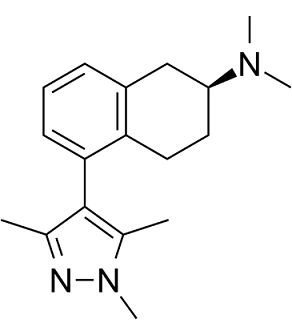
AS19 is a novel, highly potent and specific 5-HT7 serotonin receptor agonist with an IC50 value of 0.83 nM and a Ki of 0.6 nM. AS19 is specific for 5-HT7 over 5-HT1A, 5-HT1B, 5-HT1D, and 5-HT5A receptors (Kis = 89.7 nM, 490 nM, 6.6 nM and 98.5 nM, respectively). AS19 enhances memory consolidation and reverses Scopolamine- or Dizocilpine-induced amnesia.
Physicochemical Properties
| Molecular Formula | C18H25N3 |
| Molecular Weight | 283.411204099655 |
| Exact Mass | 283.204 |
| Elemental Analysis | C, 76.28; H, 8.89; N, 14.83 |
| CAS # | 1000578-26-6 |
| PubChem CID | 23642275 |
| Appearance | Light yellow to brown ointment |
| Density | 1.1±0.1 g/cm3 |
| Boiling Point | 413.3±45.0 °C at 760 mmHg |
| Flash Point | 203.7±28.7 °C |
| Vapour Pressure | 0.0±1.0 mmHg at 25°C |
| Index of Refraction | 1.595 |
| LogP | 3.71 |
| Hydrogen Bond Donor Count | 0 |
| Hydrogen Bond Acceptor Count | 2 |
| Rotatable Bond Count | 2 |
| Heavy Atom Count | 21 |
| Complexity | 356 |
| Defined Atom Stereocenter Count | 1 |
| SMILES | CN(C)[C@H]1CCC2=C(C=CC=C2C3=C(C)N(C)N=C3C)C1 |
| InChi Key | BTTOYOKCLDAHHO-HNNXBMFYSA-N |
| InChi Code | InChI=1S/C18H25N3/c1-12-18(13(2)21(5)19-12)17-8-6-7-14-11-15(20(3)4)9-10-16(14)17/h6-8,15H,9-11H2,1-5H3/t15-/m0/s1 |
| Chemical Name | 1,2S,3,4-tetrahydro-N,N-dimethyl-5-(1,3,5-trimethyl-1H-pyrazol-4-yl)-2-naphthalenamine |
| Synonyms | (2S)-(+)-5-(1,3,5-TRIMETHYLPYRAZOL-4-YL)-2-(DIMETHYLAMINO)TETRALIN; LA5AQ5R6QS; CHEMBL2164327; (2S)-N,N-dimethyl-5-(1,3,5-trimethyl-1H-pyrazol-4-yl)-1,2,3,4-tetrahydronaphthalen-2-amine; |
| HS Tariff Code | 2934.99.9001 |
| Storage |
Powder-20°C 3 years 4°C 2 years In solvent -80°C 6 months -20°C 1 month |
| Shipping Condition | Room temperature (This product is stable at ambient temperature for a few days during ordinary shipping and time spent in Customs) |
Biological Activity
| Targets | Human 5-HT7 Receptor (IC50 = 0.83 nM); Human 5-HT7 Receptor (Ki = 0.6 nM) 5-HT1A Receptor (Ki = 89.7 nM); 5-HT1B Receptor (Ki = 490 nM); 5-HT1D Receptor (Ki = 6.6 nM); 5-HT5 Receptor (Ki = 98.5 nM) |
| ln Vitro | After 48 hours, the addition of AS19 (1 μM) totally restored the proliferation of T cells treated with p-chlorophenylalanine, which had been severely reduced [2]. |
| ln Vivo |
In an autoplastic Pavlovian/instrumental learning challenge, AS19 (0.5–10 mg/kg; subcutaneous injection; 24 hours duration; batch of Wistar stent) therapy enhances memory consolidation [1]. This work aimed to evaluate further the role of 5-HT7 receptors during memory formation in an autoshaping Pavlovian/instrumental learning task. Post-training administration of the potential 5-HT7 receptor agonist AS 19 or antagonist SB-269970 enhanced memory formation or had no effect, respectively. The AS 19 facilitatory effect was reversed by SB-269970, but not by the selective 5-HT1A antagonist WAY100635. Amnesia induced by scopolamine (cholinergic antagonist) or dizocilpine (NMDA antagonist) was also reversed by AS 19. Certainly, reservations regarding the selectivity of AS 19 for 5-HT7 and other 5-HT receptors in vivo are noteworthy and, therefore, its validity for use in animal models as a pharmacological tool. Having mentioned that, it should be noticed that together these data are providing further support to the notion of the 5-HT7 receptors role in memory formation. Importantly, this 5-HT7 receptor agonist AS 19 appears to represent a step forward respect to the notion that potent and selective 5-HT7 receptor agonists can be useful in the treatment of dysfunctional memory in aged-related decline and Alzheimer's disease[1]. |
| Enzyme Assay | For the 5-HT(7) receptor agonists used, binding profile and intrinsic efficacy to stimulate cAMP formation in HEK-293F cells expressing the human 5-HT(7) receptor were also evaluated. AS-19 and E-55888 were selective for 5-HT(7) receptors. E-55888 was a full agonist whereas AS-19 and MSD-5a behaved as partial agonists, with maximal effects corresponding to 77% and 61%, respectively, of the cAMP response evoked by the full agonist 5-HT[3]. |
| Animal Protocol |
Animal/Disease Models: Male Wistar rats (12-week old) with self-shaping Pavlovian/instrumental learning task [1] Doses: 0.5 mg/kg, 1 mg/kg, 5 mg/kg, 10 mg/kg given Route of Administration: subcutaneous injection; 24 hrs (hrs (hours)) Experimental Results: Enhanced memory formation during automatic shaping Pavlovian/instrumental learning tasks. |
| References |
[1]. Effects of the potential 5-HT7 receptor agonist AS 19 in an autoshaping learning task. Behav Brain Res. 2005 Aug 30;163(1):136-40. [2]. Serotonin provides an accessory signal to enhance T-cell activation by signaling through the 5-HT7 receptor. Blood. 2007 Apr 15;109(8):3139-46. [3]. 5-HT7 receptor activation inhibits mechanical hypersensitivity secondary to capsaicin sensitization in mice. Pain. 2009 Feb;141(3):239-47. |
| Additional Infomation | This work aimed to evaluate the potential role of the 5-HT(7) receptor in nociception secondary to a sensitizing stimulus in mice. For this purpose, the effects of relevant ligands (5-HT(7) receptor agonists: AS-19, MSD-5a, E-55888; 5-HT(7) receptor antagonists: SB-258719, SB-269970; 5-HT(1A) receptor agonist: F-13640; 5-HT(1A) receptor antagonist: WAY-100635) were assessed on capsaicin-induced mechanical hypersensitivity, a pain behavior involving hypersensitivity of dorsal horn neurons (central sensitization). For the 5-HT(7) receptor agonists used, binding profile and intrinsic efficacy to stimulate cAMP formation in HEK-293F cells expressing the human 5-HT(7) receptor were also evaluated. AS-19 and E-55888 were selective for 5-HT(7) receptors. E-55888 was a full agonist whereas AS-19 and MSD-5a behaved as partial agonists, with maximal effects corresponding to 77% and 61%, respectively, of the cAMP response evoked by the full agonist 5-HT. Our in vivo results revealed that systemic administration of 5-HT(7) receptor agonists exerted a clear-cut dose-dependent antinociceptive effect that was prevented by 5-HT(7) receptor antagonists, but not by the 5-HT(1A) receptor antagonist. The order of efficacy (E-55888>AS-19>MSD-5a) matched their in vitro efficacy as 5-HT(7) receptor agonists. Contrary to agonists, a dose-dependent promotion of mechanical hypersensitivity was observed after administration of 5-HT(7) receptor antagonists, substantiating the involvement of the 5-HT(7) receptor in the control of capsaicin-induced mechanical hypersensitivity. These findings suggest that serotonin exerts an inhibitory role in the control of nociception through activation of 5-HT(7) receptors, and point to a new potential therapeutic use of 5-HT(7) receptor agonists in the field of analgesia.[3] |
Solubility Data
| Solubility (In Vitro) | DMSO : ~100 mg/mL (~352.85 mM) |
| Solubility (In Vivo) |
Solubility in Formulation 1: ≥ 2.5 mg/mL (8.82 mM) (saturation unknown) in 10% DMSO + 40% PEG300 + 5% Tween80 + 45% Saline (add these co-solvents sequentially from left to right, and one by one), clear solution. For example, if 1 mL of working solution is to be prepared, you can add 100 μL of 25.0 mg/mL clear DMSO stock solution to 400 μL PEG300 and mix evenly; then add 50 μL Tween-80 to the above solution and mix evenly; then add 450 μL normal saline to adjust the volume to 1 mL. Preparation of saline: Dissolve 0.9 g of sodium chloride in 100 mL ddH₂ O to obtain a clear solution. Solubility in Formulation 2: ≥ 2.5 mg/mL (8.82 mM) (saturation unknown) in 10% DMSO + 90% (20% SBE-β-CD in Saline) (add these co-solvents sequentially from left to right, and one by one), clear solution. For example, if 1 mL of working solution is to be prepared, you can add 100 μL of 25.0 mg/mL clear DMSO stock solution to 900 μL of 20% SBE-β-CD physiological saline solution and mix evenly. Preparation of 20% SBE-β-CD in Saline (4°C,1 week): Dissolve 2 g SBE-β-CD in 10 mL saline to obtain a clear solution. Solubility in Formulation 3: ≥ 2.5 mg/mL (8.82 mM) (saturation unknown) in 10% DMSO + 90% Corn Oil (add these co-solvents sequentially from left to right, and one by one), clear solution. For example, if 1 mL of working solution is to be prepared, you can add 100 μL of 25.0 mg/mL clear DMSO stock solution to 900 μL of corn oil and mix evenly. (Please use freshly prepared in vivo formulations for optimal results.) |
| Preparing Stock Solutions | 1 mg | 5 mg | 10 mg | |
| 1 mM | 3.5285 mL | 17.6423 mL | 35.2846 mL | |
| 5 mM | 0.7057 mL | 3.5285 mL | 7.0569 mL | |
| 10 mM | 0.3528 mL | 1.7642 mL | 3.5285 mL |