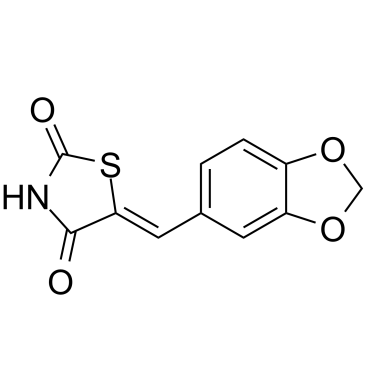
AS041164 is a novel and potent inhibitor of PI3K with selectivity for the class IB isoform PI3Kγ (IC50 = 70 nM).
Physicochemical Properties
| Molecular Formula | C11H7NO4S |
| Molecular Weight | 249.24258 |
| Exact Mass | 249.009 |
| CAS # | 6318-41-8 |
| Related CAS # | 6318-41-8 |
| PubChem CID | 1269519 |
| Appearance | Light yellow to yellow solid |
| Density | 1.6±0.1 g/cm3 |
| Index of Refraction | 1.731 |
| LogP | 2.46 |
| Hydrogen Bond Donor Count | 1 |
| Hydrogen Bond Acceptor Count | 5 |
| Rotatable Bond Count | 1 |
| Heavy Atom Count | 17 |
| Complexity | 395 |
| Defined Atom Stereocenter Count | 0 |
| SMILES | O=C1NC(=O)/C(=C/C2C=CC3OCOC=3C=2)/S1 |
| InChi Key | SDGWAUUPHUBJNQ-RUDMXATFSA-N |
| InChi Code | InChI=1S/C11H7NO4S/c13-10-9(17-11(14)12-10)4-6-1-2-7-8(3-6)16-5-15-7/h1-4H,5H2,(H,12,13,14)/b9-4+ |
| Chemical Name | (5E)-5-(1,3-benzodioxol-5-ylmethylidene)-1,3-thiazolidine-2,4-dione |
| Synonyms | AS041164 |
| HS Tariff Code | 2934.99.9001 |
| Storage |
Powder-20°C 3 years 4°C 2 years In solvent -80°C 6 months -20°C 1 month Note: This product requires protection from light (avoid light exposure) during transportation and storage. |
| Shipping Condition | Room temperature (This product is stable at ambient temperature for a few days during ordinary shipping and time spent in Customs) |
Biological Activity
| Targets |
PI3Kγ (IC50 = 70 nM); PI3Kα (IC50 = 240 nM); PI3Kβ (IC50 = 1.4 μM); PI3Kδ (IC50 = 1.7 μM) AS041164 targets Phosphoinositide 3-kinase gamma (PI3Kγ) (Ki = 0.1 μM) [1] |
| ln Vitro |
AS041164 potently inhibited the enzymatic activity of recombinant PI3Kγ with a Ki value of 0.1 μM, while exhibiting weak inhibitory effects on other PI3K isoforms (PI3Kα, PI3Kβ, PI3Kδ) with a selectivity of more than 100-fold compared to PI3Kγ [1] AS041164 dose-dependently suppressed neutrophil chemotaxis induced by fMLP or CXCL8, achieving significant inhibition (≥50%) at concentrations ranging from 1 μM to 10 μM [1] AS041164 reduced the adhesion of neutrophils to endothelial cells in vitro without compromising the phagocytic function of neutrophils [1] AS041164 inhibited reactive oxygen species (ROS) production in PMA-stimulated neutrophils, which was verified by flow cytometry using a fluorescent probe [1] |
| ln Vivo |
AS-041164 (10-100 mg/kg; oral administration; once) treatment results in the reduction of inflammatory swelling in the model of carrageenan-induced paw edema[1].
Treatment with AS-041164 (3-100 mg/kg p.o.) reduces RANTES-induced neutrophil recruitment in mice in a dose-dependent manner. As for AS-041164, the ED50 value is 27.35 mg/kg. AKT phosphorylation is decreased and chemotaxis caused by RANTES is blocked by AS-041164[1]. In the carrageenan-induced paw edema model in mice, oral administration of AS041164 (1 mg/kg, 10 mg/kg, 30 mg/kg) dose-dependently inhibited paw swelling. At the dose of 30 mg/kg, the inhibition rate reached approximately 60% when measured 6 hours after carrageenan injection [1] In the carrageenan-induced pleurisy model in mice, oral administration of 30 mg/kg AS041164 significantly reduced the number of neutrophils in pleural exudate by about 70% compared with the control group [1] In the LPS-induced peritonitis model in mice, intraperitoneal injection of 10 mg/kg AS041164 effectively inhibited the infiltration of neutrophils into the peritoneal cavity [1] AS041164 downregulated the expression levels of pro-inflammatory cytokines (CXCL1, TNF-α) in the inflamed tissues of animal models [1] |
| Enzyme Assay |
Recombinant PI3Kγ protein was mixed with phospholipid substrate (PIP2), [γ-32P]ATP, and AS041164 at various concentrations in a reaction buffer. The reaction was incubated at 30°C for a specific period and then terminated by adding a stop solution. Phosphorylated products were separated via thin-layer chromatography (TLC), and radioactivity was quantified through autoradiography. The inhibition rate of PI3Kγ enzymatic activity was calculated, and the Ki value was derived by fitting the inhibition rate curve [1] |
| Cell Assay |
Neutrophils were isolated and purified from mouse bone marrow or human peripheral blood. For chemotaxis assays, neutrophils were added to the upper chamber of Transwell inserts, and the lower chamber was filled with chemokines (fMLP or CXCL8) combined with different concentrations of AS041164. After incubation at 37°C, the number of neutrophils migrated to the lower chamber was counted [1] For adhesion assays, endothelial cells were cultured to confluence in plates, followed by the addition of neutrophils and AS041164. Non-adherent cells were washed away, and the number of adherent neutrophils was counted [1] For ROS production assays, neutrophils were loaded with a fluorescent probe, treated with AS041164, and then stimulated. ROS levels were detected and quantified by flow cytometry [1] |
| Animal Protocol |
Male Wistar rats (100-150 g) injected with carrageenan[1] 10 mg/kg, 30 mg/kg, 100 mg/kg Oral administration; once Carrageenan-induced paw edema model: Male ICR mice (20-25 g) were orally administered AS041164 (1 mg/kg, 10 mg/kg, 30 mg/kg) suspended in 0.5% carboxymethylcellulose sodium (CMC-Na) 1 hour before carrageenan injection. The control group received an equal volume of 0.5% CMC-Na. 1% carrageenan was subcutaneously injected into the right hind paw of mice, and paw volume was measured at 1 hour, 3 hours, and 6 hours after injection to calculate the swelling rate [1] Carrageenan-induced pleurisy model: Mice were intraperitoneally injected with 1% carrageenan to induce pleurisy. AS041164 (30 mg/kg) was orally administered 1 hour before carrageenan injection. Mice were euthanized 24 hours later, pleural exudate was collected, and the number of neutrophils was counted [1] LPS-induced peritonitis model: Mice were intraperitoneally injected with LPS (1 mg/kg) to induce peritonitis. AS041164 (10 mg/kg) was intraperitoneally administered 30 minutes before LPS injection. Six hours later, peritoneal lavage fluid was collected, and neutrophil infiltration was quantitatively analyzed [1] |
| Toxicity/Toxicokinetics |
Within the experimental dose range (1 mg/kg - 30 mg/kg), mice showed no obvious toxic manifestations, including no significant body weight loss, abnormal behavior, or organ damage [1] |
| References |
[1]. Phosphoinositide 3-kinase gamma inhibition plays a crucial role in early steps of inflammation by blocking neutrophil recruitment. J Pharmacol Exp Ther. 2007 Sep;322(3):923-30. |
| Additional Infomation |
AS041164 is a selective PI3Kγ inhibitor with minimal cross-reactivity with other PI3K isoforms (α, β, δ) [1] AS041164 exerts anti-inflammatory effects by blocking PI3Kγ-mediated signaling pathways, which inhibits the recruitment and activation of neutrophils in the early stages of inflammation [1] AS041164 does not impair the phagocytic function of neutrophils, indicating a favorable safety profile for its application in anti-inflammatory therapy [1] |
Solubility Data
| Solubility (In Vitro) | DMSO: ~125 mg/mL (~501.52 mM) |
| Solubility (In Vivo) |
Solubility in Formulation 1: ≥ 1.47 mg/mL (5.90 mM) (saturation unknown) in 10% DMSO + 90% Corn Oil (add these co-solvents sequentially from left to right, and one by one), clear solution. For example, if 1 mL of working solution is to be prepared, you can add 100 μL of 14.7 mg/mL clear DMSO stock solution to 900 μL of corn oil and mix evenly. (Please use freshly prepared in vivo formulations for optimal results.) |
| Preparing Stock Solutions | 1 mg | 5 mg | 10 mg | |
| 1 mM | 4.0122 mL | 20.0610 mL | 40.1220 mL | |
| 5 mM | 0.8024 mL | 4.0122 mL | 8.0244 mL | |
| 10 mM | 0.4012 mL | 2.0061 mL | 4.0122 mL |