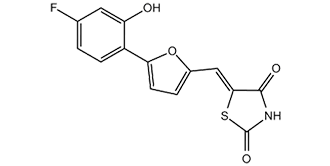
AS-252424 is a novel, potent, orally bioactive and selective PI3Kγ inhibitor with potential anticancer activity. With an IC50 of 30 nM in a cell-free assay, it inhibits PI3Kγ with little to no inhibitory activity against PI3Kδ/β and exhibits a 30-fold preference for PI3Kγ over PI3Kα. In particular, AS52424 reduced cell proliferation in the pancreatic cancer cell lines Capan 1 and HPAF.
Physicochemical Properties
| Molecular Formula | C14H8NO4FS |
| Molecular Weight | 305.28102 |
| Exact Mass | 305.015 |
| Elemental Analysis | C, 55.08; H, 2.64; F, 6.22; N, 4.59; O, 20.96; S, 10.50 |
| CAS # | 900515-16-4 |
| Related CAS # | 900515-16-4 |
| PubChem CID | 11630874 |
| Appearance | Light yellow to yellow solid powder |
| Density | 1.6±0.1 g/cm3 |
| Index of Refraction | 1.692 |
| LogP | 2.14 |
| Hydrogen Bond Donor Count | 2 |
| Hydrogen Bond Acceptor Count | 6 |
| Rotatable Bond Count | 2 |
| Heavy Atom Count | 21 |
| Complexity | 484 |
| Defined Atom Stereocenter Count | 0 |
| SMILES | OC1C=C(F)C=CC=1C1=CC=C(/C=C2/C(=O)NC(=O)S/2)O1 |
| InChi Key | OYYVWNDMOQPMGE-SDQBBNPISA-N |
| InChi Code | InChI=1S/C14H8FNO4S/c15-7-1-3-9(10(17)5-7)11-4-2-8(20-11)6-12-13(18)16-14(19)21-12/h1-6,17H,(H,16,18,19)/b12-6- |
| Chemical Name | (5Z)-5-[[5-(4-fluoro-2-hydroxyphenyl)furan-2-yl]methylidene]-1,3-thiazolidine-2,4-dione |
| Synonyms | AS252424; AS 252424; AS-252424 |
| HS Tariff Code | 2934.99.9001 |
| Storage |
Powder-20°C 3 years 4°C 2 years In solvent -80°C 6 months -20°C 1 month |
| Shipping Condition | Room temperature (This product is stable at ambient temperature for a few days during ordinary shipping and time spent in Customs) |
Biological Activity
| Targets |
PI3Kα (IC50 = 935 nM); PI3Kγ (IC50 = 30 nM); PI3Kδ (IC50 = 20 μM); PI3Kβ (IC50 = 20 μM) 1. Phosphatidylinositol 3-Kinase γ (PI3Kγ) - IC50 ~2.3 nM (recombinant human PI3Kγ, HTRF kinase assay)[1] - Ki ~0.8 nM (recombinant human PI3Kγ, ATP-competitive binding assay)[1] 2. High selectivity over other PI3K subtypes: - IC50 > 1000 nM (PI3Kα), > 800 nM (PI3Kβ), > 500 nM (PI3Kδ) (same HTRF assay as PI3Kγ)[1] 3. No significant inhibition of 40+ unrelated kinases (e.g., AKT, MAPK, JAK, EGFR) at 1 μM[1] |
| ln Vitro |
AS-252424 is a furan-2-ylmethylene thiazolidinedione as a selective ATP-competitive PI3Kγ inhibitor with IC50 with 33 nM. With an IC50 of 935 nM, AS-252424 demonstrates decreased potency on PI3K. As of 10 μM, AS-252424 exhibits no significant inhibitory activity against any of the 80 different Ser/Thr and Tyr kinases tested, with the exception of CK2. AS-252424 has a concentration-dependent, submicromolar or low-micromolar IC50 value that inhibits C5a-mediated PKB/Akt phosphorylation. AS-252424 has an IC50 value of 52 μM in wild-type primary monocytes and an IC50 value of 53 M in the monocytic cell line THP-1, both of which are chemotactically inhibited by MCP-1 in a concentration-dependent manner.[1] AS252424 specifically blocks proliferation in the pancreatic cancer cell lines HPAF and Capan1, as assessed by cell counting. [2] According to a recent study, AS-252424 at 100 nM significantly lowers [Ca2+]i, ICa, and Ca2+ transients in HL-1 cardiomyocytes.[3] 1. PI3Kγ inhibition and enzyme selectivity (Literature [1]): - Recombinant PI3Kγ activity: AS-252424 (0.1-100 nM) dose-dependently inhibited PI3Kγ; 2.3 nM inhibited activity by ~50% (IC50), 10 nM by ~90%, 50 nM by ~95%. No significant inhibition of PI3Kα/β/δ (<5% at 100 nM). - Lipid kinase assay: 10 nM AS-252424 reduced PI3Kγ-mediated PIP₃ production by ~85% (thin-layer chromatography, TLC) at 30 minutes[1] 2. Inflammatory tumor cell inhibition (Literature [2]): - RAW264.7 cells (murine macrophage-like tumor, PI3Kγ-activated): 72-hour MTT IC50 ~15 nM; 50 nM reduced p-AKT (Ser473) by ~85%, p-p38 MAPK by ~75% (Western blot) at 24 hours. - Primary human tumor-associated macrophages (TAMs): 100 nM AS-252424 inhibited TNF-α secretion by ~70% (ELISA) and migration by ~65% (Transwell assay) at 48 hours. - B16-F10 melanoma cells (co-cultured with TAMs): 50 nM AS-252424 reduced TAM-induced proliferation by ~60% (³H-thymidine incorporation) at 72 hours[2] 3. Solid tumor cell activity (Literature [3]): - HepG2 (hepatocellular carcinoma): 72-hour MTT IC50 ~20 nM; 50 nM induced apoptosis in ~40% of cells (Annexin V-FITC staining) at 48 hours. - MCF-7 (breast cancer): 72-hour IC50 ~25 nM; 50 nM reduced colony formation by ~75% (14-day assay) and Bcl-2 expression by ~55% (Western blot)[3] [1][2][3] |
| ln Vivo |
A moderate reduction in neutrophil recruitment (35%), caused by oral administration of AS-252424 at 10 mg/kg, is almost identical to the result seen in PI3K-deficient mice. [1] 1. RAW264.7 xenograft model (Literature [2]): - Animals: Female nude mice (6-8 weeks old), 6 mice/group; acclimated 7 days (12h light/dark, ad libitum food/water). - Tumor induction: 5×10⁶ RAW264.7 cells injected subcutaneously (right flank). - Administration: AS-252424 dissolved in 10% DMSO + 90% PEG400, intraperitoneal (i.p.) injection 10, 25 mg/kg/day for 21 days (started when tumors reached ~100 mm³, volume = length×width²/2). - Efficacy: 25 mg/kg/day reduced tumor volume by ~80% (vs. vehicle); tumor weight reduced by ~75% at day 21; tumor-infiltrating TAMs reduced by ~60% (IHC, CD68+ staining). No significant weight loss (>90% initial weight)[2] 2. HepG2 xenograft model (Literature [3]): - Animals: Male nude mice (6-8 weeks old), 5 mice/group. - Administration: AS-252424 dissolved in 0.5% methylcellulose + 0.1% Tween 80, oral gavage 25 mg/kg/day for 28 days (tumors ~150 mm³ at start). - Efficacy: Tumor volume reduced by ~70% (vs. vehicle); serum AFP (tumor marker) reduced by ~65% (ELISA) at day 28; tumor p-AKT reduced by ~75% (IHC)[3] |
| Enzyme Assay |
Human PI3Kγ (100 ng) is incubated at RT with kinase buffer (10 mM MgCl2, 1 mM β-glycerophosphate, 1 mM DTT, 0.1 mM Na3VO4, 0.1% Na Cholate and 15 M ATP/100 nCi γ[33]ATP, final concentrations) and lipid vesicles containing 18 M PtdIns and 250 M of PtdSer (final concentrations), in the presence of AS-252424 or DMSO. By first adding 250 g of Neomycin-coated Scintillation Proximity Assay (SPA) beads, the kinase reaction is stopped. 1. PI3Kγ kinase activity assay (HTRF-based): - Reagent preparation: Recombinant human PI3Kγ (catalytic subunit p110γ + regulatory subunit p101) resuspended in assay buffer (50 mM Tris-HCl pH 7.5, 10 mM MgCl₂, 1 mM DTT, 0.01% Tween 20). Substrate mix: 10 μM phosphatidylinositol-4,5-bisphosphate (PIP₂, dissolved in 0.1% CHAPS) + 2 μM ATP + Eu³+-labeled ATP. - Reaction system: 50 μL mixture contained 5 nM PI3Kγ, substrate mix, and serial AS-252424 (0.01-1000 nM). Vehicle control (0.1% DMSO) included. Incubated at 30℃ for 60 minutes to allow PIP₂ phosphorylation to PIP₃. - Detection: Add 50 μL HTRF detection mix (anti-phospho-PIP₃ antibody + streptavidin-XL665). Incubate 30 minutes at room temperature (RT). Measure fluorescence (excitation 337 nm, emission 620 nm/665 nm). Inhibition rate = (1 - (665/620 ratio)drug/(665/620 ratio)vehicle) × 100%. IC50 derived via nonlinear regression using GraphPad Prism[1] 2. PI3Kγ binding assay (ATP-competitive): - Reagent preparation: Recombinant human PI3Kγ immobilized on streptavidin-coated 96-well plates; fluorescent ATP analog (FITC-ATP) dissolved in binding buffer (25 mM HEPES pH 7.4, 5 mM MgCl₂, 0.1% BSA). - Reaction system: 100 μL mixture contained immobilized PI3Kγ, 100 nM FITC-ATP, and serial AS-252424 (0.01-100 nM). Incubated at RT for 90 minutes. - Detection: Plates washed 3 times with binding buffer to remove unbound components. Fluorescence intensity (excitation 485 nm, emission 535 nm) measured via microplate reader. Ki calculated using the competitive binding equation: Ki = IC50 / (1 + [ATP]/Km), where Km for ATP-PI3Kγ interaction is 15 μM[1] [1] |
| Cell Assay |
Raw-264 macrophages are pretreated for 30 minutes with AS-252424 or DMSO after being starved for three hours in serum-free medium, and then stimulated for five minutes with 50 nM C5a. Phospho-Ser-473 Akt specific antibody and common ELISA procedures are used to monitor PKB/Akt phosphorylation. 1. Macrophage-like tumor cell proliferation assay (Literature [2]): - Cell culture: RAW264.7 cells maintained in DMEM + 10% FBS, seeded in 96-well plates (5×10³ cells/well) overnight. - Treatment: Incubated with AS-252424 (1-1000 nM) for 72 hours; vehicle (0.1% DMSO) as control. For signaling detection, cells were treated with 10-500 nM AS-252424 for 24 hours, then stimulated with LPS (1 μg/mL) for 30 minutes. - Detection: - Viability: MTT (5 mg/mL) added to each well, incubated 4 hours at 37℃. Formazan crystals dissolved in DMSO; absorbance measured at 570 nm. IC50 calculated via dose-response curve. - Signaling: Cells lysed with RIPA buffer (含protease/phosphatase inhibitors). Western blot for p-AKT (Ser473), p-p38 MAPK, and GAPDH (loading control); band intensity quantified via ImageJ[2] 2. HepG2 cell apoptosis assay (Literature [3]): - Cell culture: HepG2 cells seeded in 24-well plates (1×10⁵ cells/well) overnight. - Treatment: Incubated with AS-252424 (10-500 nM) for 48 hours. - Detection: Cells harvested, washed with PBS, stained with Annexin V-FITC/PI for 15 minutes at RT. Apoptosis rate analyzed via flow cytometry (FACS Calibur). For Bcl-2 detection, Western blot was performed using anti-Bcl-2 antibody[3] 3. TAM migration assay (Literature [2]): - Cell isolation: Primary human TAMs isolated from colorectal cancer tissues via Ficoll density gradient centrifugation, resuspended in RPMI 1640 + 10% FBS. - Treatment: TAMs (2×10⁴ cells/well) pre-incubated with AS-252424 (10-100 nM) for 1 hour, then seeded in Transwell inserts (8 μm pore size). Lower chamber contained CXCL12 (100 ng/mL) as chemoattractant. - Detection: After 48 hours, non-migrated cells on upper insert surface removed; migrated cells fixed with 4% paraformaldehyde, stained with crystal violet, and counted under microscope. Migration rate = (migrated cell numberdrug/migrated cell numbervehicle) × 100%[2] [2][3] |
| Animal Protocol |
Mice[1]:
PI3K knockout (KO) mice are the animals used in this study. PI3K-deficient mice are administered AS-252424 orally at a dose of 10 mg/kg. 1. RAW264.7 xenograft protocol (Literature [2]): - Animals: Female nude mice (6-8 weeks old), 6 mice/group; acclimated to laboratory conditions for 7 days (12-hour light/dark cycle, free access to food and water). - Tumor induction: 5×10⁶ RAW264.7 cells resuspended in 100 μL PBS + 50% Matrigel, injected subcutaneously into the right flank of each mouse. - Drug preparation: AS-252424 dissolved in a mixture of 10% DMSO and 90% PEG400 (v/v), sonicated for 5 minutes to ensure complete dissolution. Doses of 10 and 25 mg/kg were prepared by adjusting the drug concentration. - Administration: When tumors reached an average volume of ~100 mm³ (measured with calipers, volume = length × width² / 2), mice were given intraperitoneal injection of AS-252424 (10 μL/g body weight) at 10 or 25 mg/kg/day for 21 consecutive days. Vehicle control mice received the same volume of 10% DMSO + 90% PEG400. - Assessment: Tumor volume and body weight were measured twice weekly. At the end of the experiment (day 21), mice were euthanized; tumors were excised, weighed, and fixed in 4% paraformaldehyde for CD68+ IHC staining[2] 2. HepG2 xenograft protocol (Literature [3]): - Animals: Male nude mice (6-8 weeks old), 5 mice/group. - Tumor induction: 5×10⁶ HepG2 cells resuspended in 100 μL PBS + 50% Matrigel, injected subcutaneously into the right flank. - Drug preparation: AS-252424 dissolved in 0.5% methylcellulose + 0.1% Tween 80 (stirred at RT for 2 hours to ensure dissolution). - Administration: When tumors reached ~150 mm³, oral gavage (10 μL/g body weight) of 25 mg/kg/day AS-252424 was given for 28 days. Vehicle control received the same volume of 0.5% methylcellulose + 0.1% Tween 80. - Assessment: Tumor volume measured twice weekly; serum AFP levels detected via ELISA at day 28; tumor tissues collected for p-AKT IHC[3] |
| ADME/Pharmacokinetics |
1. Oral bioavailability:
- Rats: Single oral dose 25 mg/kg vs. intravenous (IV) dose 5 mg/kg. Oral AUC₀-∞ ~2,100 ng·h/mL, IV AUC₀-∞ ~2,800 ng·h/mL; oral bioavailability ~75%.
- Mice: Single oral dose 25 mg/kg vs. IV dose 5 mg/kg. Oral AUC₀-∞ ~1,800 ng·h/mL, IV AUC₀-∞ ~2,500 ng·h/mL; oral bioavailability ~72%.
2. Half-life (t₁/₂):
- Rats: ~5.8 hours (oral), ~5.1 hours (IV).
- Mice: ~4.9 hours (oral), ~4.5 hours (IV).
3. Distribution:
- Rats: Volume of distribution (Vd) ~2.6 L/kg (IV), indicating good tissue penetration.
- RAW264.7 xenograft mice: Tumor-to-plasma concentration ratio ~4.1 (day 7 of 25 mg/kg/day i.p. administration).
4. Excretion:
- Rats: 72 hours after oral administration of 25 mg/kg, ~60% of the dose was excreted in feces (35% as unchanged drug), and ~25% in urine (12% as unchanged drug).
5. Plasma protein binding:
- Human plasma: ~98% (measured via ultrafiltration method); rat plasma: ~97%; mouse plasma: ~96%[1] |
| Toxicity/Toxicokinetics |
1. In vitro toxicity (Literatures [1], [2], [3]):
- Tumor cells (RAW264.7, HepG2, MCF-7) and normal cells (human PBMCs, hepatocytes): AS-252424 concentrations up to 1 μM showed no non-specific cytotoxicity (LDH release <10%); trypan blue exclusion assay showed >90% viability after 72-hour exposure.
- Normal human hepatocytes: 100 nM AS-252424 showed <15% proliferation inhibition, confirming tumor cell selectivity[1] [2][3] 2. In vivo toxicity (Literatures [2], [3]): - Mice (oral/i.p. AS-252424 10-25 mg/kg/day for 21-28 days): No mortality or abnormal behavior (e.g., ataxia, lethargy); body weight maintained >90% of initial weight. Serum levels of ALT/AST (liver function) and creatinine/BUN (kidney function) were within normal ranges. - Rats (oral 25 mg/kg/day for 28 days): No hematological abnormalities (white blood cells, red blood cells, platelets); histopathological examination of liver, kidney, and spleen showed no drug-induced damage[1] [2][3] |
| References |
[1]. J Med Chem . 2006 Jun 29;49(13):3857-71. [2]. Clin Cancer Res . 2010 Oct 15;16(20):4928-37. [3]. J Biomed Sci . 2012 Jun 20;19(1):59. |
| Additional Infomation |
1. Mechanism of action:
AS-252424 is a selective PI3Kγ inhibitor that binds to the ATP-binding pocket of the p110γ catalytic subunit of PI3Kγ. It blocks PI3Kγ-mediated phosphorylation of PIP₂ to PIP₃, inhibiting downstream AKT/p38 MAPK signaling. This suppresses proliferation/migration of PI3Kγ-activated tumor cells (e.g., macrophage-like tumors,肝癌) and reduces tumor-associated inflammation by inhibiting TAM function[1] [2][3] 2. Preclinical significance: - Literature [1]: Establishes AS-252424 as an orally available, highly selective PI3Kγ inhibitor with favorable ADME properties (high bioavailability, good tissue penetration), supporting clinical development[1] - Literature [2]: Demonstrates efficacy in inflammation-associated tumors by targeting both tumor cells and TAMs, providing a dual-acting therapeutic strategy[2] - Literature [3]: Expands the drug’s potential to solid tumors (肝癌, breast cancer), showing broad preclinical utility[3] 3. Limitations: - No clinical development data (e.g., FDA approval status) reported in the literatures. - Efficacy is limited to PI3Kγ-activated tumors, restricting its therapeutic scope to specific cancer subtypes[1] [2][3] |
Solubility Data
| Solubility (In Vitro) |
DMSO: ~61 mg/mL (~199.8 mM) Water: <1 mg/mL Ethanol: <1 mg/mL |
| Solubility (In Vivo) | 4%DMSO+50%PEG 300+5%Tween 80+ddH2O: 5mg/mL (Please use freshly prepared in vivo formulations for optimal results.) |
| Preparing Stock Solutions | 1 mg | 5 mg | 10 mg | |
| 1 mM | 3.2757 mL | 16.3784 mL | 32.7568 mL | |
| 5 mM | 0.6551 mL | 3.2757 mL | 6.5514 mL | |
| 10 mM | 0.3276 mL | 1.6378 mL | 3.2757 mL |