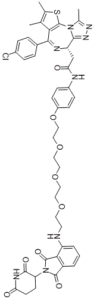
ARV-825 (ARV825) is a novel and potent BRD4 degrader based on PROTAC (proteolysis-targeting chimera) technology, anticancer activity. ARV-825 binds to BD1 and BD2 of BRD4 with Kds of 90 and 28 nM, respectively. BRD4, a bromodomain and extraterminal domain (BET) family member, is an attractive target in multiple pathological settings, particularly cancer. While BRD4 inhibitors have shown some promise in MYC-driven malignancies such as Burkitt's lymphoma (BL), BRD4 inhibitors lead to robust BRD4 protein accumulation, which may account for their limited suppression of MYC expression, modest antiproliferative activity, and lack of apoptotic induction. ARV-825 is a hetero-bifunctional PROTAC (Proteolysis Targeting Chimera) that recruits BRD4 to the E3 ubiquitin ligase cereblon, leading to fast, efficient, and prolonged degradation of BRD4 in all BL cell lines tested. Consequently, ARV-825 more effectively suppresses c-MYC levels and downstream signaling than small-molecule BRD4 inhibitors, resulting in more effective cell proliferation inhibition and apoptosis induction in BL. Cereblon-based PROTACs provide a better and more efficient strategy in targeting BRD4 than traditional small-molecule inhibitors.
Physicochemical Properties
| Molecular Formula | C46H47CLN8O9S |
| Molecular Weight | 923.4316 |
| Exact Mass | 922.287 |
| CAS # | 1818885-28-7 |
| PubChem CID | 92044400 |
| Appearance | Light yellow to yellow solid powder |
| Density | 1.5±0.1 g/cm3 |
| Index of Refraction | 1.701 |
| LogP | 2.72 |
| Hydrogen Bond Donor Count | 3 |
| Hydrogen Bond Acceptor Count | 14 |
| Rotatable Bond Count | 19 |
| Heavy Atom Count | 65 |
| Complexity | 1720 |
| Defined Atom Stereocenter Count | 1 |
| SMILES | CC1=C(SC2=C1C(=N[C@H](C3=NN=C(N32)C)CC(=O)NC4=CC=C(C=C4)OCCOCCOCCOCCNC5=CC=CC6=C5C(=O)N(C6=O)C7CCC(=O)NC7=O)C8=CC=C(C=C8)Cl)C |
| InChi Key | RWLOGRLTDKDANT-TYIYNAFKSA-N |
| InChi Code | InChI=1S/C46H47ClN8O9S/c1-26-27(2)65-46-39(26)41(29-7-9-30(47)10-8-29)50-35(42-53-52-28(3)54(42)46)25-38(57)49-31-11-13-32(14-12-31)64-24-23-63-22-21-62-20-19-61-18-17-48-34-6-4-5-33-40(34)45(60)55(44(33)59)36-15-16-37(56)51-43(36)58/h4-14,35-36,48H,15-25H2,1-3H3,(H,49,57)(H,51,56,58)/t35-,36?/m0/s1 |
| Chemical Name | 2-((S)-4-(4-chlorophenyl)-2,3,9-trimethyl-6H-thieno[3,2-f][1,2,4]triazolo[4,3-a][1,4]diazepin-6-yl)-N-(4-(2-(2-(2-(2-((2-(2,6-dioxopiperidin-3-yl)-1,3-dioxoisoindolin-4-yl)amino)ethoxy)ethoxy)ethoxy)ethoxy)phenyl)acetamide |
| Synonyms | ARV825; ARV-825; ARV 825. |
| HS Tariff Code | 2934.99.9001 |
| Storage |
Powder-20°C 3 years 4°C 2 years In solvent -80°C 6 months -20°C 1 month |
| Shipping Condition | Room temperature (This product is stable at ambient temperature for a few days during ordinary shipping and time spent in Customs) |
Biological Activity
| ln Vitro | Transient chimera ARV-825 is a heterobifunctional protein that brings BRD4 to the brain of the E3 ubiquitin ligase. BRD4 is actively recruited by ARV-825 to the brain, which leads to the quick and effective proteosome-mediated destruction of both the cereblon-binding moieties of ARV-825 and BRD4. The Kd values for ARV-825's targets range from 28-90 nM and approximately 3 μM, respectively. These values indicate that ARV-825 mediates the substoichiometric conditioning process when BRD4 is introduced. On the other hand, ARV-825 therapy inhibited downstream signaling and extended BRD4 transcription [1]. |
| References |
[1]. Hijacking the E3 Ubiquitin Ligase Cereblon to Efficiently Target BRD4. Chem Biol. 2015 Jun 18;22(6):755-63. |
| Additional Infomation | ARV-825 is a PROTAC connected by ligands for Cereblon and BRD4. ARV-825 binds to BD1 and BD2 of BRD4. |
Solubility Data
| Solubility (In Vitro) | DMSO : ≥ 50 mg/mL (~54.15 mM) |
| Solubility (In Vivo) |
Solubility in Formulation 1: ≥ 2.5 mg/mL (2.71 mM) (saturation unknown) in 10% DMSO + 40% PEG300 + 5% Tween80 + 45% Saline (add these co-solvents sequentially from left to right, and one by one), clear solution. For example, if 1 mL of working solution is to be prepared, you can add 100 μL of 25.0 mg/mL clear DMSO stock solution to 400 μL PEG300 and mix evenly; then add 50 μL Tween-80 to the above solution and mix evenly; then add 450 μL normal saline to adjust the volume to 1 mL. Preparation of saline: Dissolve 0.9 g of sodium chloride in 100 mL ddH₂ O to obtain a clear solution. Solubility in Formulation 2: ≥ 2.5 mg/mL (2.71 mM) (saturation unknown) in 10% DMSO + 90% Corn Oil (add these co-solvents sequentially from left to right, and one by one), clear solution. For example, if 1 mL of working solution is to be prepared, you can add 100 μL of 25.0 mg/mL clear DMSO stock solution to 900 μL of corn oil and mix evenly. (Please use freshly prepared in vivo formulations for optimal results.) |
| Preparing Stock Solutions | 1 mg | 5 mg | 10 mg | |
| 1 mM | 1.0829 mL | 5.4146 mL | 10.8292 mL | |
| 5 mM | 0.2166 mL | 1.0829 mL | 2.1658 mL | |
| 10 mM | 0.1083 mL | 0.5415 mL | 1.0829 mL |