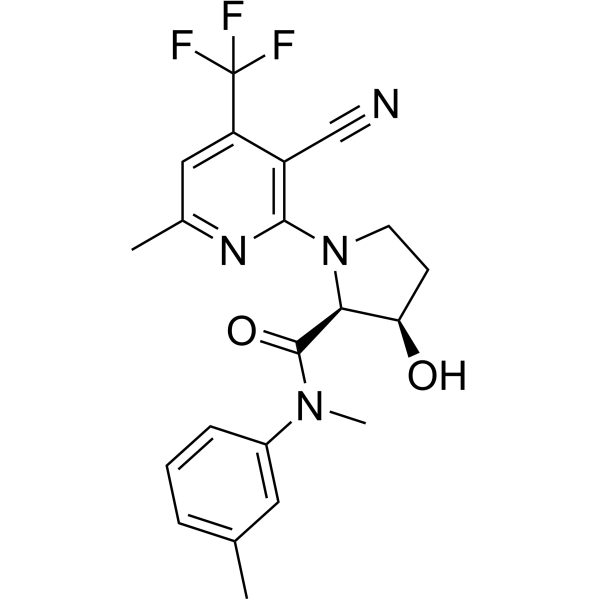
Physicochemical Properties
| Molecular Formula | C21H21F3N4O2 |
| Molecular Weight | 418.412255048752 |
| Exact Mass | 418.161 |
| CAS # | 2603528-97-6 |
| PubChem CID | 156068882 |
| Appearance | White to off-white solid powder |
| LogP | 3.9 |
| Hydrogen Bond Donor Count | 1 |
| Hydrogen Bond Acceptor Count | 8 |
| Rotatable Bond Count | 3 |
| Heavy Atom Count | 30 |
| Complexity | 679 |
| Defined Atom Stereocenter Count | 2 |
| SMILES | FC(C1C=C(C)N=C(C=1C#N)N1CC[C@H]([C@H]1C(N(C)C1C=CC=C(C)C=1)=O)O)(F)F |
| InChi Key | YHMDHAMZFMNMTF-MSOLQXFVSA-N |
| InChi Code | InChI=1S/C21H21F3N4O2/c1-12-5-4-6-14(9-12)27(3)20(30)18-17(29)7-8-28(18)19-15(11-25)16(21(22,23)24)10-13(2)26-19/h4-6,9-10,17-18,29H,7-8H2,1-3H3/t17-,18+/m1/s1 |
| Chemical Name | (2S,3R)-1-[3-cyano-6-methyl-4-(trifluoromethyl)pyridin-2-yl]-3-hydroxy-N-methyl-N-(3-methylphenyl)pyrrolidine-2-carboxamide |
| HS Tariff Code | 2934.99.9001 |
| Storage |
Powder-20°C 3 years 4°C 2 years In solvent -80°C 6 months -20°C 1 month Note: Please store this product in a sealed and protected environment (e.g. under nitrogen), avoid exposure to moisture and light. |
| Shipping Condition | Room temperature (This product is stable at ambient temperature for a few days during ordinary shipping and time spent in Customs) |
Biological Activity
| ln Vitro | In an isogenic model of BRCA1 deficiency that has been previously described, ART558 (0~10 μM; 7 days) demonstrated synthetic lethality when combined with PARPi olaparib [1]. γH2AX accumulates in cells treated with ART558 (5μM; 0~72 hours; BRCA2 wild-type or BRCA2-/- cells) [1]. Without affecting nonhomologous end joining, ART558 suppresses the primary Polβ-mediated DNA repair mechanism, Theta-mediated end joining. In tumor cells with BRCA1 or BRCA2 mutations, ART558 causes damage to DNA, promotes synthetic lethality, and amplifies the effects of PARP inhibitors. In 53BP1-deficient cells, ART558 raises biomarkers and synthetic lethality of single-stranded DNA; however, these effects are reversed when DNA nucleases that induce end resection are inhibited, indicating that these effects are connected to the process of synthetic lethality. YFP-labeled full-length Polθ has a longer residency duration at the site of laser-induced DNA damage when treated with ART558 [1]. |
| Cell Assay |
Cell Viability Assay[1] Cell Types: BRCA2 wild type or BRCA2−/− Cell Tested Concentrations: 0~10 μM Incubation Duration: 7 days Experimental Results: Demonstrated synthetic lethality in previously described BRCA1-isogenic model and with PARPi olaparib The combined effect is insufficient. Western Blot Analysis [1] Cell Types: BRCA2 wild type or BRCA2−/− Cell Tested Concentrations: 5μM Incubation Duration: 0~72 hrs (hours) Experimental Results: Shows intracellular γH2AX accumulation. |
| References |
[1]. Polθ inhibitors elicit BRCA-gene synthetic lethality and target PARP inhibitor resistance. Nat Commun. 2021 Jun 17;12(1):3636. |
Solubility Data
| Solubility (In Vitro) | DMSO : ~170 mg/mL (~406.30 mM) |
| Solubility (In Vivo) |
Solubility in Formulation 1: ≥ 5 mg/mL (11.95 mM) (saturation unknown) in 10% DMSO + 90% Corn Oil (add these co-solvents sequentially from left to right, and one by one), clear solution. For example, if 1 mL of working solution is to be prepared, you can add 100 μL of 50.0 mg/mL clear DMSO stock solution to 900 μL of corn oil and mix evenly. Solubility in Formulation 2: 4.25 mg/mL (10.16 mM) in 10% DMSO + 40% PEG300 + 5% Tween80 + 45% Saline (add these co-solvents sequentially from left to right, and one by one), suspension solution; with ultrasonication. For example, if 1 mL of working solution is to be prepared, you can add 100 μL of 42.5 mg/mL clear DMSO stock solution to 400 μL PEG300 and mix evenly; then add 50 μL Tween-80 to the above solution and mix evenly; then add 450 μL normal saline to adjust the volume to 1 mL. Preparation of saline: Dissolve 0.9 g of sodium chloride in 100 mL ddH₂ O to obtain a clear solution. (Please use freshly prepared in vivo formulations for optimal results.) |
| Preparing Stock Solutions | 1 mg | 5 mg | 10 mg | |
| 1 mM | 2.3900 mL | 11.9500 mL | 23.9000 mL | |
| 5 mM | 0.4780 mL | 2.3900 mL | 4.7800 mL | |
| 10 mM | 0.2390 mL | 1.1950 mL | 2.3900 mL |