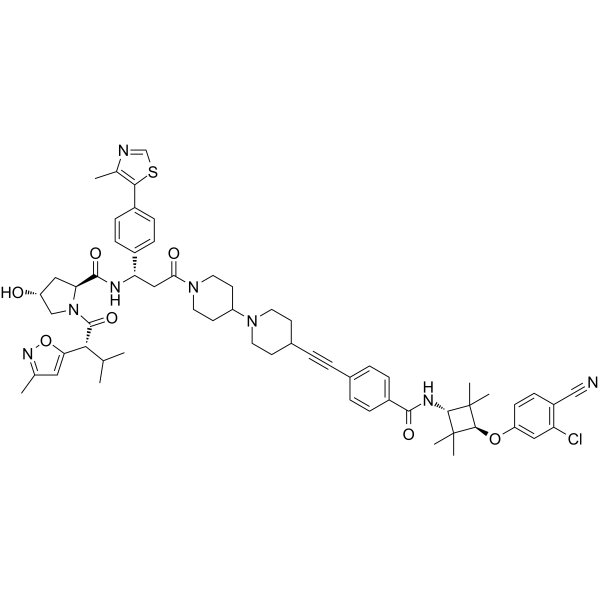
Physicochemical Properties
| Molecular Formula | C61H71CLN8O7S |
| Molecular Weight | 1095.78385281563 |
| Exact Mass | 1094.485 |
| CAS # | 2316837-08-6 |
| PubChem CID | 154704831 |
| Appearance | White to light yellow solid powder |
| LogP | 9.3 |
| Hydrogen Bond Donor Count | 3 |
| Hydrogen Bond Acceptor Count | 12 |
| Rotatable Bond Count | 15 |
| Heavy Atom Count | 78 |
| Complexity | 2200 |
| Defined Atom Stereocenter Count | 4 |
| SMILES | ClC1=C(C#N)C=CC(=C1)OC1C(C)(C)C(C1(C)C)NC(C1C=CC(C#CC2CCN(CC2)C2CCN(C(C[C@@H](C3C=CC(C4=C(C)N=CS4)=CC=3)NC([C@@H]3C[C@H](CN3C([C@@H](C3=CC(C)=NO3)C(C)C)=O)O)=O)=O)CC2)=CC=1)=O |
| InChi Key | RGPUSLXMPBTXNU-CUPIBCLHSA-N |
| InChi Code | InChI=1S/C61H71ClN8O7S/c1-36(2)53(51-29-37(3)67-77-51)57(75)70-34-46(71)30-50(70)56(74)65-49(41-15-17-42(18-16-41)54-38(4)64-35-78-54)32-52(72)69-27-23-45(24-28-69)68-25-21-40(22-26-68)10-9-39-11-13-43(14-12-39)55(73)66-58-60(5,6)59(61(58,7)8)76-47-20-19-44(33-63)48(62)31-47/h11-20,29,31,35-36,40,45-46,49-50,53,58-59,71H,21-28,30,32,34H2,1-8H3,(H,65,74)(H,66,73)/t46-,49+,50+,53-,58?,59?/m1/s1 |
| Chemical Name | (2S,4R)-N-[(1S)-3-[4-[4-[2-[4-[[3-(3-chloro-4-cyanophenoxy)-2,2,4,4-tetramethylcyclobutyl]carbamoyl]phenyl]ethynyl]piperidin-1-yl]piperidin-1-yl]-1-[4-(4-methyl-1,3-thiazol-5-yl)phenyl]-3-oxopropyl]-4-hydroxy-1-[(2R)-3-methyl-2-(3-methyl-1,2-oxazol-5-yl)butanoyl]pyrrolidine-2-carboxamide |
| HS Tariff Code | 2934.99.9001 |
| Storage |
Powder-20°C 3 years 4°C 2 years In solvent -80°C 6 months -20°C 1 month |
| Shipping Condition | Room temperature (This product is stable at ambient temperature for a few days during ordinary shipping and time spent in Customs) |
Biological Activity
| Targets | VHL |
| ln Vitro | In order to recruit AR protein to cullin 2 for ubiquitination, followed by proteasome-dependent AR degradation, ARD-61 binds to AR protein through its AR antagonist portion and von Hippel-Lindau (VHL)/cullin 2 E3 ligase through its VHL ligand portion[1]. ARD-61 (0.001-100 μM; for 7 days) has IC50 values of 235 nM and 121 nM in the MDA-MB-453 and HCC1428 cell lines, which have the highest AR expression, respectively. With IC50 values of 39, 147, and 380 nM, respectively, ARD-61 exhibits partial inhibition of cell growth in the MCF-7, BT-549, and MDA-MB-415 cell lines, all of which have a moderate level of AR protein[1]. In all three of these AR+ breast cancer cell lines, ARD-61 (25–1000 nM; 6-72 h) induces G2/M cell cycle arrest in a dose- and time-dependent manner[1]. The MDA-MB-453 and HCC1428 cell lines undergo apoptosis when exposed to ARD-61 (25–1000000 nM; 72 h)[1]. The potency and effectiveness of ARD-61 (0.01-1000 nM; 6 h) in lowering AR protein levels is very high. In the T47D cells, ARD-61 (0.01-1000 nM; 6 h) nM; 24 h) lowers the level of PR protein with a DC50 value of 0.15 nM. The ER and GR proteins are not visibly affected by ARD-61[1]. ARD-61 (1 µM) blocks the MYC and Wnt/β-catenin signaling pathways efficiently over a 24-hour period. In addition to decreasing phosphorylated and unphosphorylated HER2 and HER3 proteins, ARD-61 (1-1000 nM) is also effective against both for a 24-hour period[1]. Both MDA-MB-453 and MCF-7 cell lines exhibit complete resistance to AR degradation induced by ARD-61 (100 nM; 24 h) when VHL is effectively knocked down[1]. |
| ln Vivo | In male SCID mice, ARD-61 (25, 50 mg/kg/day; ip; for 75 days) efficiently suppresses tumor growth in the MDA-MB-453 xenograft tumor model[1]. The AR protein in the MDA-MB-453 xenograft tissue is quickly and efficiently reduced by ARD-61 (25 mg/kg; ip; for 75 days; single dose), with the effect lasting for at least 24 hours. In a time-dependent way, ARD-61 is particularly effective in lowering the mRNA level of WNT7B[1]. |
| Cell Assay |
Cell Viability Assay[1] Cell Types: MDA-MB-453 and HCC1428 cell lines Tested Tested Concentrations: 0.001, 0.01, 0.1, 1, 10, 100 μM Incubation Duration: 7 days Experimental Results: Achieves near complete inhibition of cell growth. Cell Cycle Analysis[1] Cell Types: MDA-MB-453, HCC1428 and MCF-7 cell lines Tested Tested Concentrations: 25, 250, 500, 1000, 10000, 100000 nM Incubation Duration: 6-72 hrs (hours) Experimental Results: Induced G2/M cell cycle arrest in a dose- and time-dependent manner in each of these three AR+ breast cancer cell lines. Apoptosis Analysis[1] Cell Types: MDA-MB-453 and HCC1428 cell lines Tested Tested Concentrations: 25, 250, 500, 1000, 10000, 100000 nM Incubation Duration: 6-72 hrs (hours) Experimental Results: Induced apoptosis in the MDA -MB-453 and HCC1428 cell lines in a dose-dependent manner. Western Blot Analysis[1] Cell Types: MDA-MB-453, MCF-7, BT549, MDA-MB-415 and HCC1428 cell lines Tested Tested Concentrations: 0.01, 0.03 , 0.1, 0.3, 1, 3, 10, 30, 100, 300, 1000 nM Incubation Duration: 6 hrs (hours) Experimental Results: diminished AR protein levels in the MDA-MB-453 (DC50=0.44 nM), MCF-7 (DC50= 1.8 |
| Animal Protocol |
Animal/Disease Models: MDA-MB-453 xenograft tumor model in male SCID mice[1] Doses: 25, 50 mg/kg Route of Administration: IP; daily; for 75 days Experimental Results: Effectively inhibited tumor growth. |
| References |
[1]. A highly potent PROTAC androgen receptor (AR) degrader ARD-61 effectively inhibits AR-positive breast cancer cell growth in vitro and tumor growth in vivo. Neoplasia. 2020 Oct;22(10):522-532. |
Solubility Data
| Solubility (In Vitro) | DMSO: 100 mg/mL (91.26 mM) |
| Solubility (In Vivo) |
Solubility in Formulation 1: ≥ 2.5 mg/mL (2.28 mM) (saturation unknown) in 10% DMSO + 40% PEG300 + 5% Tween80 + 45% Saline (add these co-solvents sequentially from left to right, and one by one), clear solution. For example, if 1 mL of working solution is to be prepared, you can add 100 μL of 25.0 mg/mL clear DMSO stock solution to 400 μL PEG300 and mix evenly; then add 50 μL Tween-80 to the above solution and mix evenly; then add 450 μL normal saline to adjust the volume to 1 mL. Preparation of saline: Dissolve 0.9 g of sodium chloride in 100 mL ddH₂ O to obtain a clear solution. Solubility in Formulation 2: ≥ 2.5 mg/mL (2.28 mM) (saturation unknown) in 10% DMSO + 90% (20% SBE-β-CD in Saline) (add these co-solvents sequentially from left to right, and one by one), clear solution. For example, if 1 mL of working solution is to be prepared, you can add 100 μL of 25.0 mg/mL clear DMSO stock solution to 900 μL of 20% SBE-β-CD physiological saline solution and mix evenly. Preparation of 20% SBE-β-CD in Saline (4°C,1 week): Dissolve 2 g SBE-β-CD in 10 mL saline to obtain a clear solution. Solubility in Formulation 3: ≥ 2.5 mg/mL (2.28 mM) (saturation unknown) in 10% DMSO + 90% Corn Oil (add these co-solvents sequentially from left to right, and one by one), clear solution. For example, if 1 mL of working solution is to be prepared, you can add 100 μL of 25.0 mg/mL clear DMSO stock solution to 900 μL of corn oil and mix evenly. (Please use freshly prepared in vivo formulations for optimal results.) |
| Preparing Stock Solutions | 1 mg | 5 mg | 10 mg | |
| 1 mM | 0.9126 mL | 4.5630 mL | 9.1259 mL | |
| 5 mM | 0.1825 mL | 0.9126 mL | 1.8252 mL | |
| 10 mM | 0.0913 mL | 0.4563 mL | 0.9126 mL |