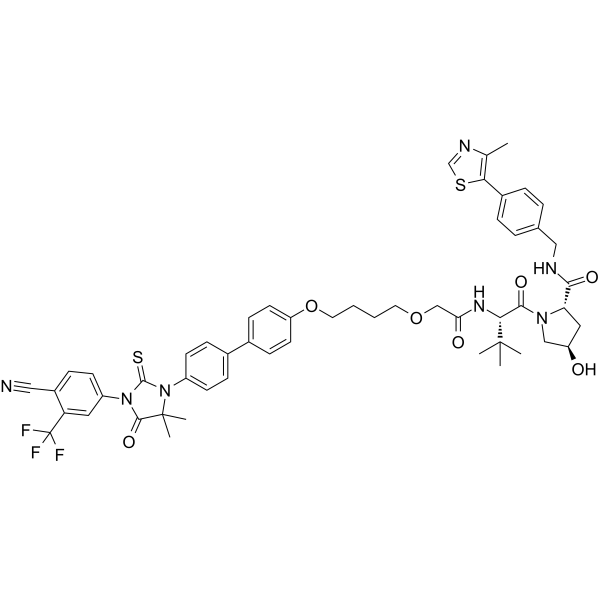
Physicochemical Properties
| Molecular Formula | C53H58F3N7O8S2 |
| Molecular Weight | 1042.19494104385 |
| Exact Mass | 1023.363 |
| CAS # | 1973403-00-7 |
| Related CAS # | 1973403-00-7;ARCC-4 hydrate; |
| PubChem CID | 122428515 |
| Appearance | White to off-white solid powder |
| LogP | 8.5 |
| Hydrogen Bond Donor Count | 3 |
| Hydrogen Bond Acceptor Count | 14 |
| Rotatable Bond Count | 18 |
| Heavy Atom Count | 72 |
| Complexity | 1940 |
| Defined Atom Stereocenter Count | 3 |
| SMILES | S=C1N(C2C=CC(C#N)=C(C(F)(F)F)C=2)C(C(C)(C)N1C1C=CC(C2C=CC(=CC=2)OCCCCOCC(N[C@H](C(N2C[C@@H](C[C@H]2C(NCC2C=CC(C3=C(C)N=CS3)=CC=2)=O)O)=O)C(C)(C)C)=O)=CC=1)=O.O |
| InChi Key | DUPAJELXESPTNF-PPZGWQTASA-N |
| InChi Code | InChI=1S/C53H56F3N7O7S2/c1-32-45(72-31-59-32)36-11-9-33(10-12-36)28-58-47(66)43-26-40(64)29-61(43)48(67)46(51(2,3)4)60-44(65)30-69-23-7-8-24-70-41-21-16-35(17-22-41)34-13-18-38(19-14-34)63-50(71)62(49(68)52(63,5)6)39-20-15-37(27-57)42(25-39)53(54,55)56/h9-22,25,31,40,43,46,64H,7-8,23-24,26,28-30H2,1-6H3,(H,58,66)(H,60,65)/t40-,43+,46-/m1/s1 |
| Chemical Name | (2S,4R)-1-[(2S)-2-[[2-[4-[4-[4-[3-[4-cyano-3-(trifluoromethyl)phenyl]-5,5-dimethyl-4-oxo-2-sulfanylideneimidazolidin-1-yl]phenyl]phenoxy]butoxy]acetyl]amino]-3,3-dimethylbutanoyl]-4-hydroxy-N-[[4-(4-methyl-1,3-thiazol-5-yl)phenyl]methyl]pyrrolidine-2-carboxamide |
| HS Tariff Code | 2934.99.9001 |
| Storage |
Powder-20°C 3 years 4°C 2 years In solvent -80°C 6 months -20°C 1 month |
| Shipping Condition | Room temperature (This product is stable at ambient temperature for a few days during ordinary shipping and time spent in Customs) |
Biological Activity
| ln Vitro | The three-promoted polymer complex binds more readily when ARCC-4 improves the protein-protein reaction between AR and VHL [1]. AR can be efficiently degraded by -4 (0.1-10,000 nM; 20 hours), with a D50 of 5 nM and a Dmax of greater than 95% [1]. Molds with ARCC-4 (100 nM; 12 hours) exhibit AR. ARCC-4 does not impede PR-A or PR-B, but it nearly solely modulates AR through chromoplast pigments [1]. Clinically significant AR mutations are effectively suppressed by ARCC-4 [1]. ARCC-4 is still functional in the presence of high androgen levels [1]. |
| Cell Assay |
Western Blot Analysis[1] Cell Types: VCaP cells Tested Concentrations: 0.1 nM, 1 nM, 10 nM, 50 nM, 100 nM, 0.5μM, 1μM. , 10 μM Incubation Duration: 20 hrs (hours) Experimental Results: Effective degradation of AR |
| References |
[1]. Androgen receptor degradation by the proteolysis-targeting chimera ARCC-4 outperforms enzalutamide in cellular models of prostate cancer drug resistance. Commun Biol. 2018 Aug 2;1:100. |
Solubility Data
| Solubility (In Vitro) | DMSO : ~200 mg/mL (~195.28 mM) |
| Solubility (In Vivo) |
Solubility in Formulation 1: 5 mg/mL (4.88 mM) in 10% DMSO + 40% PEG300 + 5% Tween80 + 45% Saline (add these co-solvents sequentially from left to right, and one by one), suspension solution; with sonication. For example, if 1 mL of working solution is to be prepared, you can add 100 μL of 50.0 mg/mL clear DMSO stock solution to 400 μL PEG300 and mix evenly; then add 50 μL Tween-80 to the above solution and mix evenly; then add 450 μL normal saline to adjust the volume to 1 mL. Preparation of saline: Dissolve 0.9 g of sodium chloride in 100 mL ddH₂ O to obtain a clear solution. Solubility in Formulation 2: 5 mg/mL (4.88 mM) in 10% DMSO + 90% (20% SBE-β-CD in Saline) (add these co-solvents sequentially from left to right, and one by one), suspension solution; with ultrasonication. For example, if 1 mL of working solution is to be prepared, you can add 100 μL of 50.0 mg/mL clear DMSO stock solution to 900 μL of 20% SBE-β-CD physiological saline solution and mix evenly. Preparation of 20% SBE-β-CD in Saline (4°C,1 week): Dissolve 2 g SBE-β-CD in 10 mL saline to obtain a clear solution. Solubility in Formulation 3: ≥ 5 mg/mL (4.88 mM) (saturation unknown) in 10% DMSO + 90% Corn Oil (add these co-solvents sequentially from left to right, and one by one), clear solution. For example, if 1 mL of working solution is to be prepared, you can add 100 μL of 50.0 mg/mL clear DMSO stock solution to 900 μL of corn oil and mix evenly. (Please use freshly prepared in vivo formulations for optimal results.) |
| Preparing Stock Solutions | 1 mg | 5 mg | 10 mg | |
| 1 mM | 0.9595 mL | 4.7975 mL | 9.5951 mL | |
| 5 mM | 0.1919 mL | 0.9595 mL | 1.9190 mL | |
| 10 mM | 0.0960 mL | 0.4798 mL | 0.9595 mL |