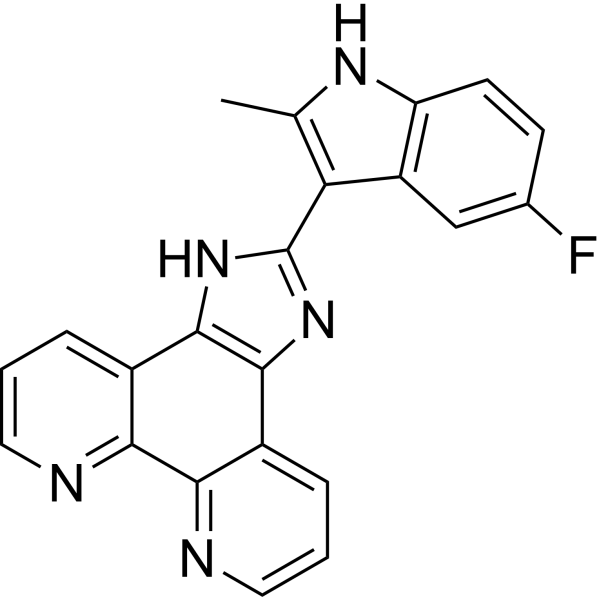
Physicochemical Properties
| Molecular Formula | C22H14FN5 |
| Molecular Weight | 367.3785 |
| Exact Mass | 367.123 |
| CAS # | 916151-99-0 |
| Related CAS # | 1691221-67-6 (HCl);916151-99-0 (Free base);1422731-37-0 (APTO-253 isomer HCl);1422826-80-9 (APTO-253 isomer free base); |
| PubChem CID | 11960271 |
| Appearance | Light yellow to yellow solid powder |
| Density | 1.5±0.1 g/cm3 |
| Boiling Point | 718.8±70.0 °C at 760 mmHg |
| Flash Point | 388.5±35.7 °C |
| Vapour Pressure | 0.0±2.3 mmHg at 25°C |
| Index of Refraction | 1.843 |
| LogP | 3.33 |
| Hydrogen Bond Donor Count | 2 |
| Hydrogen Bond Acceptor Count | 4 |
| Rotatable Bond Count | 1 |
| Heavy Atom Count | 28 |
| Complexity | 589 |
| Defined Atom Stereocenter Count | 0 |
| SMILES | 0 |
| InChi Key | NIRXBXIPHUTNNI-UHFFFAOYSA-N |
| InChi Code | InChI=1S/C22H14FN5/c1-11-17(15-10-12(23)6-7-16(15)26-11)22-27-20-13-4-2-8-24-18(13)19-14(21(20)28-22)5-3-9-25-19/h2-10,26H,1H3,(H,27,28) |
| Chemical Name | 2-(5-fluoro-2-methyl-1H-indol-3-yl)-1H-imidazo[4,5-f][1,10]phenanthroline |
| HS Tariff Code | 2934.99.9001 |
| Storage |
Powder-20°C 3 years 4°C 2 years In solvent -80°C 6 months -20°C 1 month |
| Shipping Condition | Room temperature (This product is stable at ambient temperature for a few days during ordinary shipping and time spent in Customs) |
Biological Activity
| ln Vitro | It is known that APTO-253 (LOR-253) induces KLF4. In SKOV3 and OVCAR3 cells, APTO-253 (5 μM) increases NSC 119875-induced apoptosis and increases KLF4 expression. In SKOV3 and OVCAR3 cells, APTO-253 (5 μM) similarly results in G1 arrest and decreases S and G2/M phase cells [1]. Raji and Raji/253R cell lines are cytotoxic to APTO-253, with IC50s of 105 ± 2.4 nM and 1387 ± 94 nM, respectively. In Raji cells, APTO-253 (0.5 μM) similarly damages DNA. Cells lacking BRCA1/2 exhibit hypersensitivity to APTO-253. Raji/253R's resistance to APTO-253 can be reversed by inhibiting ABCG2, as HEK-293 cells overexpressing ABCG2 are resistant to the drug [2]. AML and several types of lymphoma cell lines cannot proliferate when APTO-253 is present; its IC50 ranges from 57 nM to 1.75 µM. In AML lines, APTO-253 (500 nM) also triggers apoptosis, causes G0/G1 cell cycle arrest, and downregulates MYC RNA and protein expression. In MV4-11 cells, APTO-253 (500 nM) activates the DNA damage response mechanism. Furthermore, APTO-253 has the highest propensity to stabilize the MYC G4 sequence and is an efficient stabilizer of the Gquadruplex (G4) motif [3]. |
| ln Vivo | APTO-253 (LOR-253; 15 mg/kg; intravenously administered twice daily, twice weekly for 14 days) exhibits anti-arthritic efficacy in a CIA model [3]. |
| Animal Protocol |
Animal/Disease Models: DBA/1J male mice with collagen-induced arthritis (CIA) (6 weeks) [3] Doses: 15 mg/kg Route of Administration: IV; twice (two times) daily for 2 days per week for 14 Experimental Results: It has significant preventive and therapeutic activity against arthritis formation. |
| References |
[1]. APTO-253 Stabilizes G-quadruplex DNA, Inhibits MYC Expression, and Induces DNA Damage in Acute Myeloid Leukemia Cells. Mol Cancer Ther. 2018 Jun;17(6):1177-1186. [2]. Inhibition of c-Myc By Apto-253 As an Innovative Therapeutic Approach to Induce Cell Cycle Arrest and Apoptosis in Acute Myeloid Leukemia. Blood 2016 128:1716. [3]. Parsing multiomics landscape of activated synovial fibroblasts highlights drug targets linked to genetic risk of rheumatoid arthritis. Ann Rheum Dis. 2020 Nov2;annrheumdis-2020-218189. |
Solubility Data
| Solubility (In Vitro) | DMSO : ~60 mg/mL (~163.32 mM) |
| Solubility (In Vivo) |
Solubility in Formulation 1: 2.3 mg/mL (6.26 mM) in 10% DMSO + 40% PEG300 + 5% Tween80 + 45% Saline (add these co-solvents sequentially from left to right, and one by one), suspension solution; with heating and sonication. For example, if 1 mL of working solution is to be prepared, you can add 100 μL of 23.0 mg/mL clear DMSO stock solution to 400 μL PEG300 and mix evenly; then add 50 μL Tween-80 to the above solution and mix evenly; then add 450 μL normal saline to adjust the volume to 1 mL. Preparation of saline: Dissolve 0.9 g of sodium chloride in 100 mL ddH₂ O to obtain a clear solution. Solubility in Formulation 2: 2.08 mg/mL (5.66 mM) in 10% DMSO + 90% (20% SBE-β-CD in Saline) (add these co-solvents sequentially from left to right, and one by one), suspension solution; with ultrasonication. For example, if 1 mL of working solution is to be prepared, you can add 100 μL of 20.8 mg/mL clear DMSO stock solution to 900 μL of 20% SBE-β-CD physiological saline solution and mix evenly. Preparation of 20% SBE-β-CD in Saline (4°C,1 week): Dissolve 2 g SBE-β-CD in 10 mL saline to obtain a clear solution. (Please use freshly prepared in vivo formulations for optimal results.) |
| Preparing Stock Solutions | 1 mg | 5 mg | 10 mg | |
| 1 mM | 2.7220 mL | 13.6099 mL | 27.2198 mL | |
| 5 mM | 0.5444 mL | 2.7220 mL | 5.4440 mL | |
| 10 mM | 0.2722 mL | 1.3610 mL | 2.7220 mL |