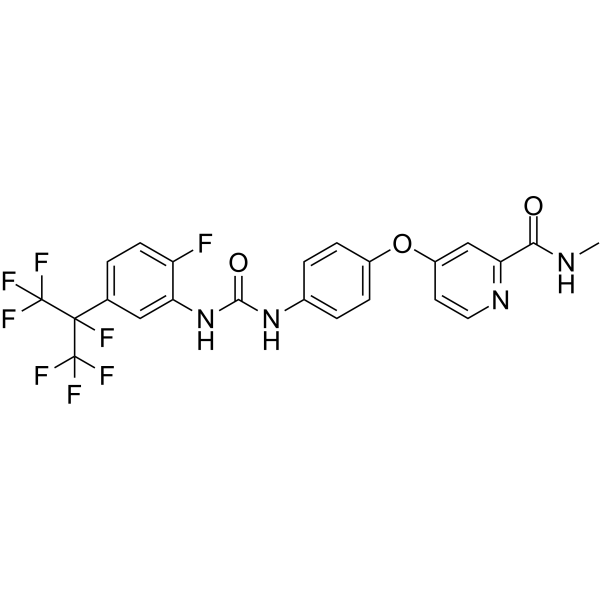
Physicochemical Properties
| Molecular Formula | C23H16F8N4O3 |
| Molecular Weight | 548.38537311554 |
| Exact Mass | 548.109 |
| CAS # | 2188236-41-9 |
| PubChem CID | 131953288 |
| Appearance | Off-white to light yellow solid powder |
| LogP | 4.9 |
| Hydrogen Bond Donor Count | 3 |
| Hydrogen Bond Acceptor Count | 12 |
| Rotatable Bond Count | 6 |
| Heavy Atom Count | 38 |
| Complexity | 806 |
| Defined Atom Stereocenter Count | 0 |
| SMILES | FC(C(F)(F)F)(C(F)(F)F)C1C=CC(=C(C=1)NC(NC1C=CC(=CC=1)OC1C=CN=C(C(NC)=O)C=1)=O)F |
| InChi Key | MVUPJRHPAMCBQJ-UHFFFAOYSA-N |
| InChi Code | InChI=1S/C23H16F8N4O3/c1-32-19(36)18-11-15(8-9-33-18)38-14-5-3-13(4-6-14)34-20(37)35-17-10-12(2-7-16(17)24)21(25,22(26,27)28)23(29,30)31/h2-11H,1H3,(H,32,36)(H2,34,35,37) |
| Chemical Name | 4-[4-[[2-fluoro-5-(1,1,1,2,3,3,3-heptafluoropropan-2-yl)phenyl]carbamoylamino]phenoxy]-N-methylpyridine-2-carboxamide |
| HS Tariff Code | 2934.99.9001 |
| Storage |
Powder-20°C 3 years 4°C 2 years In solvent -80°C 6 months -20°C 1 month |
| Shipping Condition | Room temperature (This product is stable at ambient temperature for a few days during ordinary shipping and time spent in Customs) |
Biological Activity
| ln Vitro | In a soft agar experiment, APS6-45 (3-30 nM; 3 weeks) significantly inhibits the growth of TT human Medullary Thyroid Carcinoma (MTC) cell colonies[1]. RAS pathway activity signaling in human MTC cell lines TT and MZ-CRC-1 is substantially inhibited by APS6-45 (1 μM; 1 h)[1]. |
| ln Vivo | APS6-45 (10 mg/kg; po daily for 30 d) does not alter body weight but instead prevents the formation of TT tumors in mice[1]. In mice, APS6-45 (0.1-160 mg/kg; one po) had no discernible harmful effects[1]. In mice, APS6-45 (20 mg/kg; one dose) had a lengthy half-life (5.6 h), a Cmax of 9.7 µM, and an AUC0-24 of 123.7 µM·h[1]. |
| Animal Protocol |
Animal/Disease Models: Female nude mice (6 weeks) are implanted with TT cells[1] Doses: 10 mg/kg Route of Administration: Po daily for 30 days Experimental Results: Led to partial or complete responses in 75% and was well tolerated. Animal/Disease Models: Male ICR mice (6 weeks of age)[1] Doses: 20 mg/kg (pharmacokinetic/PK Analysis) Route of Administration: A single po Experimental Results: T1/2=5.6 h, Cmax=9.7 µM, AUC0-24=123.7 µM •h. |
| References |
[1]. A whole-animal platform to advance a clinical kinase inhibitor into new disease space. Nat Chem Biol. 2018 Mar;14(3):291-298. |
Solubility Data
| Solubility (In Vitro) | DMSO: 250 mg/mL (455.88 mM) |
| Solubility (In Vivo) |
Solubility in Formulation 1: ≥ 2.08 mg/mL (3.79 mM) (saturation unknown) in 10% DMSO + 90% Corn Oil (add these co-solvents sequentially from left to right, and one by one), clear solution. For example, if 1 mL of working solution is to be prepared, you can add 100 μL of 20.8 mg/mL clear DMSO stock solution to 900 μL of corn oil and mix evenly. (Please use freshly prepared in vivo formulations for optimal results.) |
| Preparing Stock Solutions | 1 mg | 5 mg | 10 mg | |
| 1 mM | 1.8235 mL | 9.1176 mL | 18.2352 mL | |
| 5 mM | 0.3647 mL | 1.8235 mL | 3.6470 mL | |
| 10 mM | 0.1824 mL | 0.9118 mL | 1.8235 mL |