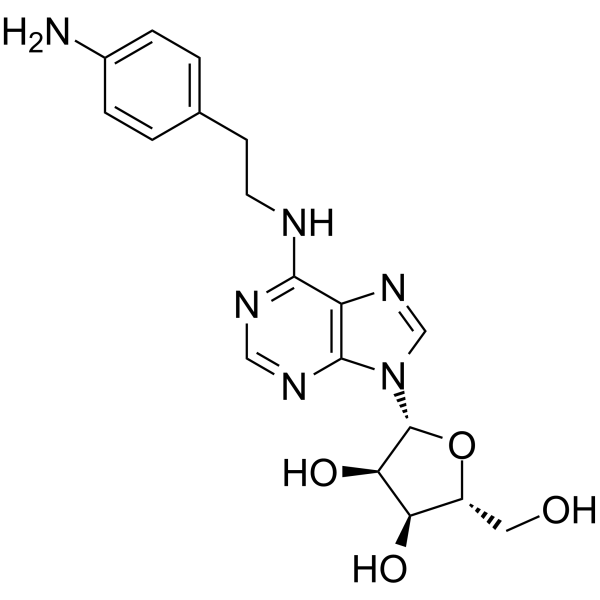
Physicochemical Properties
| Molecular Formula | C18H22N6O4 |
| Molecular Weight | 386.40508 |
| Exact Mass | 386.17 |
| CAS # | 89705-21-5 |
| PubChem CID | 9952135 |
| Appearance | Typically exists as solid at room temperature |
| Density | 1.65g/cm3 |
| Boiling Point | 781.8ºC at 760 mmHg |
| Flash Point | 426.6ºC |
| Index of Refraction | 1.775 |
| LogP | 0.328 |
| Hydrogen Bond Donor Count | 5 |
| Hydrogen Bond Acceptor Count | 9 |
| Rotatable Bond Count | 6 |
| Heavy Atom Count | 28 |
| Complexity | 509 |
| Defined Atom Stereocenter Count | 4 |
| SMILES | N(C1=NC=NC2N([C@H]3[C@H](O)[C@H](O)[C@@H](CO)O3)C=NC1=2)CCC1C=CC(N)=CC=1 |
| InChi Key | XTPOZVLRZZIEBW-SCFUHWHPSA-N |
| InChi Code | InChI=1S/C18H22N6O4/c19-11-3-1-10(2-4-11)5-6-20-16-13-17(22-8-21-16)24(9-23-13)18-15(27)14(26)12(7-25)28-18/h1-4,8-9,12,14-15,18,25-27H,5-7,19H2,(H,20,21,22)/t12-,14-,15-,18-/m1/s1 |
| Chemical Name | (2R,3R,4S,5R)-2-[6-[2-(4-aminophenyl)ethylamino]purin-9-yl]-5-(hydroxymethyl)oxolane-3,4-diol |
| HS Tariff Code | 2934.99.9001 |
| Storage |
Powder-20°C 3 years 4°C 2 years In solvent -80°C 6 months -20°C 1 month |
| Shipping Condition | Room temperature (This product is stable at ambient temperature for a few days during ordinary shipping and time spent in Customs) |
Biological Activity
| ln Vitro | APNEA (N6-[2-(4-aminophenyl)ethyl]adenosine) is a non-selective agonist of adenosine A3 receptors that greatly increases phenidate at a subprotective dose of 1 mg/kg. Bital, diphenylhydantoin, and valproic acid can withstand maximal shock but are ineffective at lesser levels. APNEA (0.0039-1 mg/kg) similarly increases carbamazepine's protective effect. Low dosages of APNEA are anticipated to increase the protective action of carbamazepine via subtype A adenosine receptors. At higher doses, APNEA appears to enhance the anticonvulsant activity of other antiepileptic medicines via the adenosine A1 receptor [1]. |
| ln Vivo | In amygdala-ignited rats, APNEA (N6-[2-(4-aminophenyl)ethyl]adenosine; 2-4 mg/kg) exhibited no discernible influence on seizure parameters (seizure intensity, seizure duration, and post-discharge). Anti-epileptic medications were combined with N6-[2-(4-Aminophenyl)ethyl]adenosine at levels that did not work in animals that had fully developed epilepsy [1]. |
| References |
[1]. Borowicz KK, et al. N6-2-(4-aminophenyl)ethyl-adenosine enhances the anticonvulsive activity of antiepileptic drugs. Eur J Pharmacol. 1997 May 30;327(2-3):125-133. [2]. Borowicz KK, et al. N(6)-2-(4-aminophenyl)ethyl-adenosine enhances the anticonvulsive action of conventional antiepileptic drugs in the kindling model of epilepsy in rats. Eur Neuropsychopharmacol. 2000 Jul;10(4):237-243. |
Solubility Data
| Solubility (In Vitro) | DMSO : ~250 mg/mL (~646.98 mM) |
| Solubility (In Vivo) |
Solubility in Formulation 1: ≥ 2.5 mg/mL (6.47 mM) (saturation unknown) in 10% DMSO + 90% (20% SBE-β-CD in Saline) (add these co-solvents sequentially from left to right, and one by one), clear solution. For example, if 1 mL of working solution is to be prepared, you can add 100 μL of 25.0 mg/mL clear DMSO stock solution to 900 μL of 20% SBE-β-CD physiological saline solution and mix evenly. Preparation of 20% SBE-β-CD in Saline (4°C,1 week): Dissolve 2 g SBE-β-CD in 10 mL saline to obtain a clear solution. Solubility in Formulation 2: ≥ 2.08 mg/mL (5.38 mM) (saturation unknown) in 10% DMSO + 40% PEG300 + 5% Tween80 + 45% Saline (add these co-solvents sequentially from left to right, and one by one), clear solution. For example, if 1 mL of working solution is to be prepared, you can add 100 μL of 20.8 mg/mL clear DMSO stock solution to 400 μL PEG300 and mix evenly; then add 50 μL Tween-80 to the above solution and mix evenly; then add 450 μL normal saline to adjust the volume to 1 mL. Preparation of saline: Dissolve 0.9 g of sodium chloride in 100 mL ddH₂ O to obtain a clear solution. Solubility in Formulation 3: ≥ 2.08 mg/mL (5.38 mM) (saturation unknown) in 10% DMSO + 90% Corn Oil (add these co-solvents sequentially from left to right, and one by one), clear solution. For example, if 1 mL of working solution is to be prepared, you can add 100 μL of 20.8 mg/mL clear DMSO stock solution to 900 μL of corn oil and mix evenly. (Please use freshly prepared in vivo formulations for optimal results.) |
| Preparing Stock Solutions | 1 mg | 5 mg | 10 mg | |
| 1 mM | 2.5879 mL | 12.9396 mL | 25.8792 mL | |
| 5 mM | 0.5176 mL | 2.5879 mL | 5.1758 mL | |
| 10 mM | 0.2588 mL | 1.2940 mL | 2.5879 mL |